Get Full Government Meeting Transcripts, Videos, & Alerts Forever!
Get email alerts on the Housing Policy topic
No spam. Unsubscribe anytime.
Board advances several housing and educator-housing streamlining measures, citing need for family-friendly units
Summary
The Board of Supervisors advanced several housing-streamlining ordinances on Aug. 11, including zoning and planning-code changes to ease approval of 100% affordable and educator housing and a requirement that at least 10% of educator-housing bedrooms be three-bedroom units to better accommodate families.
The San Francisco Board of Supervisors on Aug. 11 moved several housing-related ordinances forward on first reading, unanimously approving measures intended to speed approvals for dedicated affordable housing and educator housing and to encourage more family-sized dwelling units.
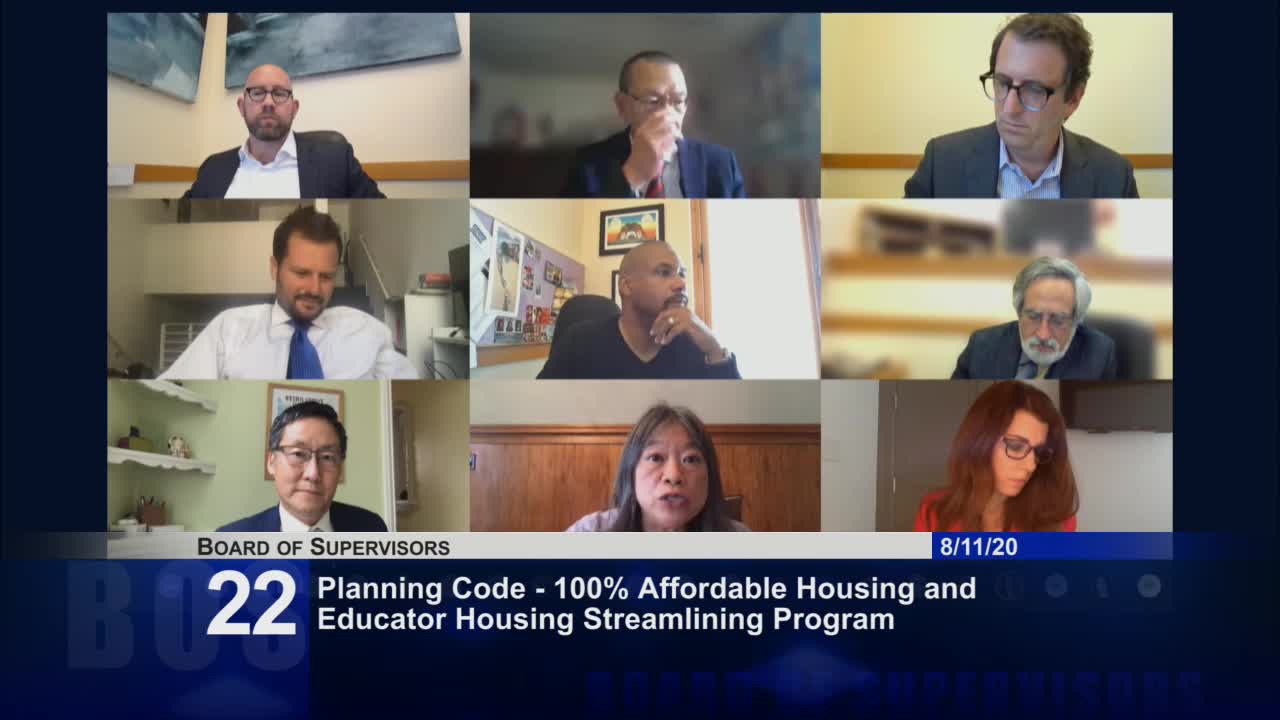
Key items advanced included: - A Planning Code amendment (Item 22) to allow extra height for projects that are 100% affordable or constitute educator housing, reduce the minimum lot-size threshold for those projects from 10,000 square feet to 8,000 square feet and remove the minimum threshold for vacant lots and surface parking lots in certain circumstances. Supervisor Sandra Fewer and colleagues said the changes would help deliver new permanently affordable developments and educator housing that otherwise face design and zoning constraints. - An ordinance (Item 44, taken out of order) establishing a minimum 10% of bedrooms in future educator-housing units as three-bedroom units, intended to make educator housing more viable for families and multigenerational households. The Land Use and Transportation Committee had recommended the proposal with a positive recommendation; supervisors said the change was aimed at supporting retention of educators who need larger units. - A separate business-oriented measure (Item 23) to expedite conditional-use approvals for small businesses; the board passed that item on first reading as part of parallel work on neighborhood economic recovery.
Sponsors and staff said the reforms were practical changes to the city's existing affordable and educator housing toolkit. Supervisor Sandra Fewer framed the measures as follow-ons to Proposition E (a voter-approved measure) and to earlier local affordable-housing actions; she said the changes reflected conversations with affordable-housing developers and financial experts. Planning staff told the board the items were intended to reduce barriers and to encourage family-sized and educator-appropriate housing in neighborhoods that historically lack such unit types.
Votes and next steps
All of the housing and educator measures were passed on first reading unanimously at the Aug. 11 meeting. The board will take final readings in a subsequent session; staff said the Planning Department and other implementing agencies will produce technical guidance to assist developers in using the new allowances while complying with design and environmental requirements.
Why this matters
San Francisco has long struggled to produce family-sized units and to create new affordable housing that matches the needs of educators and other middle-income public servants. Supporters of the changes said they make it faster and less costly to build projects that keep teachers and families in the city and increase the stock of larger units. Critics cautioned that relaxations must be carefully implemented so that design quality and neighborhood character are preserved.
Ending
The board's unanimous first-reading votes signal broad legislative support for incremental changes meant to reduce friction in producing targeted affordable and educator housing; final votes are scheduled in coming board sessions once technical implementing language is completed.