Get Full Government Meeting Transcripts, Videos, & Alerts Forever!
Get email alerts on the Tax Policy Business topic
No spam. Unsubscribe anytime.
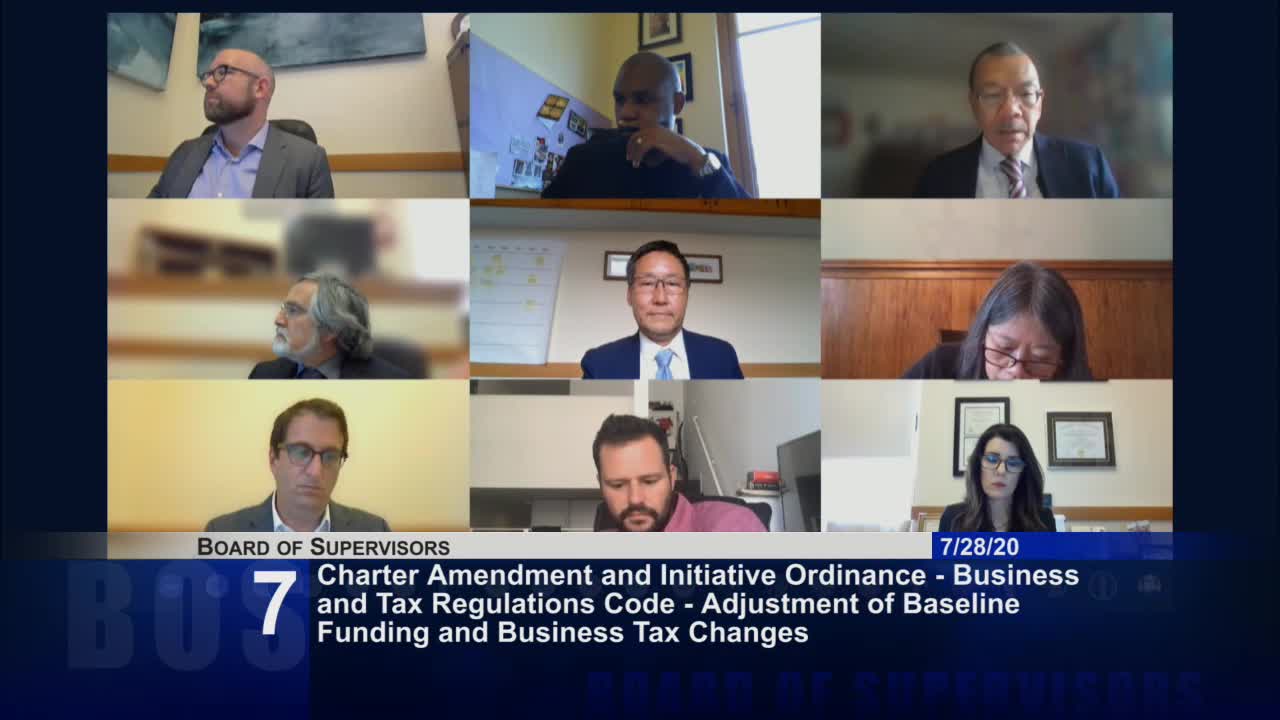
Board sends 'Small Business and Economic Recovery Act' to ballot, replacing payroll tax with gross receipts system
Summary
The Board unanimously voted to submit a charter amendment to the Nov. 3, 2020 ballot that would repeal the city's payroll tax and replace it with a gross‑receipts tax with exemptions and phased in rates designed to aid small businesses and protect social programs funded by prior measures.
The San Francisco Board of Supervisors unanimously voted on July 28 to place a charter amendment on the Nov. 3, 2020 ballot that would replace the city’s payroll tax with a gross‑receipts business tax and change the city’s budgeting baseline rules for a set of charter‑mandated funds.
President London N. Breed’s administration and a broad coalition of supervisors, labor leaders and community partners supported the measure, which was introduced at the meeting by President London Breed’s ally President Norman Yee (the transcript identifies President Yee as presiding), budget chair and other sponsors. The proposal, called by proponents the Small Business and Economic Recovery Act, intends to provide immediate relief to small businesses during the COVID‑19 recession while also creating what supporters call a more equitable and durable revenue structure.
The measure would repeal the city’s payroll tax and establish a gross‑receipts tax schedule, exempt businesses with gross receipts below thresholds (the sponsors said a $2 million exemption would protect approximately 3,100 small businesses), reduce registration fees for very small firms, and propose targeted reductions for industries hard‑hit by the pandemic including hotels and restaurants. The sponsors said the measure would free up up to $300 million in city funds by backstopping certain court‑related revenue holds and would preserve funding for housing and early care initiatives while providing immediate relief to the most affected industries.
President Yee and several co‑sponsors thanked city staff and labor partners for months of drafting and for economic modeling developed by the Controller’s office. ‘‘This is a long overdue reform of our tax system by repealing the payroll tax and replacing it with a gross receipts system,’’ President Yee said in remarks outlining the measure’s intent and the role it is intended to play during the city’s economic recovery.
Supervisors from across the board praised the package as the product of difficult negotiations; several colleagues asked to be added as co‑sponsors during the meeting. The board voted to submit the charter amendment to the voters unanimously.
Why it matters: The charter amendment would change the city’s fundamental business tax structure and its baseline appropriation calculations for certain charter‑mandated funds. The change affects how revenues are collected and how some funds are adjusted year to year; it is one of the largest municipal tax reforms considered amid the pandemic.
What happens next: The item was ordered to the ballot. If voters approve the charter change on Nov. 3, the city’s tax code and baseline funding rules will be amended according to the language adopted for the ballot question.