Get Full Government Meeting Transcripts, Videos, & Alerts Forever!
Get email alerts on the Public Health topic
No spam. Unsubscribe anytime.
Board approves remote meetings and presses for shelter, worker pay and small‑business aid during COVID‑19 emergency
Summary
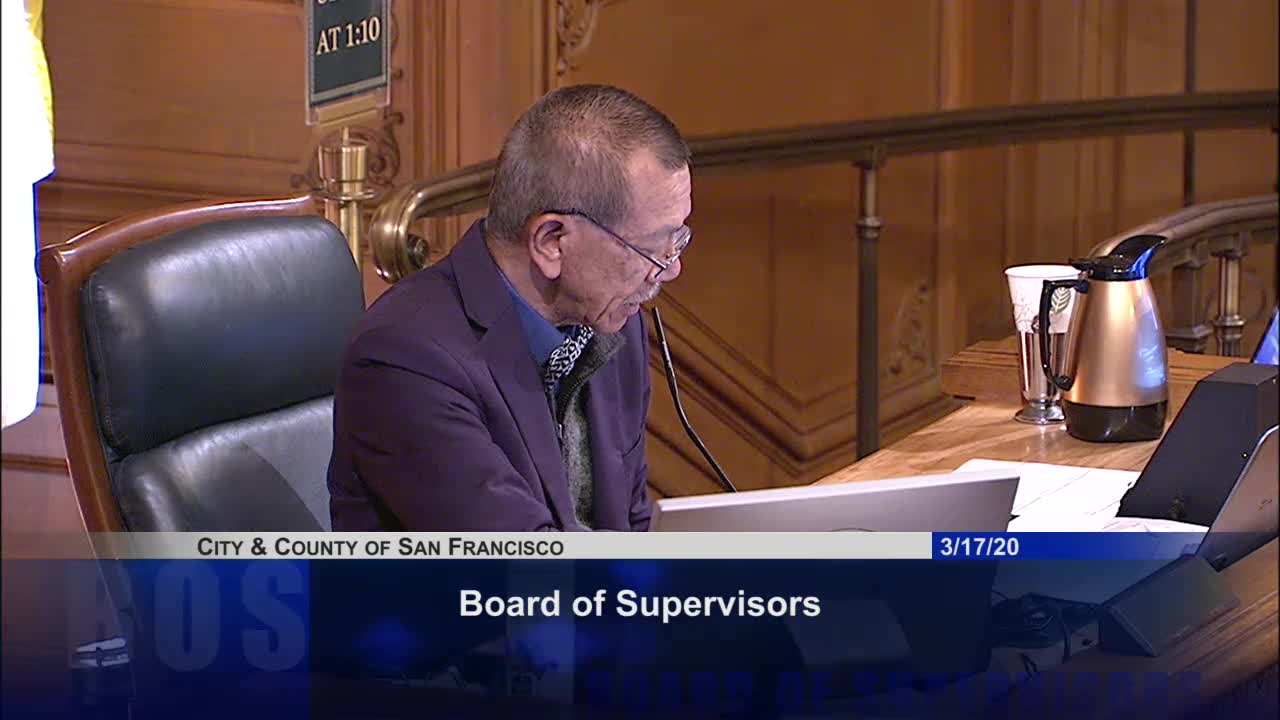
The San Francisco Board of Supervisors on March 17 voted to allow remote teleconferencing of future meetings and spent the session hearing agency plans for quarantine housing, worker protections and small‑business relief after the city imposed a Bay Area shelter‑in‑place order.
The San Francisco Board of Supervisors on March 17 voted to allow remote teleconferencing and public comment for future board meetings as the city implemented a new shelter‑in‑place public‑health order and moved quickly to organize quarantine housing, emergency services and relief for workers and small businesses.
The vote authorizing remote meetings was made by Supervisor Hillary Ronen and seconded by Supervisor Asha Safaí and passed unanimously; the clerk recorded “11 ayes.”
Why it matters: The board meeting came as Mayor London Breed and the Department of Public Health intensified citywide steps to slow spread of the novel coronavirus. The mayor, the city health director and agency heads said the priority is to reduce community transmission, protect vulnerable residents and keep health‑care and emergency staffs able to work. Mayor Breed told the board and a standing‑room audience that “the new public health order … will require San Franciscans to remain at home with exceptions only for essential outings.” Health Director Grant Colfax described the step as “a critical intervention that we know can reduce harm and save lives.”
What the city described and planned - Quarantine and isolation housing: Human Services and the Department of Homelessness and Supportive Housing described immediate steps to lease hotel rooms and other units for people who cannot safely isolate where they live. HSA said roughly 400–450 rooms were being prepared and officials were negotiating leases for additional hotels; agency staff cited a planning target of thousands of individual units if cases rise. HSH and HSA officials said sites would be used first for people who are symptomatic or have been exposed and cannot self‑isolate (for example, residents of single‑room‑occupancy buildings and people in congregate shelters), and that staffing and medical support are major constraints.
- Shelters and congregate sites: City officials said they are assessing expanded shelter options (including churches, gymnasiums and closed‑school facilities) to thin congregate shelter populations and create space for distancing, but emphasized that staffing and clinical supports are limiting factors.
- Essential services and transit: SFMTA and BART leaders told the board that public transit will continue so health‑care and other essential workers can travel to work, and that services will be adjusted to prioritize neighborhood and hospital lines. Muni said it is suspending some tourist services, adding partitions for operators and suspending some enforcement penalties (for example, temporary parking enforcement changes) while continuing to enforce rules tied to safety and access.
- Homeless outreach and hygiene: Department heads described added hand‑washing stations, outreach to people sleeping outdoors, and a policy not to clear encampments or seize personal property as a public‑health first step while urging spacing and better hygiene on the street. Officials also described work to arrange isolation spots for people who arrive at hospitals and cannot be released because they have no safe place to quarantine.
City economic and worker protections discussed - Eviction and small‑business relief proposals: Supervisor Dean Preston and Supervisor Hillary Ronen described proposed local ordinances and a rent‑stabilization‑style loan program for small businesses. Preston urged a local moratorium on evictions (residential and business) related to COVID‑19 and asked the mayor to broaden directives already in place; Ronen described a proposed $20 million city loan program to provide up to $15,000 no‑interest loans for qualifying small businesses, paired with other state and federal relief efforts.
- Worker protections and paid leave: Several supervisors introduced or cosponsored resolutions urging expanded paid sick leave for workers during public‑health emergencies, creation of a multilingual workers’ rights hotline, and state and federal action. The mayor announced a city program that will provide funds to help low‑wage workers and urged federal and state action for broader paid‑leave benefits.
- Small‑business outreach: Joaquin Torres, director of the Office of Economic and Workforce Development, described a city web portal (oewd.org/COVID19), a $1 million small‑business resiliency grant program and coordination with the Small Business Administration and neighborhood business groups. He said demand for help has surged and that the city is tracking requests and advising business owners about federal SBA disaster loans.
Board business and procedure - Committee and hearing adjustments: Supervisors altered the board agenda to bring forward a committee‑of‑the‑whole hearing on city emergency preparations and to continue a separate staffing item (item 16) to April; the board also voted to convene a closed session to consult with public‑safety and emergency officials about threats to public facilities and services.
- Process questions about mayoral emergency actions: Board members pressed the city attorney’s office for legal guidance on how and when the board must ratify mayoral emergency orders. Deputy City Attorney Anne Pearson told the board that the mayor’s initial declaration of emergency must be ratified quickly under state law, but that supplement orders issued under the declaration are governed by the city charter and should be brought to the board “as quickly as reasonably possible.” She said the board can ratify, amend or reject mayoral orders and that failure to act immediately does not eliminate the board’s authority to act later.
Quotes - Mayor London Breed: “What we are asking for everyone to do is to remain at home for all but the most essential outings for your safety and the safety of those around you.” - Dr. Grant Colfax, director of health: “This is a critical intervention that we know can reduce harm and save lives.”
What the board decided and next steps - Formal action at the meeting included a unanimous vote allowing future remote teleconferencing of board meetings and public comment. - Several routine consent resolutions and appointments passed unanimously on the consent calendar. - The board asked agency leaders to return with more detailed plans and agreed to continue formal ratification of additional mayoral emergency supplements at the next board meeting (March 24); supervisors also requested written legal guidance about the board’s powers, timelines and options to amend or reject mayoral emergency orders.
Ending Board members said they will continue to coordinate with the mayor’s office and city departments as the outbreak evolves, and urged residents to follow public‑health guidance, check the city’s COVID‑19 webpages for updates and use 311 for nonemergency questions. Officials emphasized that support for people most at risk — seniors, people who are homeless, low‑wage workers and tenants — will be a continuing focus of both the mayor’s office and the supervisors.