Get Full Government Meeting Transcripts, Videos, & Alerts Forever!
Get email alerts on the Technology Policy topic
No spam. Unsubscribe anytime.
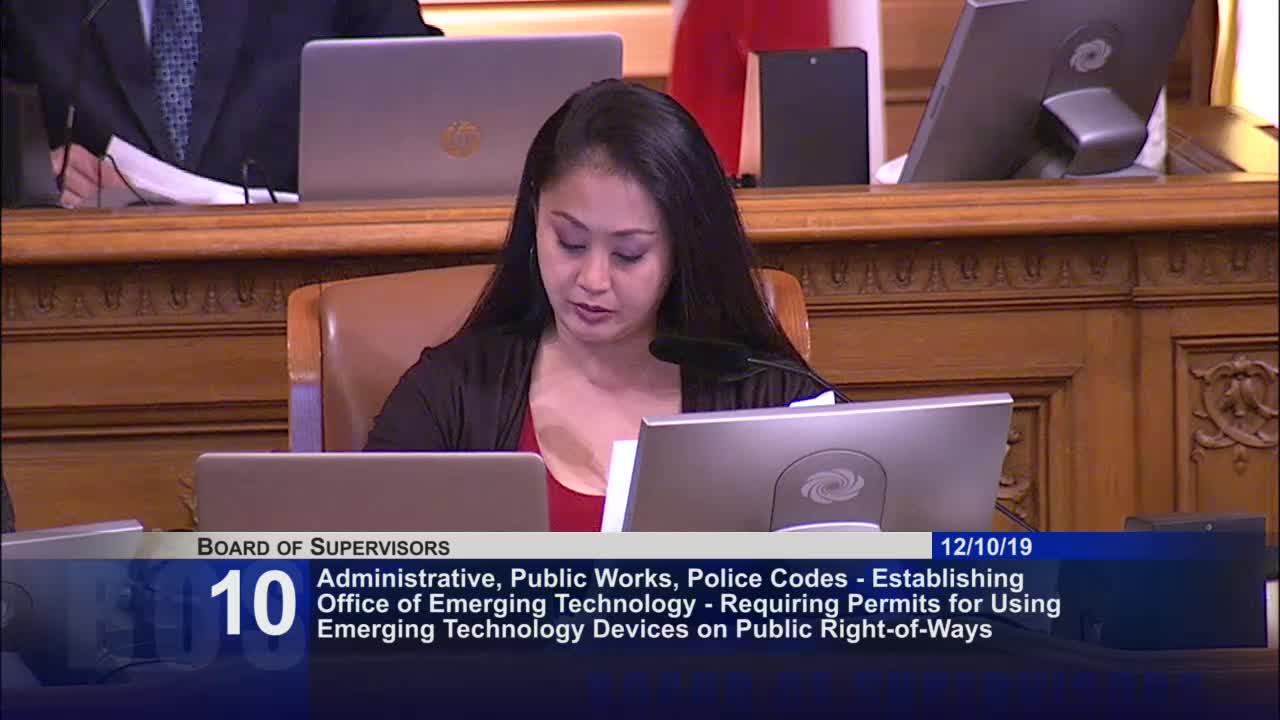
Board advances ordinance to create Office of Emerging Technology on first reading
Summary
Supervisors unanimously passed, on first reading, an ordinance to create an Office of Emerging Technology within Public Works to coordinate review and testing of new public-facing technologies, including rules for procurement and departmental coordination.
The San Francisco Board of Supervisors advanced on first reading an ordinance on Dec. 10 to create an Office of Emerging Technology in the Department of Public Works. The measure passed unanimously on first reading after sponsors described a year-long stakeholder process and technical research.
What it does: The ordinance establishes an Office of Emerging Technology (OET) to centralize review, testing and cross-departmental coordination for technologies that operate in public space. According to the sponsor's remarks, the measure sets up a policy framework to vet devices and software for mobility, privacy, public infrastructure impacts and labor effects, creates a review pathway and directs interagency data-sharing where jurisdiction overlaps.
Background: The sponsor told the board that more than 200 participants from industry, nonprofits, labor, merchants, neighborhood groups, city departments and academics contributed to the working group that designed the office. The ordinance includes processes for community engagement and technical analyses before new public-facing technologies are approved to test or operate in San Francisco.
Implementation and safeguards: The legislation requires the office to develop standards and a streamlined approval path for companies proposing public pilots, while retaining the ability to prohibit technologies that pose safety risks or harms to public infrastructure. Supporters said the office is intended both to protect the public and to create a clear path for responsible innovators.
Next steps: The board approved the ordinance on first reading and will return it for final consideration. City departments identified as partners include Public Works and the San Francisco Municipal Transportation Agency; the city attorney's office and city administrator were cited as contributors to drafting the legislation.
Outcome: Ordinance passed on first reading unanimously; implementation details and staffing remain subject to administrative decisions and budgeting.