Get Full Government Meeting Transcripts, Videos, & Alerts Forever!
Get email alerts on the Surveillance Technology topic
No spam. Unsubscribe anytime.
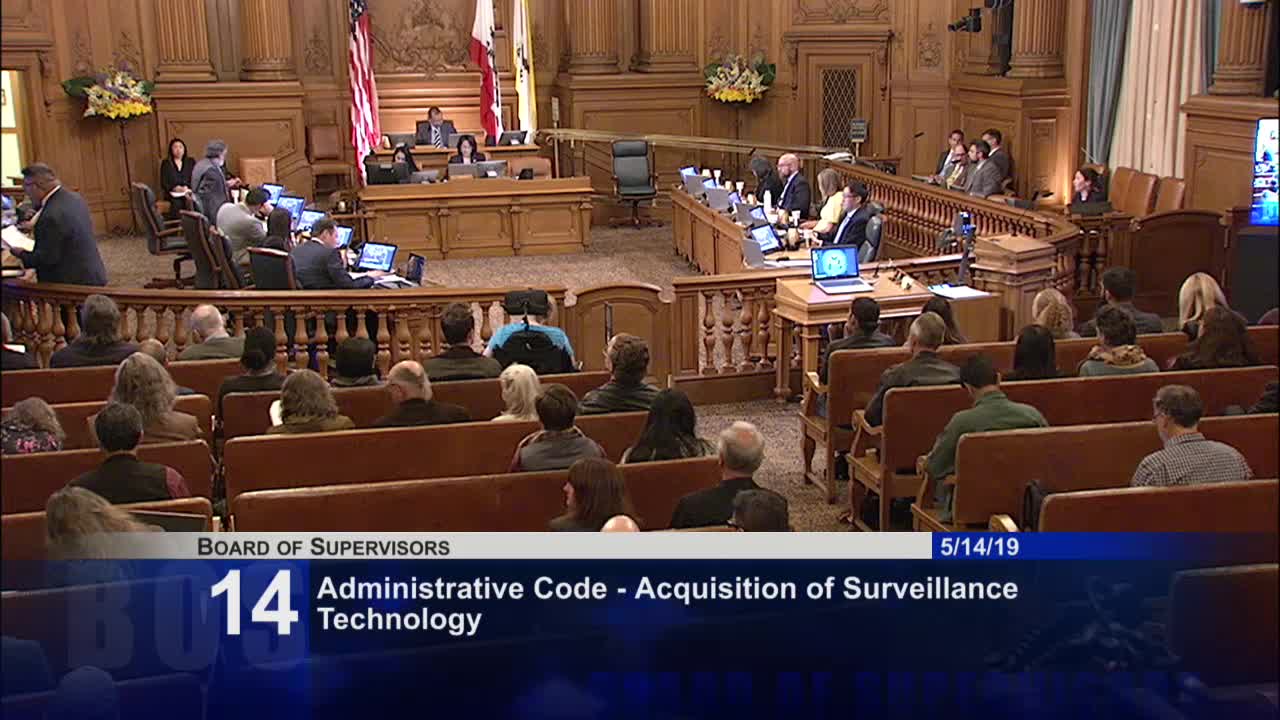
Supervisors approve surveillance-technology ordinance on first reading after amendments
Summary
The Board of Supervisors passed on first reading an ordinance requiring city departments to adopt public use policies for surveillance technologies and banning facial recognition use, after amendments that extended compliance deadlines and clarified continued use pending Board review.
The San Francisco Board of Supervisors on May 14 passed on first reading an ordinance that would require city departments to develop and publicly post use policies for surveillance technology and would bar the local use of facial recognition.
The ordinance, introduced by Supervisor Aaron Peskin, passed after an 8–1 vote following several amendments. “Put simply, this ordinance would require city departments who purchase access or use surveillance technology to develop use policies for that technology through a public vetting process and to make those policies available on a public website,” Peskin said in introducing the measure. He and supporters said the rules would cover retention periods, access, and third-party sharing.
The ordinance grew from months of committee hearings and amendments. Peskin described the bill as focused “on having accountability around surveillance technology,” and said it is not intended to ban technologies generally but to ensure transparency and public oversight. He emphasized a specific prohibition on facial recognition: “Why a ban on the use of facial recognition technology? Recent, I think we’re all aware of this, facial recognition technology actually misidentified 28 members of the United States Congress,” Peskin said during debate.
Deputy City Attorney John Gibner told the board departments may submit either omnibus or technology-specific policies, and that the ordinance applies to departments currently using surveillance technology as well as to departments that seek to acquire such tools in future. "A department can submit an omnibus policy that covers all the surveillance technology that the department uses or a department could submit piecemeal policies for each type of surveillance technology it uses," Gibner said.
Several amendments were adopted before the vote, including extending the compliance deadline from 120 to 180 days, allowing departments to continue use of existing technologies pending Board review, giving the Committee on Information Technology discretion to extend deadlines in 90‑day increments, and lengthening the deadline for exigent‑circumstance reports from 45 to 60 days. Peskin moved the package of eight amendments; Supervisor Feuer seconded the motion.
Police and transit officials pressed for clarity about workload and public safety impacts. Greg McEachern, commander of the Police Department’s Investigations Bureau, told supervisors the department estimates the review and contracting work will require “somewhere between 2 and 4 full time employees” to support implementation. The SFMTA chief security officer said approval of a department policy is what would preserve continued use of cameras on buses and other operator safety tools.
The roll call vote on final passage on first reading was: Mar (aye); Peskin (aye); Safaie (aye); Stephanie (no); Yi (aye); Brown (aye); Feuer (aye); Haney (aye); Mandelmann (aye). The ordinance passed 8–1 on first reading and will return for further Board action and public review.
Supporters cited last year’s Proposition B, the city’s “privacy-first” measure, as background for the citywide policy push; they also provided a list of community organizations supporting the ordinance. Opponents, including Supervisor Stephanie, said she remained unconvinced on whether the measure sufficiently safeguarded public‑safety uses and worried about politicization of approval decisions.
The Board’s amendments also included an explicit carve‑out allowing departments to use surveillance technology for internal investigations of city employees, contractors and volunteers. The ordinance requires departments to submit proposed policies to the Committee on Information Technology for vetting and then to the full Board for approval.
Implementation steps, staffing needs and any future limits on sharing data with state or federal agencies will be determined when each department’s policy returns to the Board for consideration.