Get Full Government Meeting Transcripts, Videos, & Alerts Forever!
Get email alerts on the Ceqa Appeal topic
No spam. Unsubscribe anytime.
Board affirms Planning Department’s categorical CEQA exemption for 3620 Buchanan after public hearing
Summary
After a contested public hearing on environmental and historic‑resource concerns, the Board of Supervisors voted 11–0 to uphold the Planning Department determination that the proposed 4‑story, 8‑unit project at 3620 Buchanan Street qualified for a Class 32 categorical exemption under CEQA.
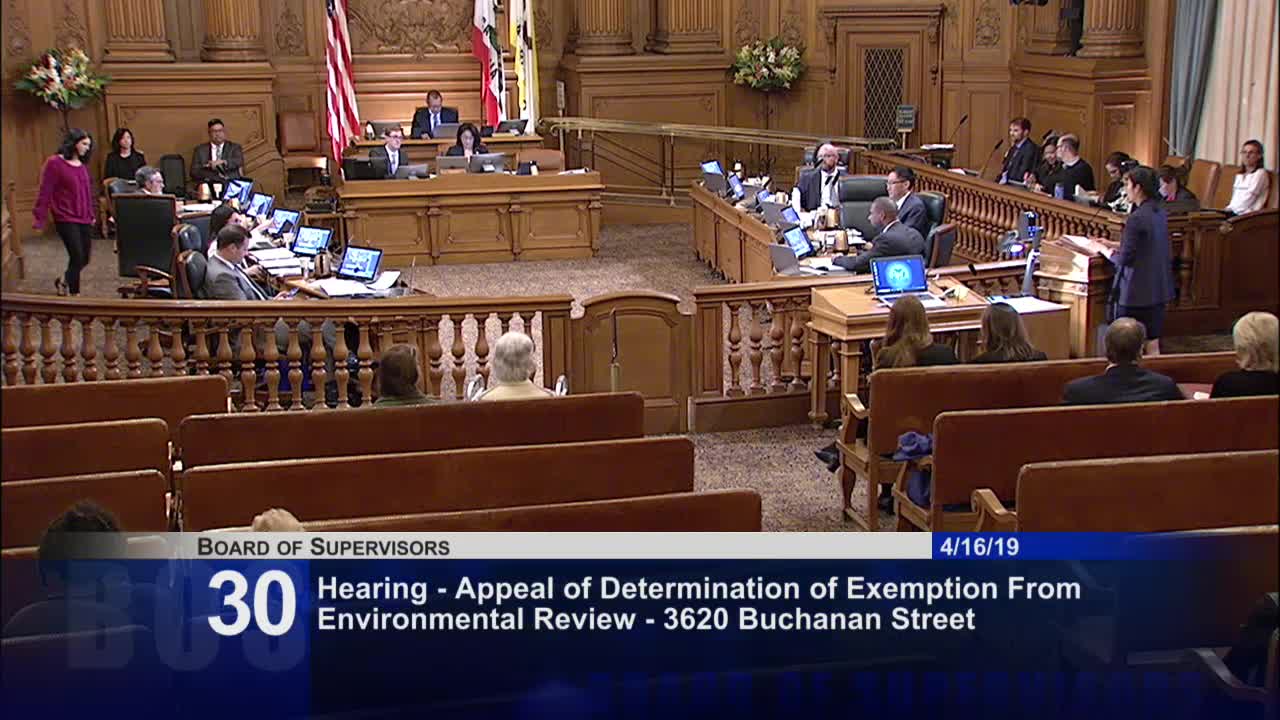
The San Francisco Board of Supervisors on April 16 held a public hearing on an appeal challenging the Planning Department’s determination that a proposed development at 3620 Buchanan Street is categorically exempt from further environmental review under CEQA. After testimony from appellants, the planning department, preservation consultants and neighbors, the board voted to uphold the department’s exemption finding by roll call vote, 11–0.
Appellants — represented by the homeowners association for 1598 Bay Street — argued the exemption could not be used because the site appears on the State’s hazardous‑substances list maintained under Government Code section 65962.5 (they pointed to Department of Toxic Substances Control correspondence) and because demolition of a garden house and a portion of an adjacent courtyard would cause a substantial adverse change to a designated historic landmark site (Landmark No. 58). The appellants also challenged whether a rear‑yard modification had been granted consistent with zoning procedures.
Planning Department staff, represented on the record by Justin Horner, responded that the garden house and patio were not individually eligible historic resources and that the project underwent design review and a certificate of appropriateness process with input from the Historic Preservation Commission and Page & Turnbull. Horner also said DTSC oversight and standard soil‑management and dust‑control requirements would apply; staff described remediation procedures used on neighboring 1598 Bay Street and said similar protocols — health and safety plans, soil management and dust control — would govern cleanup under DTSC oversight.
Page & Turnbull consultants and project design staff described preservation review and how the new building’s massing, materials and setbacks were chosen to retain the administration building’s visibility and character. Neighbors raised concerns about shadows, view impacts and parking congestion.
Supervisor Stephanie (presiding over the hearing) said she had reviewed the record and DTSC materials and concluded the remediation oversight, certificate of appropriateness and the Planning Code provisions for a rear‑yard modification meant the project met the standard for a Class 32 infill exemption. She moved to affirm the Planning Department determination (item 31). The motion passed by roll call, 11 ayes.
Quote "The California Department of Toxic Substances Control will oversee cleanup and the planning department has determined routine cleanup of subsurface contamination would not have a significant effect on the environment," Planning Department staff Justin Horner said during the hearing.
Why it matters The vote resolves a dispute over whether limited infill projects on parcels with historical designations or located within areas of former industrial use require further environmental review (such as a mitigated negative declaration or environmental impact report). The board’s decision to affirm the exemption means the project proponents can proceed toward permitting subject to DTSC and certificate of appropriateness conditions; appellants retain any judicial remedies available under CEQA timelines.