Get Full Government Meeting Transcripts, Videos, & Alerts Forever!
Get email alerts on the Board Presidency Election topic
No spam. Unsubscribe anytime.
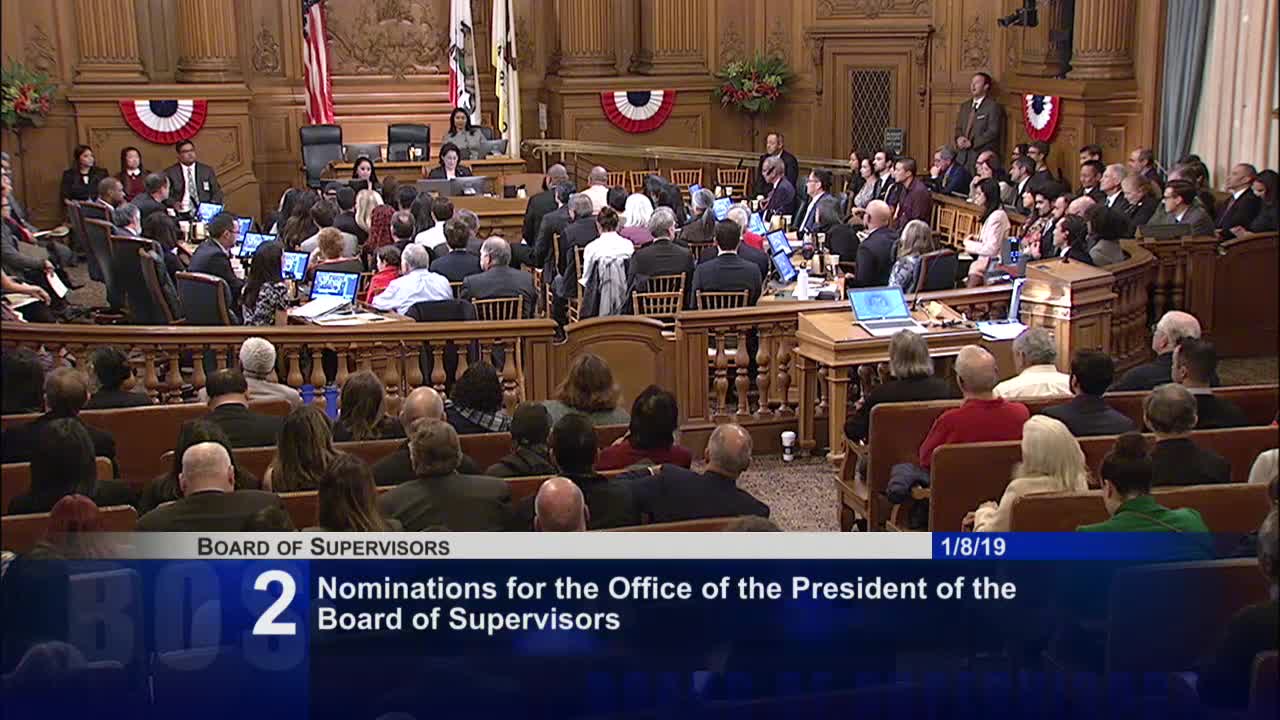
San Francisco Board elects Norman Yee president after contested vote and unanimous confirmation
Summary
At the Board of Supervisors' 2019 inauguration meeting, Supervisors nominated Norman Yee and Hillary Ronan for board president. After a first roll-call vote that split 7–4 for Yee, the board moved to rescind and then confirmed Yee by roll call 10–1.
At the San Francisco Board of Supervisors' 2019 inauguration meeting at City Hall, the board elected Supervisor Norman Yee as president after a contested nomination between Yee and Supervisor Hillary Ronan.
The outcome mattered because the board president sets the agenda, chairs meetings and has influence over committee assignments at a time when the board faces major priorities including homelessness, housing affordability and city services.
Supervisor Sandra Lee Feuer opened nominations and formally nominated Supervisor Norman Yee. Feuer told the board she had “always known Supervisor Yi to lead with integrity, compassion,” and said she believed he would “further this collective progressive vision through strong, compassionate, and steady leadership.” Supervisor Matt Haney nominated Supervisor Hillary Ronan, saying he was “very proud to nominate my friend, Supervisor Hillary Ronan, to be the next president of the board.”
The meeting included an extended public-comment period focused on the nomination. Dozens of speakers addressed the board; many labor and neighborhood leaders urged support for Ronan. Susan Solomon, identified as president of United Educators of San Francisco and speaking for the San Francisco Labor Council, said Ronan “is a flawless and fierce advocate for organized labor and workers in the city of San Francisco.” Numerous speakers from Latino, immigrant, arts and labor organizations urged the supervisors to elect Ronan as board president.
The board then conducted a roll-call vote in alphabetical order by supervisor. The first tally recorded seven votes for Norman Yee (Brown, Feuer, Mandelmann, Peskin, Safai, Stefani and Yee) and four votes for Hillary Ronan (Haney, Marr, Ronan and Walton). The clerk announced, “There are 7 ayes for Supervisor Yi and 4 ayes for Supervisor Ronan,” and congratulated President Yee.
Following that announcement, Supervisor Gordon Marr moved to rescind the prior action and to reappoint Supervisor Yee by acclamation; Supervisor Aaron Peskin seconded the motion. The board then took a roll-call vote on the motion to “unanimously appoint Supervisor Norman Yee as the board president,” which passed 10–1 (Supervisor Ronan recorded the lone no). The clerk recorded 10 ayes and 1 no.
Taken together, the proceedings resulted in Norman Yee’s installation as president of the Board of Supervisors. The record shows two related formal actions: the initial contested roll-call vote (7–4) and a subsequent roll‑call confirmation on a motion to appoint Yee by the larger margin (10–1).
Board members and the mayor used their closing remarks to emphasize an intent to work together. Mayor London Breed congratulated the new president and the newly seated supervisors and urged collaboration on the city’s policy priorities. President Yee thanked his colleagues and invited the board to begin its work.
What the board did not do at the meeting was take any additional policy votes tied to the presidency; the actions recorded concern only the nominations and the selection of the president. The board moved next into other inauguration business and adjourned after the ceremony and public comment.
Votes at a glance Initial roll-call (first count): Norman Yee — 7; Hillary Ronan — 4. Motion and roll-call to confirm appointment by board action: Passed 10–1 (Supervisor Ronan recorded the single no).
What to watch next As board president, Norman Yee will set committee assignments and the board’s early-year agenda. Supervisors stressed the need to act on homelessness, housing affordability and public-safety concerns; those issues are likely to dominate committee work and budgeting this term.