Get Full Government Meeting Transcripts, Videos, & Alerts Forever!
Get email alerts on the Homelessness Contracts topic
No spam. Unsubscribe anytime.
Board approves retroactive $117.2 million Tenderloin supportive‑housing contract after heated review of oversight failures
Summary
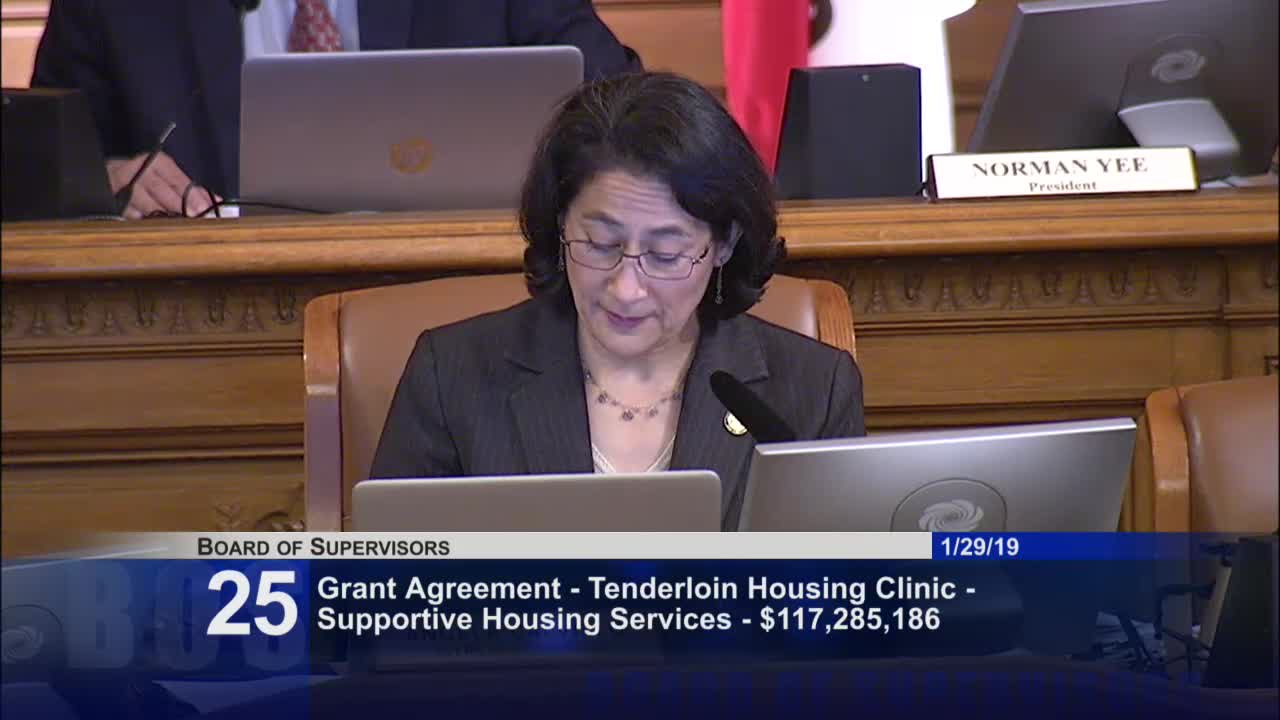
The San Francisco Board of Supervisors on Jan. 29 retroactively approved a long‑running grant agreement between the Department of Homelessness and Supportive Housing and the Tenderloin Housing Clinic, voting 8–3 to ratify the original contract and later amendments that raise the total to $117.2 million.
The San Francisco Board of Supervisors on Jan. 29 retroactively approved a long‑running grant agreement between the city’s Department of Homelessness and Supportive Housing (HSH) and the Tenderloin Housing Clinic, voting 8–3 to ratify the original contract and two later amendments that bring the total authorized amount to $117,200,000.
The action, item 25 on the agenda, resolved an unusual situation in which the original 2014 agreement was executed while the contract was under the prior Human Services Agency and — city officials said — never presented to the board for authorization in violation of Charter section 9.118. HSH staff and the city controller described the gap as an administrative oversight discovered only after the department created a consolidated inventory and audit of inherited contracts.
Why it matters: The contract funds supportive services for 1,566 units of permanent supportive housing for formerly homeless adults in the Tenderloin. Supervisors said they were alarmed that an agreement above the $10 million Charter threshold moved forward without legislative approval, and some said the breach undermined the board’s core fiscal role.
HSH deputy director for administration and finance Gigi Whitley told supervisors the department inherited incomplete documentation when it was created in August 2016 and later discovered that the 2014 contract had been executed without board approval. “We have taken a number of steps to ensure that this never occurs again,” Whitley said, detailing staff changes, new contract analysts, training with the Office of Contract Administration and the Controller, and revised legal and signature checklists.
City Controller Ben Rosenfield told the board that the control that requires board approval for contracts over $10 million is not easily automated and relies on departmental procedures and central oversight. “Clearly something was missed at that moment many years ago here on this contract,” Rosenfield said.
Some supervisors pressed for stronger accountability. “A contract in excess of $10,000,000 could be let without approval of the San Francisco Board of Supervisors is, to put it mildly, deeply disturbing,” said Supervisor Aaron Peskin, who announced he would vote no. Supervisor Peskin and two others — Supervisors Ronen and Yee — cast the three dissenting votes.
HSH said it has taken additional steps that include: replacing contract staff, instituting pre‑signing legal review checklists, flagging contracts exceeding $10 million for early procurement planning, conducting a search of historical records to identify gaps, and committing to new procurement where documentation cannot be reconstructed. HSH also said it would perform new procurements in some cases rather than attempt to recreate prior processes.
Contract history and amounts: The board approved retroactive authorization for the original $74,000,000 grant; a first amendment that increased the total by $7,700,000 to $82,000,000; and a second, further amendment to extend the term through June 30, 2020 and increase the total by $35,100,000, producing a new authorized total of $117,200,000.
Vote and next steps: The resolution passed 8–3. Supervisors Peskin, Ronen and Yee voted no. HSH said continuing services depends on board approval; Whitley told the board that “if you don’t approve the contract, we will not be able to continue the services at 1,566 units of permanent supportive housing” and that re‑procuring would take time and could put tenants at risk.
The board asked HSH and the Controller to return with a review of controls and improvements. Several supervisors also urged follow‑up reporting so the board can confirm the department’s changes to procurement and contract oversight.