Get Full Government Meeting Transcripts, Videos, & Alerts Forever!
Get email alerts on the Land Use Ceqa topic
No spam. Unsubscribe anytime.
Supervisors certify environmental finding for 2750 19th Street project; opponents said CEQA review is outdated
Summary
The Board of Supervisors certified the planning department's categorical exemption determination for a 60-unit project at 2750 19th Street while opponents urged a full project-level environmental review, citing traffic, TNC impacts and displacement risks.
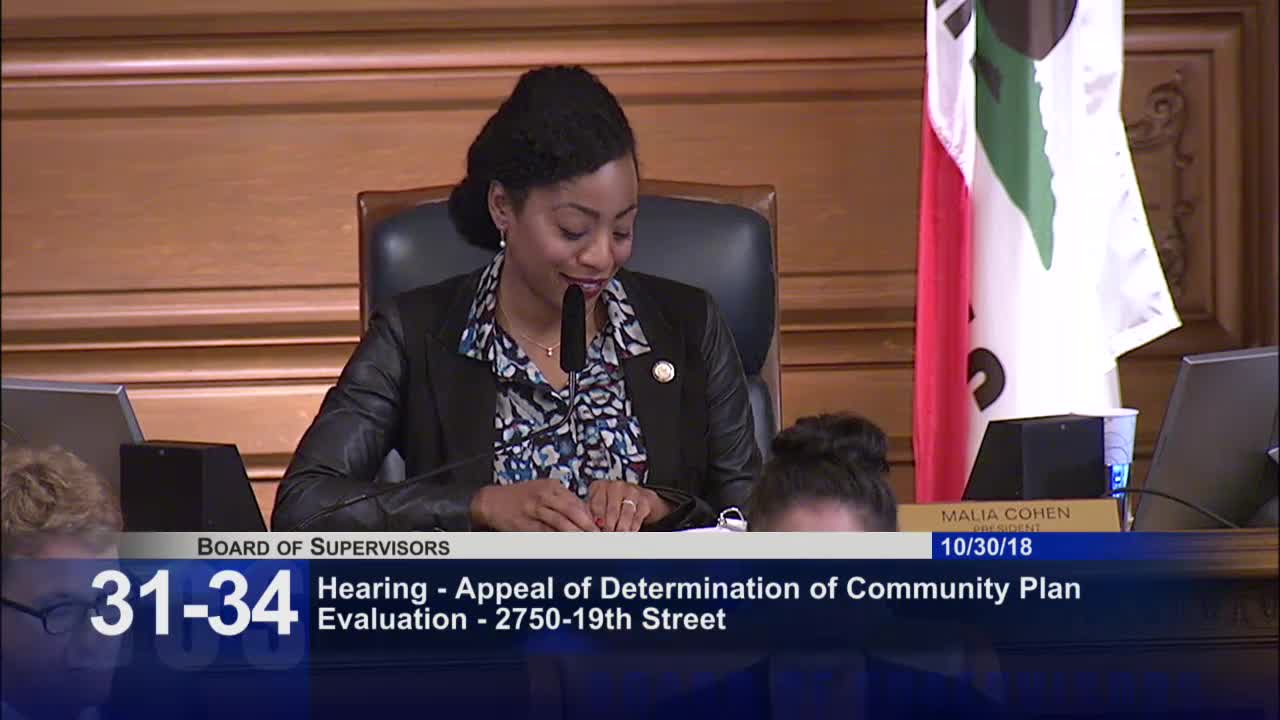
The San Francisco Board of Supervisors on Oct. 30 certified a community-plan-level environmental determination for a 60-unit mixed-use project at 2750 19th Street, rejecting an appeal that asked the city to require a project-level environmental impact report.
Appellants led by the group Our Mission No Eviction argued the project's community plan exemption, tiered to the Eastern Neighborhoods EIR, failed to account for changed conditions since that plan-level study — in particular the growth of transportation network companies (TNCs), higher-than-anticipated building of market-rate housing, increased delivery traffic and the cumulative impacts on displacement and neighborhood infrastructure.
"This project will further exacerbate traffic congestion, pollution, greenhouse gases, and noise as a result of adding private cars, the heavy use of TNC ride-hails, and constant household deliveries," appellant Larissa Pedroncelli said. She and other speakers argued the Eastern Neighborhoods EIR relied on older methodology and did not study the city's current transportation modes or pipeline projects in the Mission.
Planning Department staff told the board the department performed project-level studies using updated models and found no new or more severe environmental impacts than those addressed in the Eastern Neighborhoods EIR. "Let me state very clearly and respectfully that this is absolutely incorrect," Planning Department staffer Justin Horner said of the appellants' claim that no updated analysis was performed. He added the department's community-plan exemption included updated analyses for transportation, air quality, greenhouse gas emissions and noise, and applied current vehicle-miles-traveled approaches.
The department and project sponsor said the community-plan exemption process is the proper CEQA pathway for projects consistent with an area plan EIR unless a project-specific, peculiar environmental impact is identified. Mark Loper, speaking for the project sponsor, said the project prepared background technical reports on transportation, noise, hazardous materials, geotechnical issues and preservation — and that none identified unique environmental impacts requiring a project EIR.
Many speakers from neighborhood groups, labor and community organizations urged the board to require a fuller review. Testimony cited research attributing a rise in congestion and vehicle miles traveled to TNCs and argued the project offers insufficient on-site affordability and inadequate long-term protections for the planned PDR (production, distribution, repair) space.
Planning department staff and the sponsor said the department's updated transportation methodology — under active revision and being shared with the Planning Commission — shows lower vehicle-trip generation rates for housing than older guidance. Manoj Madhavan of the Planning Department said preliminary results applying the updated trip rates reduced the project's estimated vehicular trips from roughly 46 to about 28.
After questions and deliberation, Supervisor Aaron Peskin moved — seconded by Supervisor Catherine Tang — to approve the planning department's determination (item 32) and to table the related reversal motions (items 33 and 34) pending further process. The roll-call vote to affirm the department's action was unanimous.
The board's action preserves the project's use of the Eastern Neighborhoods EIR for CEQA purposes while leaving other non-CEQA policy issues such as long-term PDR affordability, neighborhood impacts and housing balance to permitting and community negotiation processes. Opponents said they were likely to pursue other avenues, including court review, to press for more extensive environmental study and stronger community protections.