Get Full Government Meeting Transcripts, Videos, & Alerts Forever!
Get email alerts on the Waste Management topic
No spam. Unsubscribe anytime.
Supervisors pass ordinance targeting large refuse generators to boost recycling and composting
Summary
The board approved on first reading an ordinance requiring audits of large refuse generators to improve diversion rates, with exemptions and phased timelines for nonprofits and certain food vendors.
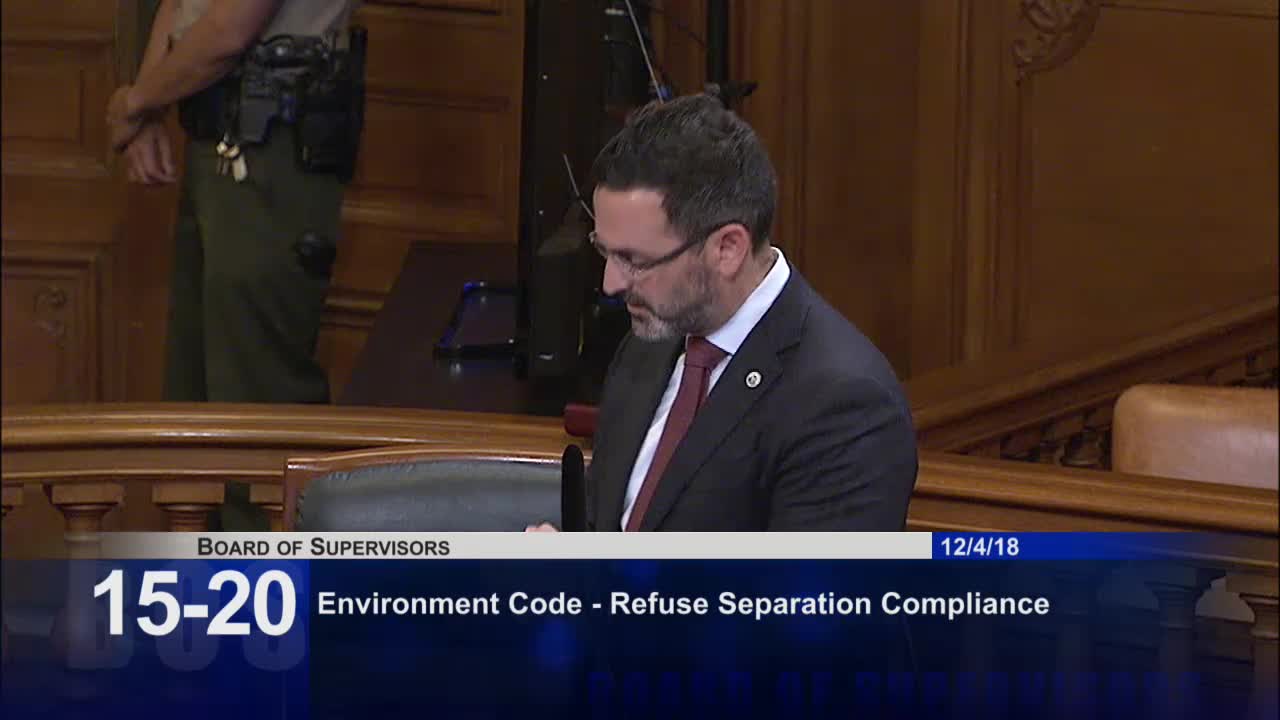
The San Francisco Board of Supervisors approved on first reading an ordinance on Dec. 4 requiring regular audits of large refuse generators—such as large office buildings, hotels, hospitals and universities—to reduce the city’s landfill waste.
Supervisor Safaie, who carried the ordinance, told the board that although the city has made progress on diversion, “60% of what we send to landfill is still recyclable or compostable,” and that “less than 1% of the entire customer base…produce 20% of what we send to landfill.” He said the ordinance aims to compel large waste generators to sort onsite or hire facilitators to improve diversion.
The ordinance sets a higher audit threshold for large generators (changed from an earlier 30 cubic yards to 40 cubic yards in committee), phases in enforcement over a three‑year baseline period, and includes concessions for nonprofit affordable‑housing providers and food banks. The measure authorizes the Department of the Environment to perform audits in coordination with Recology and allows the director discretion for entities demonstrating financial hardship.
“Part of the information…was able to demonstrate that in those cases where they hired the facilitator, not only did it save them on their overall garbage bill, it paid for the facilitator and had overall savings,” Safaie said.
During debate supervisors pressed for protections for small and mission‑critical nonprofit providers and for more time for certain types of generators; the final package included extra flexibility for nonprofits, two audit opportunities for designated groups and an extended effective date for city agencies. The board accepted the amendments and passed the ordinance on first reading.
Ending: The ordinance moves forward with a phased implementation; the Department of the Environment will develop audit procedures, report back to the board and work with affected nonprofit vendors to identify grants and technical assistance.