Get Full Government Meeting Transcripts, Videos, & Alerts Forever!
Get email alerts on the Land Use Zoning topic
No spam. Unsubscribe anytime.
Board certifies Central SoMa environmental report after daylong appeals hearing; motions to reverse tabled
Summary
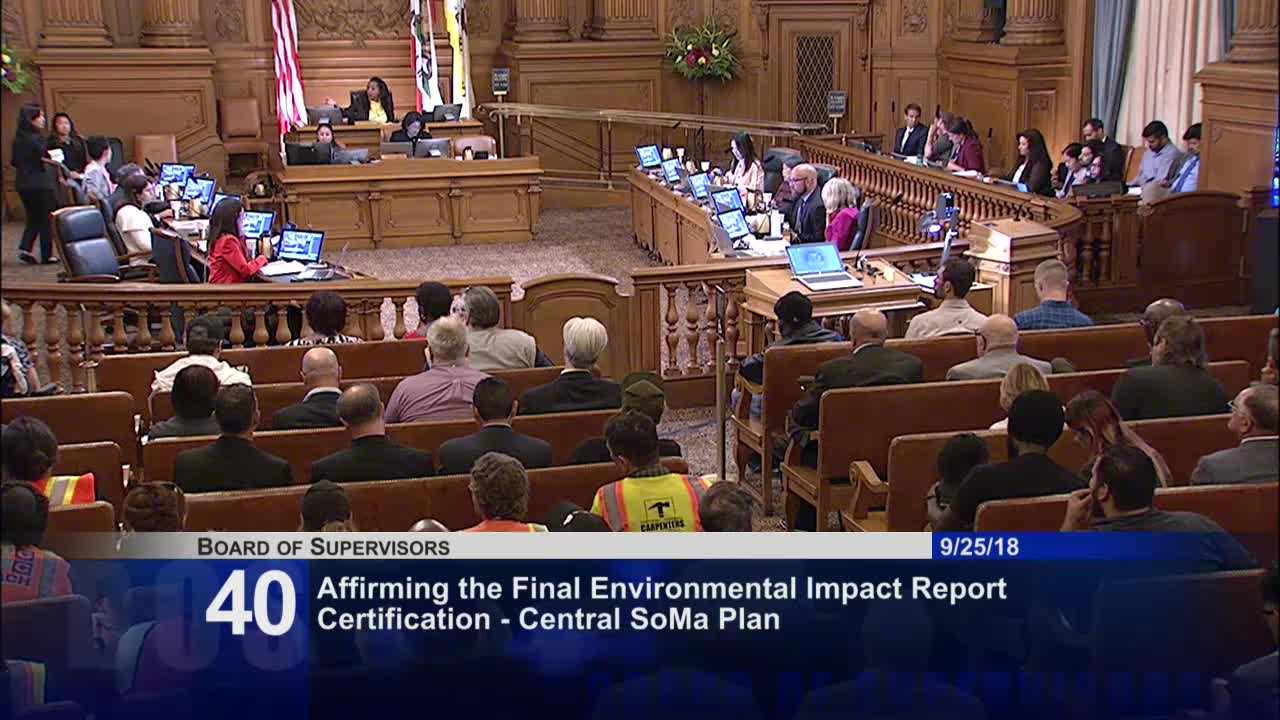
After a daylong hearing with five appellants, the Board of Supervisors voted 10–0 to affirm the Planning Commission's certification of the Final Environmental Impact Report for the Central SoMa plan and tabled motions seeking to reverse that certification and direct written findings.
The Board of Supervisors voted 10—0to—00 on Sept. 25 to affirm the Planning Commission's certification of the Final Environmental Impact Report (FEIR) for the Central SoMa plan, following a multipart appeals hearing that lasted several hours and featured five appellants raising concerns about air quality, traffic and displacement.
The vote was on Item 40, the motion to affirm the commission's certification of the FEIR. The board simultaneously tabled related motions (Items 41 and 42) that would have conditionally reversed the Planning Department's certification or directed the preparation of additional findings.
Why it matters: Central SoMa is one of the city's largest and most consequential area plans. Planning staff and the commission concluded the FEIR adequately analyzed environmental impacts and proposed feasible mitigation. Opponents argued the report underestimates health risks, worsens the jobs-housing imbalance, and fails to protect existing low-income and immigrant communities.
What the appellants said: Richard Drury, representing residents affiliated with SF Blue, told the board the plan "delivers a whole lot of office space" versus housing and warned the plan would worsen the jobs-housing imbalance. "We had 63,000 new workers but at most 14,000 new homes," he said, arguing the imbalance would increase congestion and pollution.
Angelica Cabande, representing South of Market Community Action Network (SomCan), said the plan would "transform this area into a new financial district" and urged stronger safeguards for families and the Neighborhood's youth-and-family special use district.
Planning department response: Planning staff defended the FEIR as compliant with the California Environmental Quality Act (CEQA) and said the document analyzed two scenarios. Liz White of the Planning Department summarized that the FEIR is "adequate, complete, and complies with CEQA," and noted the report's full-buildout analysis for 2040 projects a substantially lower air-pollution cancer risk than a hypothetical immediate-build scenario cited by opponents.
Key technical points the board heard: - The FEIR contains two emissions scenarios: an existing-plus-project hypothetical using 2014 emissions, which yields a high, but unrealistic, near-term cancer-risk figure referenced by opponents; and a 2040 buildout scenario that uses projected vehicle and emissions changes and gives a maximum cancer-risk projection (8.1 additional lifetime cancers per 1 million people at the most exposed point, according to planning staff). - Appellants argued the report omits mitigation such as mandatory filtration for existing buildings that would enter air-pollution exposure zones; planners said an air-quality improvement strategy was added to the mitigation program and additional measures will be studied. - Transportation analysis used vehicle-miles-traveled (VMT) per-capita thresholds adopted citywide rather than traditional level-of-service metrics. Planning staff reported per-capita VMT for the plan would be below regional 2005 averages under the adopted tests. Appellants and several supervisors said ride-hailing effects and idling near freeways still merit closer study. - Appellants raised seismic concerns tied to soft soils and liquefaction; the Planning Department said CEQA requires analysis only if the plan itself would exacerbate existing hazards and that project-level geotechnical review and building-code compliance will govern detailed mitigation.
Board action and next steps: By a 10'0aye roll-call, the board affirmed the FEIR certification (Item 40) and tabled Items 41 and 42. Planning staff acknowledged that if the board or project sponsors want to study an alternative with substantially more housing, the department can prepare a supplemental environmental analysis or addendum; a supplemental EIR would take longer and require additional studies. Several supervisors urged supplemental work to examine higher-housing alternatives, living-wall requirements, stronger community advisory oversight on spending of public benefits, and a new nexus study for the jobs-housing linkage fee.
Quotable: "The Central SoMa Plan EIR is adequate, complete, and complies with the California Environmental Quality Act," Planning staff said in closing.
Why the decision matters locally: The Central SoMa plan covers large parcels around the central subway and Transbay hub. Planning staff said the plan could accommodate roughly 8,600 housing units and 32,500 jobs and generate more than $2 billion in public benefits over time; opponents say its job-heavy profile risks displacement and local health impacts unless the city adopts extra protections. With the FEIR certification affirmed, the zoning and the plan itself will return to the Board for subsequent legislative action; project-level environmental reviews will still be required as individual developments are proposed.