Get Full Government Meeting Transcripts, Videos, & Alerts Forever!
Get email alerts on the Land Use topic
No spam. Unsubscribe anytime.
Board amends HomeSF to try to steer developers toward local inclusionary program; adds 36‑month "use it or lose it" rule
Summary
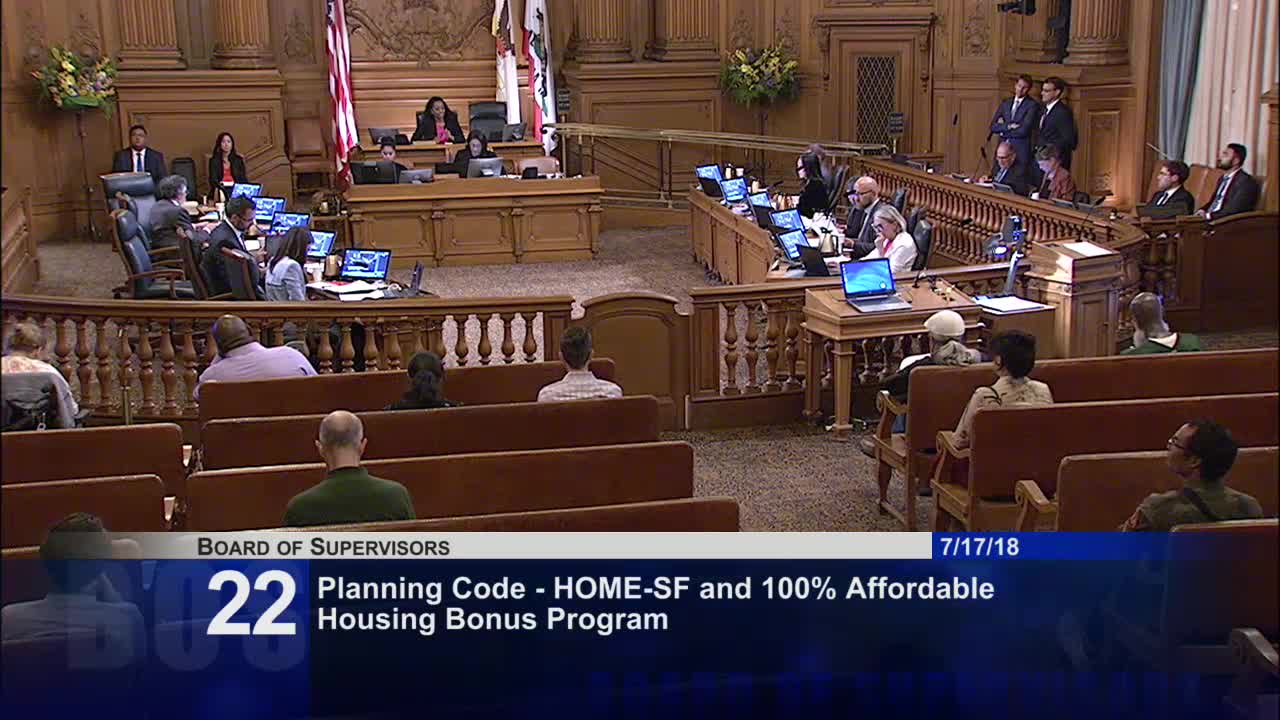
Supervisors approved first‑reading amendments to the HomeSF program to increase incentives for developers to choose the city's inclusionary program over the state density bonus. The board added an expiration for planning approvals if no building or site permit is pulled within 36 months.
The Board of Supervisors on July 17 adopted amendments on first reading to HomeSF, the city's voluntary inclusionary housing and density‑bonus program, in a move the sponsor said is intended to push developers away from the state density bonus and toward local affordability requirements.
Supervisor Catherine Carranza Tang, who presented the ordinance and a set of technical amendments, told the board that some project sponsors have been opting for the state density bonus law or avoiding inclusionary requirements entirely. Tang gave examples she said illustrated the difference HomeSF could make: "On Judith Street ... under base zoning they would build 6 units; under HomeSF they could build 20 units, 6 of which would be affordable," and she cited 2601 Van Ness and a project at 2 Russia Street with similar comparisons.
Among the changes the board adopted was a "use it or lose it" provision suggested by staff and technical advisors that causes planning commission approvals under HomeSF to expire 36 months after approval if the project sponsor has not procured a building permit or site permit. Tang and planning staff said the change is designed to discourage entitlement speculation and to get projects moving.
Supervisor Safai and other board members spoke in support of the amendment, calling it a creative way to encourage developers to choose HomeSF rather than the state density bonus. The board also directed the Technical Advisory Committee (TAC) for inclusionary housing to study indexing HomeSF rates and to examine differences between ownership and rental approaches before January 1, 2020.
The motion to amend passed and the ordinance passed its first reading on July 17. A roll call on the final item showed nine ayes and two absences (two supervisors off the floor earlier), and the ordinance cleared first reading as amended.
The amendments are intended to increase the number of affordable units produced under local incentives, to accelerate development of projects that use HomeSF, and to direct further study of program details and indexing by the TAC. Planning staff and the sponsor said the changes aim to make HomeSF a more attractive option for project sponsors considering where and how to build.