Get Full Government Meeting Transcripts, Videos, & Alerts Forever!
Get email alerts on the Housing topic
No spam. Unsubscribe anytime.
Board advances revised ADU ordinance to streamline accessory‑dwelling construction
Summary
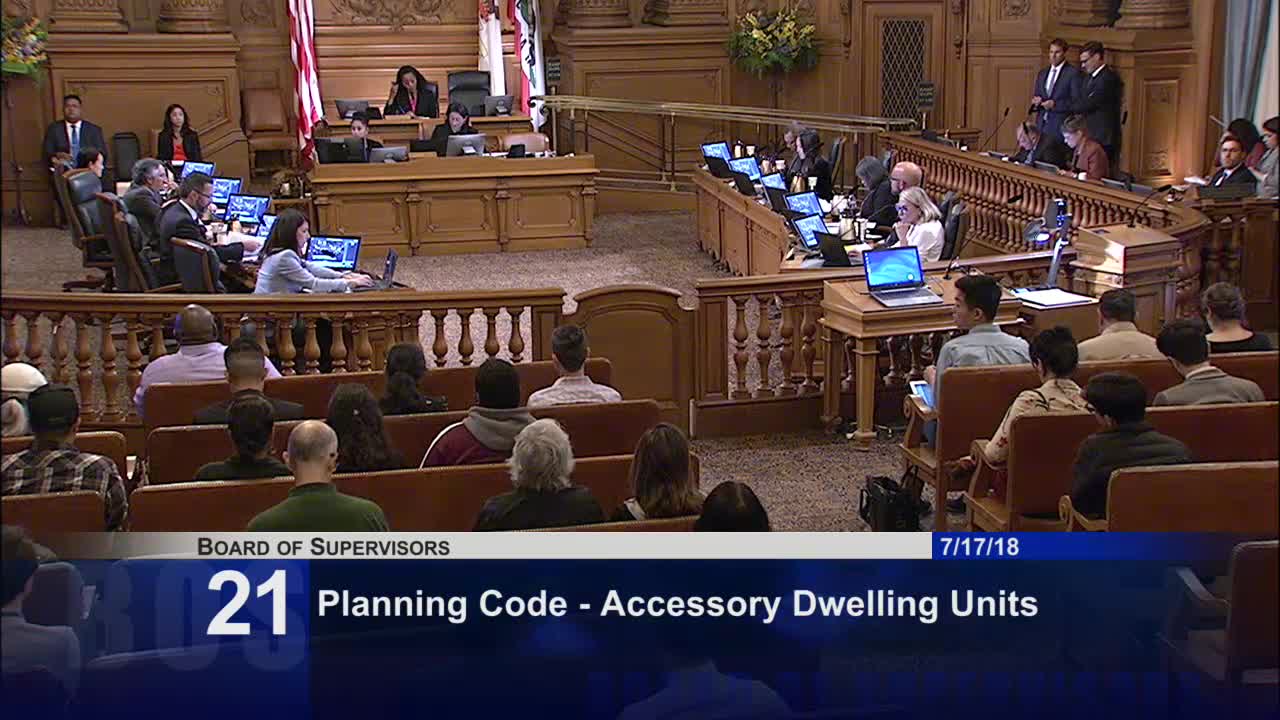
The San Francisco Board of Supervisors on July 17 advanced changes to the city's accessory dwelling unit rules, approving the ordinance on first reading with amendments intended to speed permitting and address neighborhood concerns.
The San Francisco Board of Supervisors on July 17 advanced changes to the city's accessory dwelling unit (ADU) rules, approving the ordinance on first reading with several amendments intended to speed permitting and address neighborhood concerns.
Supervisor Catherine Carranza Tang, the ordinance sponsor, told the board the changes aim "to figure out how it is that we could better streamline our city's processes to allow people to build more accessory dwelling units," saying ADUs are "a more affordable way to add more housing units to San Francisco." Tang described a package of amendments the board adopted, including limiting the number of unauthorized units that can be legalized to one, mandating certain pre-application neighbor meetings in cases that involve filling beneath cantilevered structures, and capping any horizontal expansion within the buildable envelope at the existing building height. Tang also said the board would sever the street‑tree payment provision and return that portion to the Land Use Committee for separate consideration.
The board accepted a separate amendment offered by Supervisor Aaron Peskin to clarify the conditional‑use procedures for unauthorized units. Peskin proposed that a conditional use authorization "will not be required for removal if the zoning administrator has determined in writing that the unit cannot be legalized under any applicable provision of this code," and the board incorporated clarifying language about which unauthorized units may be legalized.
Other supervisors, including Sandra Fewer and Gordon Mar, voiced general support for measures intended to reduce permitting barriers and better coordinate planning, fire, and building department processes for ADU projects.
The board also voted to "duplicate the file" and send the portion of the ordinance related to street‑tree approvals back to the Land Use Committee. Supervisor Tang's duplicate‑file motion was seconded and carried without objection; the balance of the ordinance passed on first reading by unanimous consent.
What passed on July 17 is a first‑reading approval; the ordinance must return for a second reading and final passage. The amendments adopted clarify how and when an existing unauthorized unit may be legalized, create a limited neighbor‑notification/pre‑application requirement in certain circumstances, and delay final action on the street‑tree in‑lieu provision by sending that piece back to committee.
The planning department and the city's building and fire agencies were identified repeatedly during debate as the offices the board expects to coordinate closely with the new rules to reduce discretionary bottlenecks and ensure fire and public‑safety standards are met.
The board took the action during its regular meeting on July 17; the ordinance passed its first reading the same day and will return for further committee review and additional votes before becoming law.