Board advances Mission Rock: supervisors approve zoning, financing and deal terms for 28-acre waterfront project
Loading...
Summary
The Board advanced the Mission Rock waterfront redevelopment on Feb. 13, approving zoning, financing and transaction steps for a 28-acre proposal that will convert a port parking area into housing, parks and offices and that sponsors said will set aside 40% of housing as affordable to low- and middle-income households.
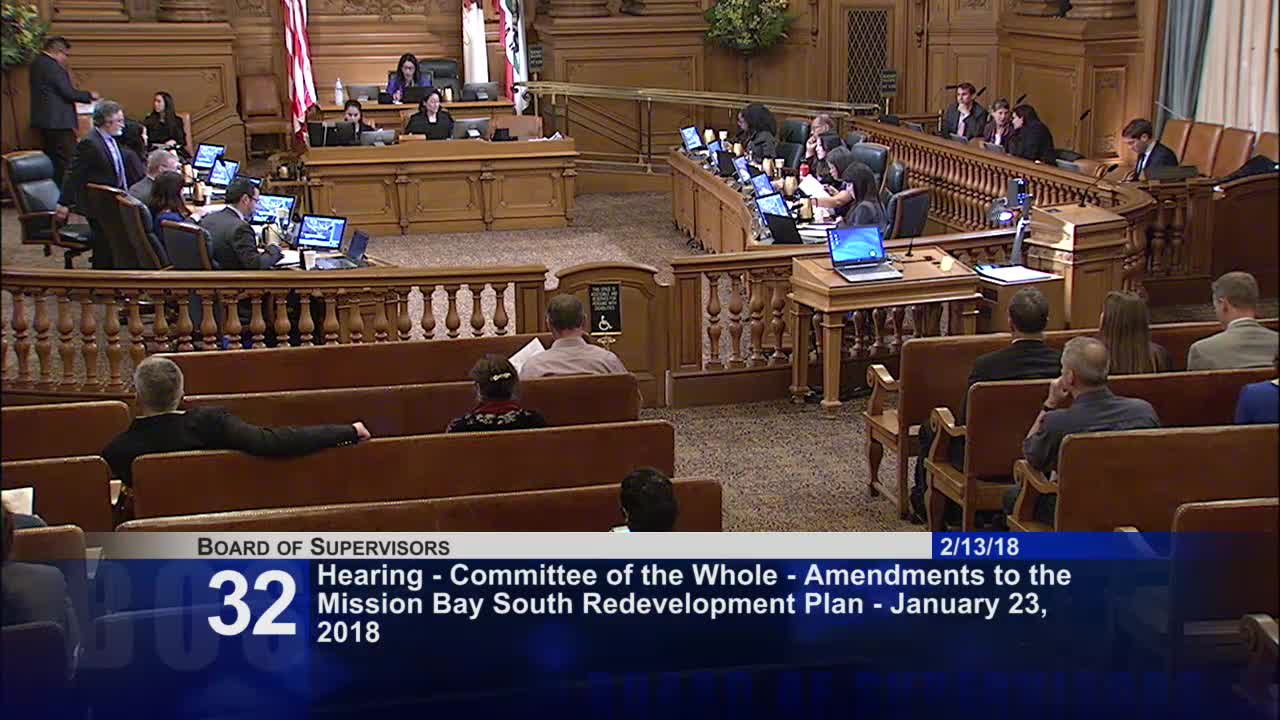
The San Francisco Board of Supervisors on Feb. 13, 2017 approved multiple ordinances and resolutions enabling the Mission Rock mixed-use development on Seawall Lot 337 and Pier 48, advancing zoning, financing and transaction steps needed to build housing, parks and offices on a 28-acre waterfront site.
The Board's actions include creation of the Mission Rock Special Use District in the Planning Code, approval of a development agreement and a disposition-and-development agreement with the Port of San Francisco, and establishment of a project area within the Port's Infrastructure Financing District (IFD) to capture property-tax increment to fund public infrastructure. Supervisors adopted the principal items and related resolutions by unanimous votes at this meeting or via committee actions; many ordinance readings were taken on their first reading as allowed by the Board.
Port deputy director Mike Martin framed the project as the follow-up to Senate Bill 815, which changed trust restrictions and created an opportunity to build housing and generate revenues for port maintenance and shoreline resilience. "We at the Port feel very optimistic about this project on several levels," Martin said, noting the proposal converts an underused surface parking area into housing, open space and revenues to support seismic and seawall needs.
Project sponsors from the San Francisco Giants said Mission Rock resulted from years of public outreach and planning. "Mission Rock is the product of years of hard work and thoughtful community planning," said Jack Baer of the Giants. Fran Weld, senior vice president of development, described a package of public benefits including more than eight acres of parks and open space, neighborhood-serving retail, and 40 percent of homes designated as affordable to low- and middle-income households. "Forty percent of the homes will be affordable to low, moderate and middle income families," Weld said.
Office of Community Investment and Infrastructure (OCII) project manager Mark Slutskin described a narrow amendment to the Mission Bay South Redevelopment Plan that removes a small strip of land known as P20; the board voted to amend the redevelopment plan and to approve related actions.
Rebecca Benesini of the Port summarized financial elements of the IFD: the Mission Rock project area within the Port-wide IFD would direct a share of new property tax increment (the city share) to eligible uses including backbone infrastructure, public parks, shoreline adaptation and historic preservation of Pier 48. The port estimates roughly $191 million in backbone infrastructure costs (2017 dollars) and about $90 million for historic preservation work at Pier 48; the IFD is expected to be one of several funding sources including developer capital, prepaid lease proceeds and a community facilities district.
Supervisors asked detailed questions about implementation and timing. Project sponsors and port staff said they expected to move quickly: sponsors stated plans to file a phase-one application within the calendar year and aim for a groundbreaking in 2019, with interim performance milestones and port remedies if milestones are missed. The sponsor and staff also described workforce and local hiring commitments, a goal of 30 percent local hire and 20 percent local business enterprise participation, and mitigation funding for transportation, transit and shoreline resilience.
Transportation agencies and neighborhood representatives discussed a package of transit and active-transportation investments attached to the project, including queue-management measures to limit traffic interference with the T Third Line, transit vehicle and yard investments, protected bike facilities and support for expanded water transit. Carly Payne of SFMTA described mitigation measures to reduce transit delay and improve pedestrian and bicycle connections. Project-associated transportation impact fees were described in an exhibit to the disposition-and-development agreement and are intended to support transit, bike/ped and water-transit projects identified collaboratively by city agencies and community partners.
Supervisors and community members also raised schools and childcare. The project and city agencies agreed to work with the San Francisco Unified School District on demographic studies and site planning to ensure the area can serve school-aged residents; sponsors reiterated a commitment to on-site childcare and coordination with SFUSD. The Giants and city staff also detailed park design, sea-level-rise adaptation (raising site grade to accommodate projected rise and contributing to a portwide shoreline protection fund), and neighborhood-serving retail and PDR (production, distribution, repair) space.
Board members praised the level of outreach, the size and affordability commitments, and the project's public-benefit package. Several supervisors described Mission Rock as a model for balancing housing, open space and infrastructure investments on public land.
The approvals at the Feb. 13 meeting included: adoption (or first-reading adoption) of the Mission Rock Special Use District zoning amendments; approval of the disposition and development agreement and related memoranda of understanding; and establishment of the IFD project area and authorization to issue bonds in an amount not to exceed approximately $1.3 billion for Mission Rock project-area infrastructure (subject to further procedural steps). Many items were approved by the Board on first reading or via committee actions and will return for subsequent readings as required by charter and code.