Get Full Government Meeting Transcripts, Videos, & Alerts Forever!
Get email alerts on the Environmental Review topic
No spam. Unsubscribe anytime.
Board Upholds Planning Department CEQA Exemption for Proposed Halal poultry butcher in Bayview
Summary
The Board of Supervisors voted to affirm the Planning Department's categorical exemption under CEQA for a proposed Saba Live poultry facility at 1526 Wallace Avenue and denied an appeal from the Animal Legal Defense Fund, while opponents urged further environmental review citing air, wastewater and cumulative impacts in Bayview-Hunters Point.
The San Francisco Board of Supervisors on Feb. 13, 2017 voted to uphold the Planning Department's determination that a proposed Halal poultry slaughter and processing operation at 1526 Wallace Avenue is categorically exempt from environmental review under the California Environmental Quality Act (CEQA).
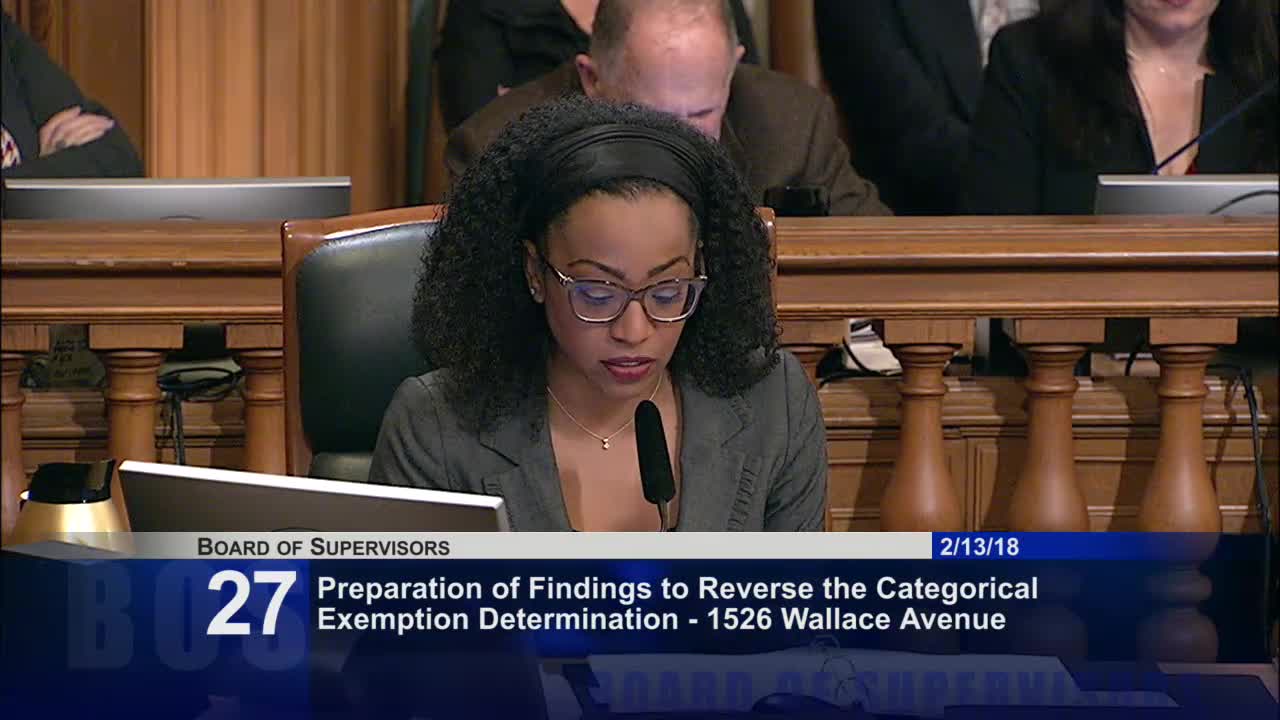
The board's action affirmed the Planning Department's class 1 (and, subsequently, class 3) exemption and denied an appeal filed by the Animal Legal Defense Fund (ALDF). The motion to approve the Planning Department exemption (Item 25) and table related motions (Items 26 and 27) was made by Supervisor Malia Cohen, seconded by Supervisor Ahsha Safaie, and passed by roll call.
ALDF attorney Christina Stella told supervisors the organization sought a remand to the Planning Commission so that a full environmental review could address what ALDF characterized as significant air-quality, disease-transmission and animal-welfare impacts tied to live-animal transport and confined indoor slaughter. "A facility that seeks to transport, confine in indoor cages and slaughter more than 100,000 animals annually has environmental effects that must be considered under CEQA," Stella said, arguing the Bayview's history of industrial pollution made the project an "unusual circumstance" that should preclude an exemption.
Planning Department environmental planner Laura Lynch responded that staff found the 2,100-square-foot tenant improvement and change of use qualified for categorical exemptions and that additional permitting and inspections by DPH and the Public Utilities Commission (PUC) would apply. "The department continues to find that the CEQA determination complies with the requirements of CEQA and the categorical exemption is the appropriate environmental review determination," Lynch said.
Counsel for the applicant, Dan Fratton, said the facility would be small scale compared with large agricultural operations cited in the ALDF materials and that it would comply with a host of state and local food-safety and waste-handling regulations. "This is a family-owned business. Once you account for the regulations and the small scale of Saba's operation, there isn't a fair argument of significant impacts," Fratton said, adding the Oakland Saba facility operates next to homes without the problems public commenters described.
Supervisors, residents and public-health experts questioned how the facility would handle animal waste, wastewater volume and odor control. Tomio Takashta of the SFPUC's wastewater pretreatment program said a comparable Saba facility in Oakland reported roughly 2,000 gallons per day of water use and that the PUC would permit and monitor discharges; he said a significant industrial user threshold for the pretreatment program is 25,000 gallons per day. Patrick Fazl of DPH's Environmental Health Branch said fixed mechanical noise sources are limited to 45 decibels at nearby residences under the city's noise standards and DPH would enforce those rules.
Residents and neighborhood advocates from Bayview-Hunters Point testified against the exemption, saying the community bears a disproportionate share of industrial and environmental burdens. A number of speakers urged the board to require a full Environmental Impact Report and to consider cumulative impacts. Supporters of the project, including customers and community organizations, said the business would meet cultural food needs, create local jobs and operate under city and state oversight.
Supervisor Cohen said she had weighed the environmental-justice concerns raised by speakers but did not find evidence in the record that would compel reversal of the Planning Commission's approval. "I took the allegations of environmental injustice and evasion of necessary CEQA considerations incredibly seriously," Cohen said at the close of the hearing. She moved to approve Item 25 and table Items 26 and 27; the motion passed on roll call.
The board's action affirms the Planning Department's exemption determination. The project still must complete approvals and permits from DPH, PUC and other agencies before operations could begin; those permits will govern wastewater handling, solid-waste removal, odor control and food-safety inspections.
Votes at a glance: The motion to approve Item 25 (affirm exemption) and table Items 26 and 27 was approved by roll call (11 ayes, 0 no).