Get Full Government Meeting Transcripts, Videos, & Alerts Forever!
Get email alerts on the Child Care topic
No spam. Unsubscribe anytime.
Board eases zoning rules to expand child care capacity, ordinance passes unanimously on first reading
Summary
The board passed an ordinance on first reading to make child care facilities principally permitted in most zoning districts and to allow shared open space with residential uses, intended to ease space constraints and speed new child care openings.
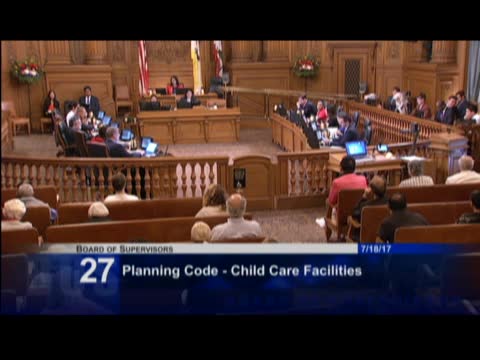
The Board of Supervisors on July 18 unanimously approved on first reading an ordinance to change city zoning rules to expand sites where child care facilities can operate and to allow residential open space to meet child care open-space requirements during weekday operating hours.
Why it matters: San Francisco faces a shortage of affordable child care slots for infants and toddlers. Sponsors said the zoning changes remove municipal barriers that make it difficult for providers and developers to set aside safe, compliant space for child care, helping create up to several hundred new slots as construction and development proceed.
What the ordinance does: The legislation makes child care facilities principally permitted in most zoning districts (with specific exceptions such as certain production, distribution and repair districts), reduces notice requirements in some cases, and allows residential developments to share required minimum open space to satisfy child care open-space requirements for weekday operation hours while still meeting state licensing standards.
Discussion and support: Sponsor Supervisor Norman Yee (recorded as Supervisor Yee) described a roughly 2,600-infant-and-toddler waiting list for affordable care and said the change would allow providers to open facilities more easily. He thanked Planning Commissioner Christine Johnson, the Planning Department, the Office of Early Care and Education and multiple supervisors for co-sponsorship. Several supervisors voiced support and were added as co-sponsors during floor debate. Planning staff answered procedural questions about how many projects had used conditional-use processes in recent years.
Action and next steps: The ordinance passed unanimously on its first reading. Sponsors said this measure complements recent budget increases aimed at funding more child care slots and that implementation will be coordinated with the Planning Department and Office of Early Care and Education.
Ending: The ordinance clears the path for providers and developers to create more child care capacity; implementation details will be handled by city planning and licensing staff.