Get Full Government Meeting Transcripts, Videos, & Alerts Forever!
Get email alerts on the Housing topic
No spam. Unsubscribe anytime.
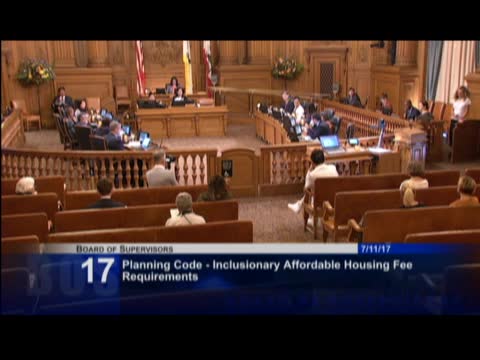
Supervisors amend inclusionary-housing rules to boost family-sized units; ordinance passes first reading
Summary
The Board adopted amendments to the city's inclusionary housing ordinance requiring more family-sized units and tightening occupancy rules for certain higher-priced affordable ownership units; amendments passed after debate and one dissent on a specific amendment, and the ordinance moved forward on first reading.
The San Francisco Board of Supervisors on Tuesday approved amendments to the city's inclusionary housing ordinance designed to increase the share of family-sized units in new development and to clarify eligibility and occupancy rules for some middle-income ownership units.
Supervisor Ahsha Safaí, the measure's sponsor on dwelling-unit mix, said the amendments require projects of more than 10 units to include at least 25 percent 2- and 3-bedroom units, "with a minimum of 10 percent 2 bed, 3 bedrooms," language she read into the record during debate. She said the change is intended to produce a better mix of family-sized housing through the city's inclusionary program.
Supervisor Kim proposed and led a related amendment to ensure that certain for-sale "middle-income" units at higher purchase-price tiers carry a minimum occupancy requirement to avoid studios at prices close to market being counted as inclusionary units. After negotiation with Planning and the Mayor's Office of Housing, staff and the city attorney clarified that the amendments set minimum-occupancy requirements for specific AMI tiers and directed the Mayor's Office of Housing to place the detailed procedures and preferences in its lottery manual within six months of the ordinance's effective date.
The board debated unit-mix percentages, how the requirement interacts with HomeSF density-bonus areas, and the possible redistribution of studios across AMI tiers. Supervisor Norman Yee expressed support for the overall legislation but said he was "a little disappointed with the percentage" and questioned the difference between the 25 percent minimum and the 40 percent figure used in some upzoned areas under other programs.
During a roll call on the amendment that set the minimum-occupancy rule for higher-priced affordable units, the board approved the change 10-1, with Supervisor Norman Yee recorded in the dissent. The ordinance as amended passed unanimously on first reading later in the meeting.
Sponsors directed the city attorney and planning staff to refine the ordinance language and to provide the Mayor's Office of Housing and Community Development with a timeline to publish the preferences and lottery procedures. Several supervisors noted additional technical amendments or requested that related Office of Community Investment and Infrastructure (OCII) language be returned for the next meeting.
The amendments aim to prioritize family-sized units (two- and three-bedroom units) in the inclusionary pipeline and to reduce the likelihood that studios priced near market rates will fulfill inclusionary obligations for for-sale developments. The ordinance was passed on first reading "as amended" and will return for further readings and final adoption.