Get Full Government Meeting Transcripts, Videos, & Alerts Forever!
Get email alerts on the Housing topic
No spam. Unsubscribe anytime.
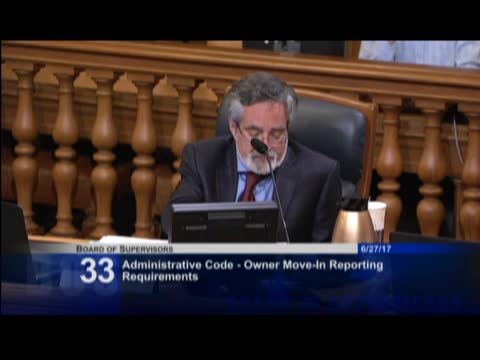
Board approves major inclusionary housing ordinance on first reading after lengthy debate
Summary
The San Francisco Board of Supervisors voted unanimously on first reading to approve an amended ordinance raising private developers' contributions to affordable and middle-income housing, setting new percentage requirements and new rules on unit mix and grandfathering; officials said additional technical fixes will return at later hearings.
The San Francisco Board of Supervisors on June 27 voted unanimously on first reading to advance an amended ordinance that raises the city's inclusionary housing requirements for market-rate development and adds new middle-income set-asides.
Supporters said the ordinance, negotiated across several supervisor offices and stakeholder groups, will produce more low- and middle-income homes in a city with rising displacement and shrinking middle-class housing.
Supervisor Kim, the bill's primary sponsor, told colleagues the ordinance restores a 15 percent requirement for low-income inclusionary units while adding a first-time 10 percent requirement for middle-income units, setting a combined 25 percent baseline: "This is really a historic ordinance. We are setting the highest rate in the nation for our private market rate developers in terms of our expectation for them to contribute back in towards building working class and middle class housing," Supervisor Kim said.
Why it matters: San Francisco faces a shortfall of housing across income levels. Backers said the measure is intended to capture more affordable housing from market-rate projects as the city grows, while adding explicit requirements for unit sizes aimed at families.
What the ordinance would do and the debate
The ordinance returns key inclusionary rules to the planning code and ties the final fee and on-site/off-site alternatives to a fiscal feasibility study the city has commissioned. As described on the floor, the principal elements include: - Restoring a 15 percent low-income inclusionary requirement and a 10 percent middle-income requirement (25 percent total) for projects subject to the rule. - A new requirement directing a percentage of 2- and 3-bedroom units to help families remain in San Francisco. - A grandfathering clause for projects that submitted a complete environmental application prior to 2016-01-12. - An annual fee update mechanism tied to city construction and acquisition cost indexes and a commitment to a fiscal-feasibility study that will inform a permanent fee schedule.
Supervisor Peskin, a co-sponsor, framed the change as a long-running policy evolution dating back to earlier inclusionary rules and said the state-level density bonus process must align to capture the full obligation the city seeks: "In order to capture the same percentage on state density bonus, Assembly Bill 915 needs to pass," Peskin said, asking that the board put that expectation on the record.
Supervisor Safaie and other members emphasized the negotiated nature of the measure, noting organized labor, affordable-housing advocates and developers took part in a technical advisory committee that produced the fiscal-feasibility work and amendments. Safaie said the ordinance aims to address a gap in workforce and middle-income housing for janitors, teachers, nurses and first responders.
Amendments and procedure
Supervisors read several technical amendments into the record during the floor debate (dates, scope clarifications, and "use-it-or-lose-it" provisions tied to a 30-month timeframe for projects to begin work). Deputy City Attorney John Gibner advised one of the proposed changes required additional legal analysis and therefore would be withdrawn and returned for later consideration; the board agreed to move forward with the remaining technical fixes and to return unresolved language for subsequent committee review.
The board adopted the amendments and passed the ordinance as amended on first reading unanimously (11-0). Sponsors said the file will return for further review and a second reading; staff sign-off and a duplicate committee file may require alignment before the second reading.
Context and next steps
Sponsors repeatedly described the ordinance as the result of months of negotiations and an effort to implement voter direction in a way that allows the city to capture the maximum feasible inclusionary requirement while keeping projects financially viable. Supporters said the controller's office feasibility work and the technical advisory committee were central to setting the new package.
Supervisor Kim said the ordinance will come back with additional technical fixes and that a duplicate version is scheduled for a Land Use Committee hearing on July 10, with the second reading anticipated in mid-July.
Ending
Backers described the vote as a milestone in a multi-year effort and said they will monitor state action (notably AB 915) and implement the fiscal study'driven schedule that will determine the final fee levels and administrative details.