Get Full Government Meeting Transcripts, Videos, & Alerts Forever!
Get email alerts on the Public Health Tobacco Policy topic
No spam. Unsubscribe anytime.
San Francisco supervisors pass first-reading ordinance restricting sale of flavored tobacco, including menthol
Summary
The Board of Supervisors voted unanimously on first reading to advance an amended ordinance that would ban sales of flavored tobacco, including menthol, while delaying the ordinance's effective date to give retailers more time to comply.
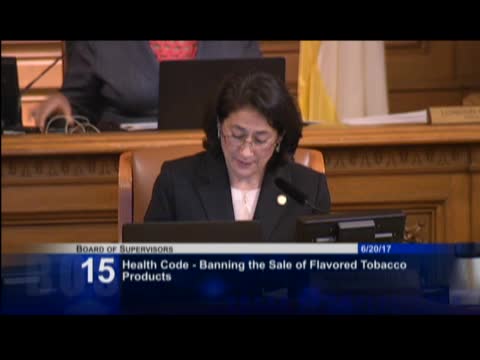
The San Francisco Board of Supervisors on Tuesday passed on first reading an amendment to the city's health code that would prohibit tobacco retailers from selling flavored tobacco products, including menthol cigarettes.
Supervisor Cohen, the ordinance's principal sponsor, framed the measure as a public-health step aimed at reducing youth initiation and long-term addiction, saying flavored products "taste good" and "mask the harsh flavor of tobacco," making experimentation and lifelong use more likely. Cohen said the city pays about $380 million annually for tobacco-related health care expenses and argued local action is needed as federal protections for public health shift.
The ordinance would amend the San Francisco Health Code to bar sales of flavored tobacco products. During debate, Cohen proposed and won an amendment to move the ordinance's operative date from Jan. 1, 2018, to April 1, 2018, giving retailers extra time to prepare. Cohen also said outreach and enforcement details would be spelled out in Department of Public Health regulations and signaled intent to expand corner-store retail assistance programs to help small businesses transition away from tobacco sales.
Supervisors voiced support for the public-health goals but repeatedly raised concerns about impacts on small, neighborhood retailers. Supervisor Feuer said she supported the ordinance but will ask the Budget and Legislative Analyst to study fees and penalties affecting corner stores and to recommend mitigation measures; she also noted plans to increase funds for store-makeovers by $200,000. Supervisor Safaie and Supervisor Sheehy emphasized the measure's potential to reduce health disparities, including higher menthol use by African American smokers and flavored-product initiation among teenagers.
Supervisor Cohen said city data show the large majority of retailers sell fewer than 50 cigarette packs annually and that sales are declining. She said she will work with a retailers' committee to ease the economic transition for affected businesses.
After the amendment was adopted, the board took the item "without objection," and the ordinance passed unanimously as amended on first reading.
The ordinance will return for a subsequent reading and final passage before it takes effect. The transcript records that the board approved the amended ordinance unanimously on the first reading; details about enforcement, rulemaking timelines and any final vote were described as to be set by the Department of Public Health and in following actions of the board and administration.