Get Full Government Meeting Transcripts, Videos, & Alerts Forever!
Get email alerts on the Jail Reenvisioning topic
No spam. Unsubscribe anytime.
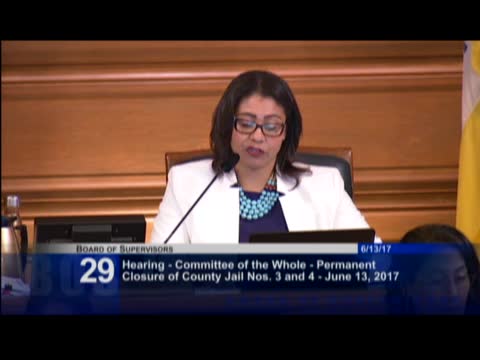
Board hears plan to reduce jail bed days, with goal of permanently closing County Jail Nos. 3 and 4
Summary
The Board of Supervisors heard the Jail Replacement Project work group's recommendations to reduce 83,220 jail bed days so San Francisco can close County Jail Nos. 3 and 4; the report emphasizes diversion, mental-health and substance-use treatment beds, expanded pretrial services and data improvements rather than new jail construction.
The San Francisco Board of Supervisors on June 13 convened as a committee of the whole to receive recommendations from a year-long Jail Replacement Project work group aimed at permanently closing County Jail Nos. 3 and 4 by substantially reducing jail bed days.
The hearing was called by Board President London Breed, who said the board's goal was to "reduce jail bed days and instead increase investments in mental health, homelessness services, diversion, and education." The work group, chaired by Sheriff Vicki Hennessy, Department of Public Health Director Barbara Garcia, and Roma Guy of Taxpayers for Public Safety, recommended a goal equivalent to removing 228 people per day from custody (83,220 bed days per year) to create capacity in the remaining county facilities.
Why it matters: Work group members and supervisors said a focus on reducing bed days — especially for a relatively small number of people with long stays in custody — could avoid rebuilding or expanding jails, shift spending into treatment and housing, and address racial disparities in the county jail population.
The work group's key findings and recommended steps - Concentration of bed days: Relatively few people serving long custody stays account for the bulk of annual bed days. The group recommended targeting those long-stay cases for diversion or expedited placement in treatment. "Relatively few prisoners with the longest days have the biggest impact on bed days," the report notes. - Behavioral-health placements: Public Health reported that about 360 people in 2015 occupied roughly 18,000 bed days while waiting for residential substance use or locked psychiatric placements. The report prioritized reopening 15 psychiatric respite beds (a site called Hummingbird Place), adding roughly 34 medical-respite beds, 30-plus locked conservatorship beds under negotiation, and 37 residential substance-use treatment beds funded by a state grant. - Pretrial and diversion expansion: The city has expanded pretrial diversion and adopted a validated public-safety assessment. The city budget included additional funding for pretrial services (the mayor approved $700,000 for the pretrial program in discussion). The work group urged expanding pretrial capacity and the public defender's bail unit, and improving night- and weekend decision-making so people who will not be prosecuted are not detained for multiple days. - Law enforcement-assisted diversion and crisis response: The group recommended piloting LEAD-style law-enforcement-assisted diversion that provides a warm handoff to case managers and peer providers rather than booking for low-level offenses tied to substance use or behavioral health crises. Public Health also described plans to embed behavioral-health clinicians with police tactical teams and to expand community crisis response capacity. - Data and accountability: Members emphasized the need for better criminal-justice data sharing across agencies to measure impacts and racial disparities and to predict how specific investments change bed days. The group asked for investment in justice-information systems and a common race/ethnicity standard across criminal-justice agencies.
What city leaders said - President Breed said the board had amended a prior funding application to retain final approval over any new jail and urged a shift from incarceration to services where appropriate. - Director Barbara Garcia described multiple near-term capacity additions and shifts in service delivery, including the Hummingbird Place respite unit, expanded medical respite and sobering beds, new conservatorship beds, and a $5.9 million award to expand the Community Assessment and Services Center to 24-hour operations. - Sheriff Vicki Hennessy, co-chair of the work group, stressed the collaborative nature of the effort and the need for continued interdepartmental cooperation.
Public testimony and concerns Speakers from advocacy groups, legal-services organizations, and community coalitions urged the board to: prioritize housing and employment supports, avoid expanding policing as the gateway to services, center people with lived experience in planning, and press for local bail reform to prevent wealth-based detention. Several speakers warned that LEAD-style programs should not expand police decision-making about treatment eligibility.
What was not decided The hearing was a presentation and discussion of the work group's recommendations; no vote to close facilities or to allocate additional long-term capital funding occurred at the hearing. Supervisors and presenters said implementation will require subsequent hearings, ongoing monitoring of outcomes, and budget decisions in the city's fiscal process.
Next steps Supervisors said they will follow up with committee hearings, ongoing oversight of implementation and the budget process, and specific hearings on related topics such as bail reform and youth alternatives. President Breed concluded the hearing by saying, "this work is far from over," and filed the hearing record with the board.
Ending note: The work group framed the question as one of services and capacity rather than bricks and mortar: the path recommended centers treatment, diversion, data, and housing as the primary ways to reduce days in custody and to end operations at older jail facilities.