Get Full Government Meeting Transcripts, Videos, & Alerts Forever!
Get email alerts on the Police Accountability Officer Allegations topic
No spam. Unsubscribe anytime.
Multiple public commenters accuse SFPD officers of repeated misconduct, urge independent investigations
Summary
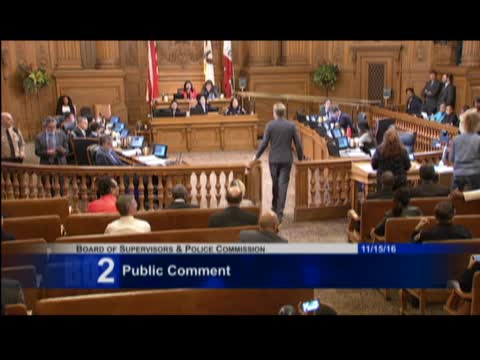
During a joint Board of Supervisors/Police Commission hearing, many speakers alleged a pattern of abusive conduct by officers they named, asked the city to strengthen independent investigation capacity and questioned the Police Officers Association's influence.
A string of public commenters at a joint meeting of the San Francisco Board of Supervisors and the Police Commission accused specific San Francisco Police Department officers of repeated misconduct, cited civil suits and Office of Citizen Complaints activity, and urged expanded independent investigations and accountability.
The claims drew sustained public attention because multiple speakers described similar types of encounters — from alleged on-street harassment and excessive force to a protester dragged by hair — and said repeated complaints and civil litigation had not produced disciplinary outcomes they considered adequate.
David Carlos Oliveri, identifying himself as with San Franciscans for Police Accountability, told the hearing he was "shocked" that an officer who had been accused of brutality remained in a leadership role within the department’s union. "I'm not sure how the commission could possibly work with somebody like this who has a record himself of violence," Oliveri said, referring to allegations about an officer described in testimony as the partner of the Police Officers Association vice president.
Multiple speakers named Officer Joshua Cabillo (transcript spelling varies) and Sergeant Anthony "Tony" Montoya. Commenters described a set of incidents they said showed a pattern: a 15-year-old killed in South San Francisco connected in speakers' accounts to the same officer; long histories of complaints, mediation outcomes they characterized as inadequate, and civil settlements. One commenter said a protester was dragged by the hair and suffered bruises; another described multiple personal encounters that resulted in a complaint that the speaker said was mediated with no finding against the officer.
Speakers repeatedly criticized the Office of Citizen Complaints (OCC), now called the Department of Police Accountability, for what they described as limited follow-through and for a system that leaves early investigative work with SFPD. A public commenter paraphrased an OCC investigator as telling them the department would not investigate patterns across complaints because "that would not be fair," and that only the chief could look for patterns through internal early-intervention systems.
Several speakers urged the DA’s office to staff a fully independent investigations unit and for the Board and commission to press for resources. Interim Chief Tony Chaplin and Captain Michael Conley said the mayor funded positions for an independent investigations bureau at the district attorney’s office and that the DA had posted job announcements and was interviewing candidates; Chaplin said a memorandum of understanding between the department and the DA was in its final phases.
Commenters also raised the Police Officers Association’s role. Several said the union’s political spending and public statements have hampered reforms; others said the union can be a constructive stakeholder but needs to align with contemporary policy changes. Supervisor Aaron Peskin (referred to in the meeting as Supervisor Peskin) and Commission President Susie Loftus discussed the difficulties of balancing union representation and systemic reform.
Speakers requested concrete changes: more vigorous record-keeping of complaints, the use of external audits of departmental data, expedited timelines for disciplinary policy updates and more public reporting about OCC findings. Several community members said they had filed OCC complaints and civil suits; some described expensive towing or lost property as a collateral harm of contested enforcement actions. The meeting's public-comment period included representation from San Franciscans for Police Accountability, residents who described personal encounters, and community organizations that support victims of police misconduct.
Police command staff reiterated their commitment to better data collection and to working with the DA and the Department of Police Accountability on investigations. The hearing produced no formal disciplinary actions; speakers and supervisors said they would continue to press for independent investigatory capacity and faster policy work.