Get Full Government Meeting Transcripts, Videos, & Alerts Forever!
Get email alerts on the Police Reform Implementation topic
No spam. Unsubscribe anytime.
San Francisco leaders present integrated plan to implement DOJ police recommendations
Summary
City officials told a joint session of the Board of Supervisors and Police Commission that they have organized an implementation matrix to act on the Department of Justice assessment and related reviews, and outlined near-term steps on data collection, training and body-worn cameras.
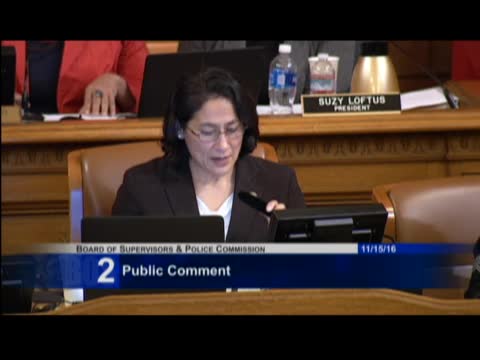
During a joint meeting of the San Francisco Board of Supervisors and the San Francisco Police Commission, city officials described a structured plan to implement recommendations from the U.S. Department of Justice and several local reviews of San Francisco Police Department practices.
The plan matters because the DOJ assessment, the Blue Ribbon Panel and other reviews together generated hundreds of recommendations — officials say the combined set totals about 479 recommendations — and the city outlined how it intends to prioritize and verify work to rebuild public trust.
Diana Oliva Arroche, director of violence prevention services in the mayor’s office, told the hearing the DOJ’s collaborative assessment produced “94 findings, 272 recommendations” and that Mayor Ed Lee accepted and pledged to implement every recommendation. Interim Chief Tony Chaplin and Captain Michael Conley (Connolly) of SFPD’s Professional Standards and Principal Policing Bureau described a project-management approach to do that work.
Captain Conley said the department created an “integrated matrix” that groups all recommendations into the DOJ’s five objective areas and assigns each a bureau executive sponsor, a project manager and reporting timelines. He said about 44 recommendations were classified as high priority and had been assigned to executive sponsors within about 10 days of the report’s public release, with status updates expected within roughly three weeks. Conley said a verification package will require executive sign-off and final approval by the chief and the mayor’s office when an item is completed.
Officials highlighted several near-term operational moves. Diana Oliva Arroche and Captain Conley said the department has deployed body-worn cameras to district stations, with nine of 10 district stations reported fully outfitted "at the end of this week" and a plan to train and equip support units in January 2017. Conley confirmed all recruits receive crisis intervention team (CIT) training and said SFPD is expanding CIT, hostage negotiation and de-escalation training that emphasizes “time, distance and barriers.” He cited a series of recent incidents in which officers contained subjects and relied on negotiators and crisis teams to resolve situations without loss of life.
Conley described an SFPD smartphone application that city staff said is being piloted to capture standardized demographic and use-of-force data. He said Southern Station was the first beta deployment and called early results “phenomenal.” The department plans to work with academic partners to analyze the data; officials said the procurement process (RFP) for that partnership had not been finalized and no release date was given.
Several supervisors and commissioners pressed for specifics: how culture change will be measured, how the department will ensure rapid policy changes and how soon outside analysis of policing data will begin. Supervisor Jane Cohen (referred to in the meeting transcript as Supervisor Cohen) urged a fast timeline and asked that the city move within “30 to 60 days” to secure an analyst or team to help interpret collected data.
Captain Conley said the mayor had issued letters requiring city departments to assist SFPD implementation and described a multi-step execution flow: task assignment to working groups, planning and research with internal and external stakeholders, a professional-standards review, and chief-level sign-off before matters reach the commission. He said the department is continuing collaboration with DOJ staff and community partners to refine priorities.
The hearing included requests from community representatives for additional transparency and faster action on verified problem areas. Several speakers asked the city to prioritize independent investigation capacity and to ensure data collection is timely and auditable. Chief Chaplin said the city has funded positions for an independent investigations unit at the district attorney’s office and that the mayor and DA were finalizing a memorandum of understanding; he said the DA's office had begun hiring for the unit.
City officials declined to give an exact date for when all recommendations would be completed but reiterated the new project-management and verification steps as the mechanism for tracking progress. The Board and Commission scheduled additional oversight hearings and asked staff to provide interim status reports.