Get Full Government Meeting Transcripts, Videos, & Alerts Forever!
Get email alerts on the Labor Wages topic
No spam. Unsubscribe anytime.
Board unanimously passes ordinance to require prevailing wages for security guard contracts and certain event work
Summary
Supervisors approved, unanimously on first reading, an ordinance to require prevailing wages in city contracts for security guard services and for such services at certain city events; proponents said the change protects largely nonunionized workers and aligns security‑guard pay and benefits with other prevailing‑wage city contractors.
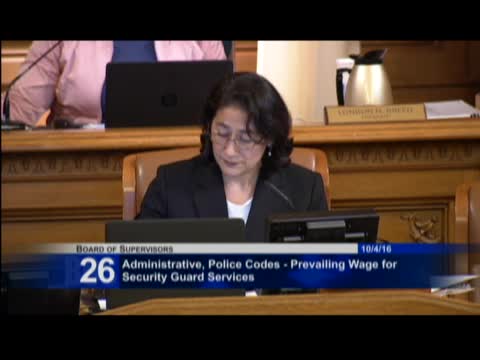
On Oct. 4 the Board of Supervisors unanimously passed, on first reading, an ordinance to add security guard services to the city’s prevailing‑wage requirements.
Supervisor London Breed formally introduced the ordinance but Supervisor Jane Kim delivered the floor presentation, describing the ordinance’s scope: it would require prevailing wages in city contracts for security guard services and apply prevailing wages to guards at certain city events and facilities. It also included a technical police‑code clarification regarding worker retention for security guards.
Supervisor Kim noted national and state statistics about the security industry and argued the ordinance would raise wages, require fringe benefits, and reduce the incentive to cut pay to win city contracts. Kim credited SEIU USWW and city staff for working on the measure.
The ordinance is intended to match city practice for other service areas—such as janitorial services and trade show work—where the city already imposes prevailing wages for work on city property. On a unanimous voice vote the board passed the ordinance on first reading.
Why it matters: Security guards are a large, often low‑paid workforce; the ordinance aims to raise compensation and benefits for guards who work under city contracts and at city events. Supporters argued the change would improve service quality and economic security for workers; opponents did not make a recorded floor argument at this meeting.
Next step: The ordinance passed first reading and will return for required subsequent readings and adoption under the city’s ordinance procedures.