Get Full Government Meeting Transcripts, Videos, & Alerts Forever!
Get email alerts on the Vote 16 Youth Voting topic
No spam. Unsubscribe anytime.
Board, Youth Commission Hear Dozens in Push to Let 16- and 17-Year-Olds Vote in City Races
Summary
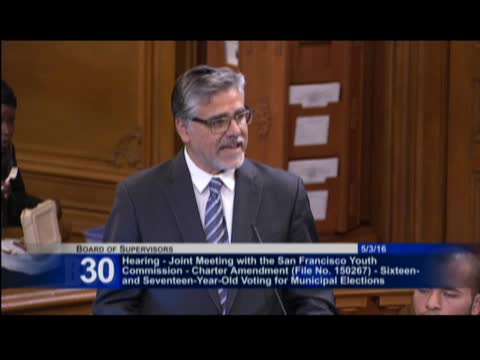
Supervisor John Avalos introduced a charter amendment to let 16- and 17-year-olds vote in San Francisco municipal elections and the Board of Supervisors held a joint hearing with the San Francisco Youth Commission that featured extensive youth testimony in favor of the change.
Supervisor John Avalos introduced a charter amendment on May 3 to let 16- and 17-year-olds vote in San Francisco municipal elections, and the Board of Supervisors held a joint public hearing with the San Francisco Youth Commission that featured dozens of young people and elected officials urging passage.
“We have before us a charter amendment to extend the right to vote to young people ages 16 and 17,” Supervisor John Avalos told the board as he opened the special joint session. The measure would ask voters in November to change the city charter so local elections — but not state or federal contests — would be open to 16- and 17-year-olds.
The Youth Commission and students from public and private high schools made the principal case: voting behavior is habitual, and registering young people while they are still in school would produce higher turnout and a more representative electorate over time. “Voting is habitual and once someone casts their first vote, they will most likely continue voting,” said Jillian Wu, vice chair of the San Francisco Youth Commission. The commission presented research showing that jurisdictions that permit 16- and 17-year-old voting have higher youth turnout and that early participation can raise participation among older family members.
Public Defender Jeff Adachi, who addressed the board in support, said the proposal would nurture the next generation of civic leaders. “These are initiatives that are being pushed by young people,” Adachi said, urging officials to encourage youth participation rather than exclude it.
City officials described implementation hurdles if the charter change passes. John Arndt, director of the Department of Elections, said the department’s voter database and other processes assume voters are 18 and older. “Everything is based on voters being 18 and over,” Arndt said, and adding 16- and 17-year-old voters would require database and ballot handling changes. Arndt advised the board that, because the statewide voter database is under development, the city could face technical and integration work with the Secretary of State’s office before younger voters could be fully supported.
Deputy City Attorney John Givner cautioned that the office had provided confidential legal advice on the constitutional question of the voting age and that he could not elaborate publicly, saying, “we’ve advised you on it, confidentially — and that’s all I can say at this point.” Several supervisors acknowledged the legal question but said it should be put to voters.
The hearing included extended public testimony from high-school students, teachers and youth advocates who described civic education efforts at San Francisco Unified School District and argued that students are already discussing public policy and would benefit from the opportunity to vote in local races. Multiple students recounted civic projects and classroom work, and youth speakers urged supervisors to let city voters decide whether to lower the local voting age.
After the hearing the Youth Commission moved, and approved by roll call, a recommendation urging the Board of Supervisors to forward the charter amendment to the November ballot; the roll call showed many ayes and one recorded no. On the board floor later, Supervisor Avalos moved to continue the charter amendment hearing to the board meeting of May 10 to allow additional work and outreach; the board approved the continuance by roll call (11 ayes). Several supervisors publicly added their names as cosponsors and said they intended to support placing the amendment before voters.
Why it matters: supporters say the amendment could increase long-term voter turnout, better represent neighborhoods with many children and immigrant families, and tie voter registration to in-class civics education. Opponents and several board members said there are legal and technical questions to resolve — including how a local change interacts with California’s constitutional voting-age provisions and the statewide voter registration system — and asked for more analysis on cost and administration before a final placement on the ballot.
Next steps: The board continued the charter amendment to its May 10 meeting. If supervisors vote to place the proposal on the November ballot, the city’s elections and legal offices would need to scope system changes and public education before ballots are finalized.