Get Full Government Meeting Transcripts, Videos, & Alerts Forever!
Get email alerts on the Public Health Tobacco topic
No spam. Unsubscribe anytime.
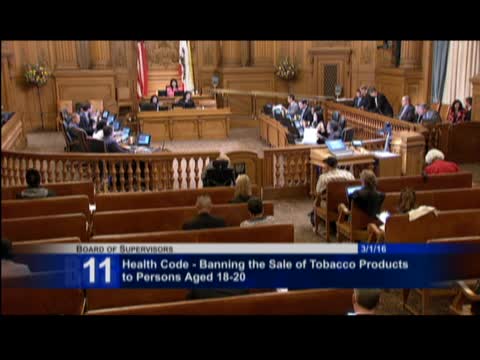
Board passes ordinance on first reading to raise legal tobacco purchase age to 21
Summary
On March 1 the Board passed on first reading an ordinance to raise the minimum legal age to purchase all tobacco products — including e-cigarettes and smokeless tobacco — from 18 to 21. Supporters cited public-health data; the ordinance drew industry litigation threats.
The Board of Supervisors passed on first reading an ordinance on March 1 to raise the legal age to purchase any tobacco product, including cigarettes, smokeless tobacco and electronic cigarettes, from 18 to 21.
Supervisor Scott Wiener, the ordinance’s lead sponsor, cited public-health research and UCSF findings that early initiation increases lifetime smoking. Wiener and cosponsors (Supervisors Maher, Cohen and Farrell) described the change as a straightforward public-health intervention. Supporters referenced Institute of Medicine modeling that a nationwide change to age 21 would reduce youth smoking and premature deaths.
Supporters also said local jurisdictions and several states have adopted age-21 measures; opponents in the tobacco industry signaled threats of litigation asserting state preemption claims. Wiener said the local ordinance complements state law and makes enforcement easier by removing the ability of 16- and 17-year-olds to legally buy tobacco while noting San Francisco’s history of litigation and public-health legal actions.
The measure passed the Board on first reading unanimously and will return for a subsequent reading and final adoption. The sponsor said enforcement would use the same structure as existing tobacco laws and that the city would accept reports of lost or stolen firearms (for a different proposal also introduced earlier), exempting reporters from prosecution under that measure’s language.
Why it matters: The ordinance expands the city’s public-health policy to limit youth access to tobacco products and may face industry legal challenges; under local rules, a second reading is required for final adoption.