Get Full Government Meeting Transcripts, Videos, & Alerts Forever!
Get email alerts on the Memorials Comfort Women topic
No spam. Unsubscribe anytime.
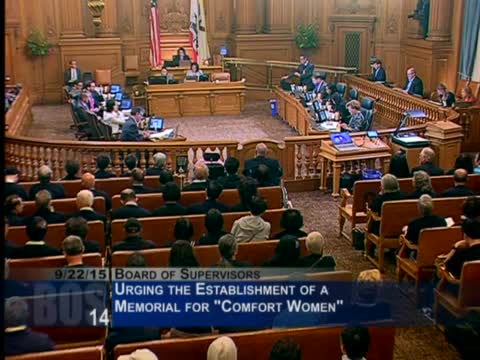
Board approves resolution to establish a public memorial for 'comfort women' after amendments and debate
Summary
The Board of Supervisors unanimously adopted a resolution supporting a public memorial recognizing women forced into sexual slavery during World War II, following amendments that broadened contextual language and committed city departments and community groups to a working group for design and placement.
The San Francisco Board of Supervisors on Sept. 22 adopted a resolution supporting the creation of a public memorial honoring the so-called 'comfort women''women and girls forced into sexual slavery by the Imperial Japanese Army prior to and during World War II.
Supervisor Mark Farrell (note: transcript name uses "Marr"; author is Supervisor Mar/Marr), who introduced the resolution, framed it as a city effort to remember victims and to support education and community programming aimed at preventing human trafficking. The resolution cites historical atrocities and calls for a public memorial that provides a place for remembrance, reflection and community education.
The item drew several hours of public testimony and extended debate among supervisors. Supporters described the memorial as part of a broader commitment to victims of wartime sexual violence and to anti-trafficking work. "Her courage, bravery, and leadership are something that I will never forget," Supervisor Mar said of Halmony (Yong Soo) Lee, a survivor who traveled from Korea to speak to the board.
Some members of the Japanese-American community and other local leaders expressed concern that the resolution should avoid language the community perceived as broadly assigning blame to an entire people or nation. Supervisors debated amendments intended to make the resolution inclusive and to place the comfort-women atrocity in historical context without diluting its core recognition. Supervisor Scott Wiener moved amendments to acknowledge the broader context of victimization of women in other nations while explicitly stating those facts do not excuse the actions of the Japanese Imperial Army; Supervisor Norman Yee joined that effort.
Supervisor Mar offered several technical amendments and a plan to form a working group that will include the Comfort Women Justice Coalition, city officials and community leaders to design and implement the memorial within a year. He said the coalition had already raised private funds and that the intent is a public, accessible location for the memorial.
After amendments were adopted without objection, the board adopted the resolution unanimously. The clerk recorded 11 ayes.
Ending: The resolution directs city staff to form a working group with the coalition and other stakeholders to identify site, design and an implementation timeline; the board's action also calls for educational programming on human trafficking and remembrance activities going forward.