Get Full Government Meeting Transcripts, Videos, & Alerts Forever!
Get email alerts on the Rent Stabilization topic
No spam. Unsubscribe anytime.
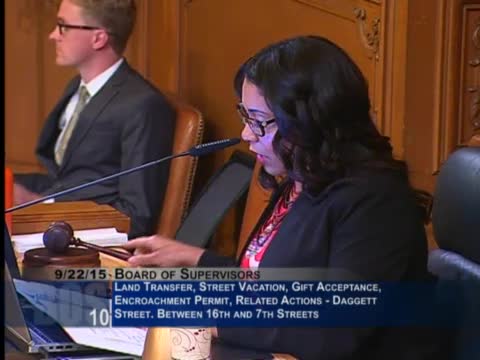
Supervisors approve broad rent-stabilization amendments, split on roommate rule
Summary
The San Francisco Board of Supervisors on Sept. 22 approved amendments to the city's residential rent stabilization and arbitration ordinance, strengthening tenant protections on minor lease-violation evictions and vacancy rent control while voting separately on a contested provision that limits landlords' ability to deny additional occupants.
The San Francisco Board of Supervisors on Sept. 22 passed a package of amendments to the city's residential rent stabilization and arbitration ordinance aimed at reducing evictions for minor lease violations and codifying local protections now allowed under state law.
The package passed the board on a divided roll call for a single, narrowly drawn occupancy provision and then passed the remaining ordinance unanimously on first reading. The divided vote on the occupancy subsection was 7-4 in favor of the narrower version; the final vote on the remainder of the ordinance was 11-0.
The ordinance's author, Supervisor Jane Kim, told the board the measures respond to a rising number of evictions and displacement in the city, and she summarized the main changes: requiring eviction notices in multiple languages; requiring landlords to provide proof for alleged violations in so-called 'low-fault' cases; giving tenants a reasonable opportunity to cure petty violations; clarifying that illegal residential occupancy (for example, units not lawful for residential use) is a limited ground for eviction; and codifying vacancy rent-control protections tied to state law. "Taken together, this package of reasonable amendments provides protections for our most vulnerable tenants during the speculative housing market," Kim said.
The package requires landlords to publish eviction notices in English and several other languages and includes a cure period for minor lease violations such as hanging laundry or storing a stroller in a hallway. Kim said the amendments attempt to balance tenant protections with landlord rights and recognized the rent board and city attorney's input in shaping the text.
Several supervisors voiced support for most of the ordinance while isolating concerns about the provision that limits landlords' ability to refuse additional occupants beyond code limits. Supervisor Scott Wiener described that single subsection as a discrete question that could be separated for a vote: "There's a lot of good stuff in this legislation that will protect tenants and keep people stable in their housing. The one section that I cannot support ... is the section that basically, in my view, eliminates landlords' ability to limit the number of residents living in a building." He asked the board to divide that question out for a separate vote.
Dylene Wolf, executive director of the Rent Board, explained how subtenant relationships work under the rent ordinance and the conditions under which a master tenant's replacement roommate might create a landlord-tenant relationship. She said unapproved subtenants who hold over can be subject to eviction as a just-cause ground, while an approved subtenant would be entitled to rent ordinance protections but could face a Costa-Hawkins market reset if the last original tenant permanently vacates.
After debate, the board voted first on the separated subsection (page 8, line 9 through page 9, line 19 of the draft). Roll call on that specific subsection produced seven ayes and four nos. Supervisors voting no on the separated occupancy language were Supervisor Farrell, Supervisor Tang, Supervisor Weiner and Supervisor Yi; supervisors voting yes included Kim, Mar, Avalos, Breed, Campos, Christensen and Cohen.
The remainder of the ordinance then passed unanimously on the roll call that followed. The clerk recorded 11 ayes for the package as amended on first reading.
Supervisor Kim and supporters said the package is intended to curb 'gotcha' evictions and protect seniors, disabled residents and immigrants who they said are disproportionately targeted. Opponents of the occupancy language said it could limit lease terms and landlord discretion and might have unintended consequences for building management and common-area use.
The ordinance on first reading will return to the board for second reading and final passage per the City Charter timetable.
Ending: The board's action on Sept. 22 kept the central tenant-protection reforms intact while choosing to treat the occupant-approval provision as a separate policy question. The rent-board staff will be asked to issue guidance as the ordinance proceeds to subsequent readings and implementation steps.