Get Full Government Meeting Transcripts, Videos, & Alerts Forever!
Get email alerts on the Housing topic
No spam. Unsubscribe anytime.
Mayor, supervisors clash over size of affordable housing bond as Mission moratorium push gains steam
Summary
Mayor Edwin Lee on Tuesday introduced a $250 million affordable-housing general obligation bond he said he plans to send to voters this November, saying the money would accelerate construction and rehabilitation of below-market housing and public-housing repairs.
Mayor Edwin Lee on Tuesday introduced a $250 million affordable-housing general obligation bond he said he plans to send to voters this November, saying the money would accelerate construction and rehabilitation of below-market housing and public housing repairs.
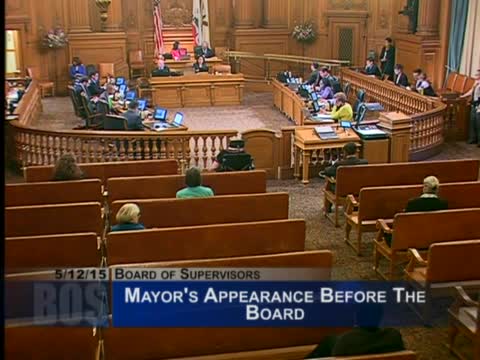
"I'm excited to join the members of our board to introduce a $250,000,000 affordable housing general obligation bond to take to the voters this November," Mayor Edwin Lee said in opening remarks at the Board of Supervisors meeting.
The mayor said the bond would be one part of a broader affordability plan that aims to build, rehabilitate and preserve housing for low- and middle-income San Franciscans, including public-housing residents and a new middle-class rental program.
Why it matters: Supervisors split over pace and scale of spending. Several supervisors — led by Supervisor Avalos and supported by Supervisors Marr and others — said $250 million falls short of what is needed to address displacement and affordability, especially in neighborhoods such as the Mission. They proposed exploring a substantially larger bond and other measures to protect tenants.
Supervisor Avalos criticized the mayor's figure as too small for the scale of the problem. "The notion that we can tell the public that we are addressing the housing crisis with a $250,000,000 bond to me, I don't believe that is...a band aid," Supervisor Avalos said, urging larger, citywide measures and introducing a rival proposal calling for a $500 million “sustainable communities affordable housing bond.”
Supervisor Marr and others described the urgency in neighborhoods where residents are being displaced. Marr said a $500 million bond could fund acquisition, new units, land banking and public-housing repairs: "Dollars 200,000,000 to build up to 1,000 additional affordable units...dollars 100,000,000 to land bank up to 15 new sites...dollars 80,000,000 to fill the gap in the Hope SF public housing rebuild."
At the same time, Supervisor Campos announced a motion to have the board hear a proposed moratorium on new market-rate development in the Mission District as a committee of the whole, saying community members asked the board to consider a temporary pause as a tool to protect existing residents from further displacement. Campos said the moratorium proposal is based on data about displacement in the Mission and limited land availability there.
Other supervisors urged caution. Board President Breed and others said the $250 million measure is meant to be a viable ballot measure that can pass without raising taxes or displacing other bonding priorities; Breed noted past large housing-bond proposals failed to win two-thirds voter approval. "This bond is the right cause, the right size at the right time," Breed said.
Supervisor Farrell requested objective analysis before policy decisions are made. Farrell and Supervisor Wiener said they asked the city controller and chief economist to produce an economic report on any proposed moratorium and on the effects of different bond sizes and timelines. "We want factual data and analysis into this policy discussion," Farrell said.
What happened next: The debate produced two parallel tracks: (1) the mayor's team and several supervisors moved to advance the $250 million bond as a ballot measure the city can realistically pass, and (2) other supervisors pushed for larger funding, land-banking and a neighborhood moratorium, seeking further study and committee hearings. Campos formally introduced a motion to hear the moratorium as a committee of the whole; the motion was presented for consideration during new business and to be scheduled for further action.
Context and limits: Supervisors and the mayor repeatedly framed the bond as one component of a multi-source, multi-year financing effort that also relies on developer fees, state and federal funds, and the city's affordable housing trust fund. Board members warned that raising the bond size could require tax increases or reduce capacity for other deferred capital needs.
Looking ahead: The board and mayor signaled continued negotiations over bond size, program priorities and any temporary development controls for the Mission. Supervisors said they expect additional reports and committee hearings before any final placement on the November ballot.