Get Full Government Meeting Transcripts, Videos, & Alerts Forever!
Get email alerts on the Historic Preservation topic
No spam. Unsubscribe anytime.
Board upholds planning department, affirms mitigated negative declaration for Commonwealth Club project after lengthy hearing
Summary
After a multi-hour public hearing with hundreds of pages of testimony on historic significance, the Board of Supervisors voted unanimously to affirm the Planning Department's final mitigated negative declaration for the Commonwealth Club's proposed renovation and addition at 110 The Embarcadero / 115 Stewart Street.
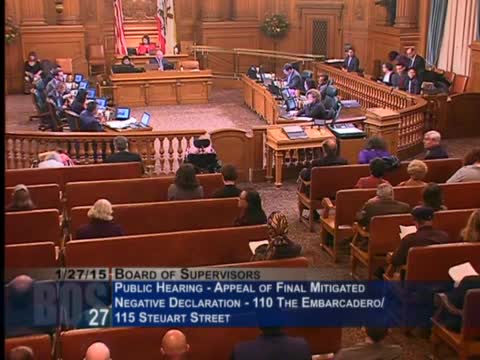
The Board of Supervisors heard more than two hours of public testimony on Jan. 27 before voting unanimously to uphold the Planning Department's Final Mitigated Negative Declaration (FMND) for a proposed renovation and single-story vertical addition at 110 The Embarcadero / 115 Stewart Street, the site long associated in local history with the 1934 longshore strike.
Appellants led by David Osgood of the Rincon Point Neighbors Association argued the building's Embarcadero facade and the entire structure are historic resources tied to the events of the 1934 strike and that substantial evidence in the record supports preparation of an Environmental Impact Report. Osgood urged preservation of the Embarcadero face and cited past board action in February 2009 that overturned a negative declaration on a different proposal at the same site.
Project supporters, including Commonwealth Club President Gloria Duffy, labor representatives and the San Francisco Labor Council, asked the board to uphold the FMND. The club's presentation emphasized that the proposal will restore the Stewart Street facade, add an interpretive exhibit about the 1934 strike, and achieve high energy performance with operable windows and other sustainability measures. The club said the Embarcadero elevation is being designed to allow operable windows and a high-performance glass facade to meet ventilation and energy goals.
Planning staff (senior preservation planner Tina Tam and Environmental Review Officer Sarah Jones) explained the department's determination that the property qualifies as a historic resource for association with the longshoremen and the 1934 general strike. Planning found the Stewart Street facade to be most directly associated with the historic events and concluded the proposed changes would not materially impair the building's ability to convey its significance such that it would no longer qualify as a resource under CEQA. The planning staff recommended upholding the FMND.
Deputy City Attorney Marlena Byrne advised the board on the legal options: the board could remand the matter for further analysis or direct planning to prepare an EIR if the board finds a "fair argument" of significant unmitigated environmental impacts. Following public testimony and rebuttals from both sides, the board voted to affirm the Planning Department's FMND and deny the appeal; the clerk recorded 11 ayes.
The hearing included extensive written and oral input from neighborhood preservation groups, historians and labor union representatives. The Commonwealth Club and several labor organizations said the club will preserve and actively interpret the site's labor history for the public; opponents urged a stricter preservation outcome and an EIR to analyze impacts in more depth.