Get Full Government Meeting Transcripts, Videos, & Alerts Forever!
Get email alerts on the Transbay Cfd topic
No spam. Unsubscribe anytime.
Board establishes Transbay Mello‑Roos district, corrects tax formula; staff says net‑vs‑gross error reduces revenue estimate
Summary
Supervisors adopted resolutions on July 15 to create the Transbay Community Facilities District (a Mello‑Roos special tax district) and set a legal ceiling for indebtedness. City staff acknowledged an implementation error and revised the rate and method to charge the special tax on net leasable square footage rather than gross square footage, cut
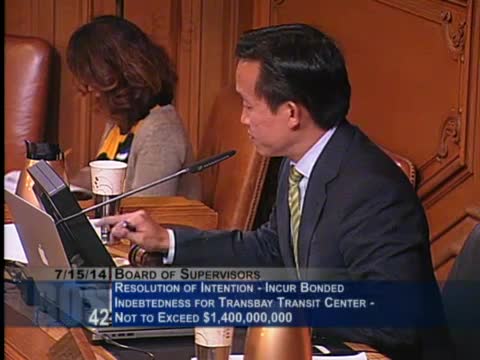
The Board of Supervisors adopted two resolutions on July 15, 2014, to establish a Mello‑Roos Community Facilities District (CFD) for the Transbay Transit Center area and set a legal ceiling for bonded indebtedness.
Supervisor Jane Kim introduced the measures and described them as necessary to finance public infrastructure in the Transbay district, including the Caltrain downtown extension and public open space associated with the terminal redevelopment. The resolutions are an enabling step that sets a legal ceiling for potential bonded debt but do not by themselves issue bonds.
Ken Rich of the Office of Economic and Workforce Development told the board staff had received a letter from developers challenging aspects of the valuation and special‑tax calculation. Staff acknowledged one error: the rate and method had been written to apply the special tax to gross square footage while valuations were being calculated on net leasable square feet. Staff amended the rate‑and‑method document to charge the tax on net square feet, which staff said would reduce the prior bonded‑proceeds estimate (previously cited at about $990 million) by roughly 10–20 percent.
Supervisor Wiener supported the Transbay program but said the CFD will yield less for the downtown extension than earlier estimates suggested and urged regional coordination to secure funding for the rail extension. Supervisor Farrell thanked staff for ongoing negotiations with developer groups; staff said further refinements could be made prior to the public hearings and bond decisions scheduled for September.
Why this matters: The CFD is intended to capture a portion of increased property value created by new development to finance critical transportation and open‑space investments. The correction from gross to net square footage and the subsequent reduction in revenue estimates materially affect the funds the city expects to contribute toward the downtown rail extension.
Next steps: Staff said it will continue meetings with developer groups, finalize the rate‑and‑method document and hold the required public hearing and possible bond authorization in September.