Get Full Government Meeting Transcripts, Videos, & Alerts Forever!
Get email alerts on the Transit Advertising topic
No spam. Unsubscribe anytime.
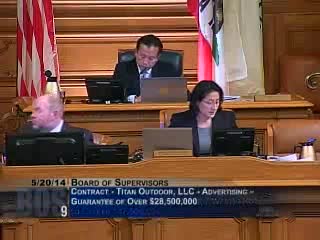
Board approves SFMTA advertising contract with Titan after debate over bus wraps and digital ads
Summary
The San Francisco Board of Supervisors voted to authorize a five-year transit advertising contract with Titan Outdoor that removes digital video ads but keeps a higher cap on vehicle wraps after a lengthy debate about aesthetics and Muni funding.
The San Francisco Board of Supervisors on Tuesday approved a five-year contract allowing the San Francisco Municipal Transportation Agency to execute a transit-advertising agreement with Titan Outdoor, after supervisors debated whether to limit vehicle "wraps" on Muni buses and whether to allow digital video advertising.
Supervisor London Breed, who sponsored changes to remove video advertising and add protections for vehicle-wrap complaints, said the contract is a necessary revenue source for Muni. "Dollars could pay for free muni for seniors 1 and a half times over or buy almost 2 new trains every year," Breed said during the hearing.
The contract, which the Municipal Transportation Agency (MTA) said guarantees a minimum payment of $28,500,000 to SFMTA over the five‑year term, drew divided comments from the board. Opponents criticized the visual impact of window-wrap ads and the prospect of increasing the maximum number of wrapped vehicles from the existing cap, while supporters said the revenue is needed to support services such as free fares for youth and seniors.
Supervisor John Avalos and others pressed MTA staff for assurances about negotiation outcomes. Ed Ryskin, director of transportation, told the board that MTA and the contractor are willing to remove video/digital advertising and that MTA would accept a cap on wrapped vehicles as low as the status quo of 15 if that was the board's direction. "The contractor is willing to do that, and we are willing to do that if that's the direction of the majority of the board," Ryskin said.
Gail Stein, the MTA contract manager, explained the financial implications. "As long as there are 15 wraps in the contract, the contractor will pay us $325,000 for each year of the contract guaranteed," she said, noting that any wraps above that level would produce additional revenue under the contract's revenue‑share terms.
Several supervisors framed the vote as a tradeoff between street aesthetics and the operating needs of Muni. Supervisor Breed said she does not favor the wraps but supported the contract after securing language removing digital advertising and requiring MTA to track complaints. Supervisor Farrell and others said they could accept the contract as proposed to protect planned and existing service expansions.
After discussion and several supervisors signaling preferences for a lower cap (some for 15, others for 20), the board took a roll-call vote on the contract as proposed and the resolution authorizing the MTA to execute it. The resolution passed with seven votes in favor and four opposed. Ayes recorded in the roll call were Supervisors Yi, Breed, Chu, Cohen, Farrell, Tang and Wiener; no votes were recorded from Supervisors Avalos, Campos, Kim and Mar.
The board did not amend the contract text on the dais; Ryskin said staff would return with a written contract reflecting the board's direction if the majority expressed a specific cap. Deputy City Attorney John Givner explained that the board's available actions were to accept or reject a contract that MTA submits, or to request that MTA submit revised contract language for formal board approval.
The board action allows SFMTA to move ahead with the Titan contract (term dates presented to the board: July 1, 2014, to June 30, 2019) with the digital/video elements removed, while leaving in place the flexibility the MTA sought to set a higher wrap cap unless the board directs otherwise in a subsequent contract submittal.
Votes at a glance: The resolution authorizing execution of the transit advertising contract with Titan Outdoor passed 7–4.
Why it matters: The contract guarantees a baseline revenue stream SFMTA says is needed to help cover operating shortfalls and support service expansions; opponents said the visual impacts and driver safety concerns over digital ads weighed heavily and sought a stricter limit on vehicle wraps.
What’s next: MTA staff said they will present any agreed written amendments back to the board for formal acceptance if the board signals a preferred cap on wraps or other terms.