Get Full Government Meeting Transcripts, Videos, & Alerts Forever!
Get email alerts on the Labor Pay Equity topic
No spam. Unsubscribe anytime.
Board delays implementation of equal-pay reporting ordinance after extended debate, sends rules to advisory board
Summary
After hours of debate, the Board of Supervisors passed an ordinance to require certain city contractors to submit equal-pay reports but amended it to create an advisory board and delayed implementation while the board studies reporting details; members raised concerns about burden on nonprofits and data privacy.
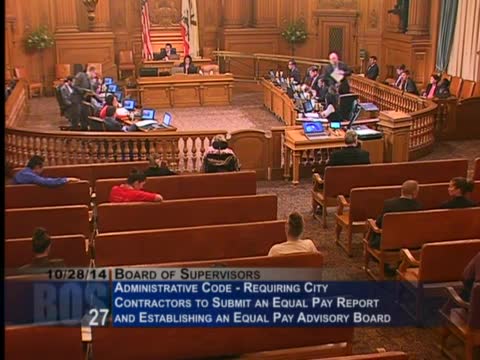
The San Francisco Board of Supervisors on Oct. 28 approved an ordinance requiring many city contractors to submit annual equal-pay reports, but the board amended the measure to create an Equal Pay Advisory Board to design data collection and delayed any reporting requirement until the advisory board issues recommendations.
Supporters framed the ordinance as a transparency tool to identify gender and race pay gaps among vendors paid with city funds. The ordinance sets an initial threshold that will apply to contractors with 20 or more employees or with city grants of $50,000 or more, but its reporting mechanics were left to the advisory board.
Supervisor David Campos, the ordinance’s author, said the measure emulates federal efforts and aims to give the city data to proactively investigate pay disparities rather than rely on individual worker complaints. "Collecting the right data is complicated," Campos said, adding the legislation creates initial phases and an advisory board to minimize administrative burdens while maximizing the usefulness of the data.
Opponents and several board members urged caution. Supervisor Sandra Lee Fewer and others warned the reporting requirement could unduly burden small nonprofits and contractors with limited human-resources capacity and raised privacy concerns about payroll data. Supervisor Katy Tang asked that city departments such as the Department of Children, Youth and Their Families be fully consulted and suggested additional vetting to avoid duplication of existing reporting systems.
The ordinance creates an Equal Pay Advisory Board with seven seats specified by qualifications — including experts in employment law, human resources and quantitative gender analysis — to produce recommendations on data fields and the reporting timeline. It also includes an amendment explicitly protecting trade secrets and proprietary information from public disclosure if a legal basis exists.
The Board approved the ordinance on first reading as amended and directed the Human Rights Commission to convene the advisory board. The measure establishes a phased timeline: the advisory board will hold public hearings and return recommendations to the Board of Supervisors; the city estimates the advisory board will present recommendations no earlier than nine months after passage.
Why it matters: San Francisco spends billions with vendors; supporters said requiring pay data from contractors is a practical lever to apply local purchasing power toward pay equity. Critics warned about administrative burden on smaller vendors and the risk of chilling effects if data collection is too onerous.
What's next: The ordinance moves to additional readings and to the newly created Equal Pay Advisory Board for a data-collection plan. The Human Rights Commission will report annually to the Board about trends, investigations and any penalties or contract sanctions for vendors found in violation.