Get Full Government Meeting Transcripts, Videos, & Alerts Forever!
Get email alerts on the Student Assessment Performance topic
No spam. Unsubscribe anytime.
Board hears sharply worded review of MAP and i‑Ready results; administration promises deeper analysis next month
Summary
Trustee concerns over MAP and i‑Ready proficiency rates prompted extended discussion; administration explained differences between assessments and said a more detailed program evaluation will be presented next month.
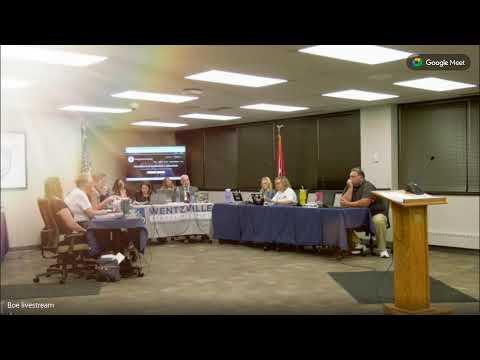
WENTZVILLE, Mo. — A lengthy discussion on Sept. 18 about student assessment data highlighted tensions between the Wentzville R‑IV Board and administration over how to read MAP and i‑Ready results and what to do next.
Director Lewis opened the agenda item by saying the district’s results — where the share of students scoring “proficient or advanced” on MAP assessments was roughly half in many grades — were unacceptable and demanded a stronger board response. “What are we gonna do to get our act together?” he asked. Lewis said he was disappointed in the pace of improvement and called for concrete steps to increase core academic instruction time.
Administration responded by explaining technical differences between assessments and how the state reports proficiency. A presenter said MAP results use a five‑point scale and that “proficient/advanced” correspond to select cut points (four and five), while the state is moving toward an on‑grade‑level metric. The district noted i‑Ready is a diagnostic and instructional tool administered three times a year with built‑in practice and supports, which tends to show higher percentages because it measures progress over time rather than a single snapshot.
Administrators also said the district is reviewing standards‑aligned, local curriculum and common assessments, increasing coaching and intervention supports, and conducting meetings with school leaders to examine teacher and school‑level data. They promised a more detailed “academic services program evaluation” at the next board meeting that will include further breakdowns and action steps.
Board members pressed for things they said would free teacher time for instruction, including weekly collaboration/release time and trimming nonessential tasks. Administration said the schedule changes are complex and require community support; staff also said the state’s changing cut scores and assessment frameworks complicate multi‑year comparisons.
No formal actions were taken; the board requested additional data and a deeper presentation at the next meeting.