Get Full Government Meeting Transcripts, Videos, & Alerts Forever!
Get email alerts on the Judiciary topic
No spam. Unsubscribe anytime.
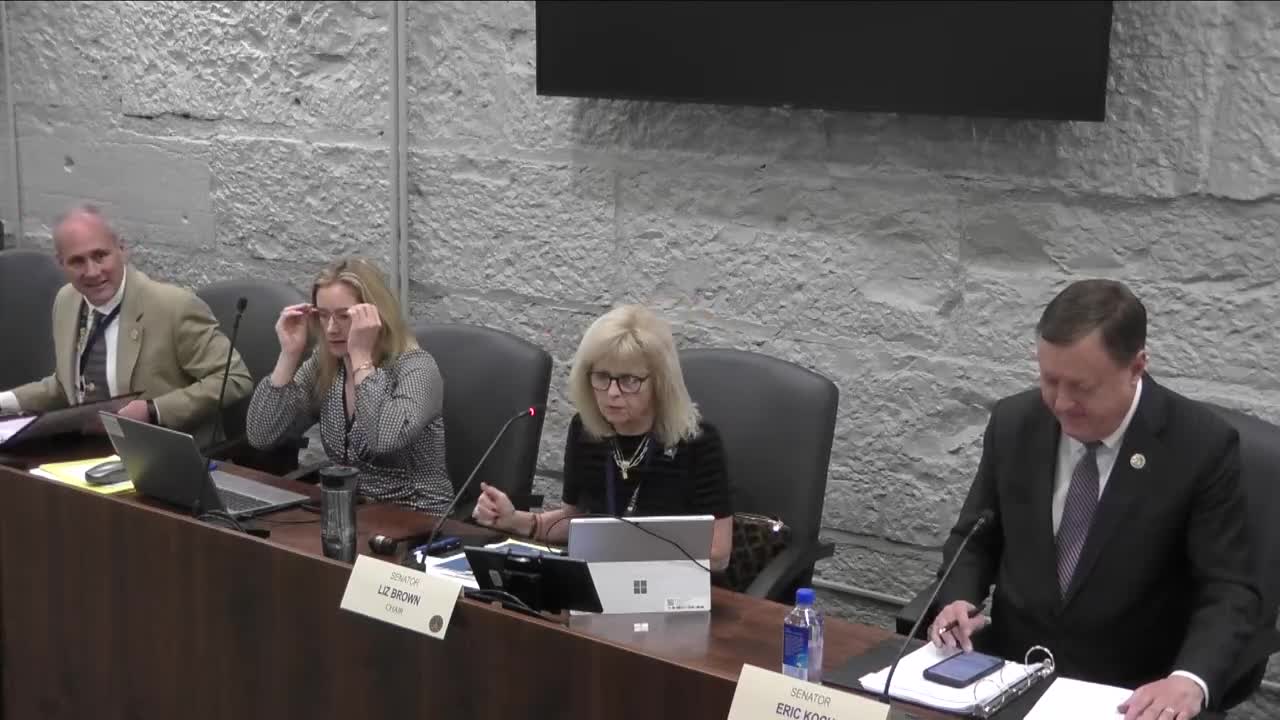
Judiciary committee advances House Bill 1144 after amendments, recommits measure to appropriations
Summary
The Senate Judiciary Committee voted to recommit House Bill 1144, the biannual courts bill, to the Appropriations Committee after approving multiple amendments including a 9-1 vote to change eviction venue rules in Indianapolis and creation of a Family Recovery Court Fund.
The Senate Judiciary Committee advanced House Bill 1144, the biennial courts bill, and voted to recommit the measure to the Appropriations Committee after adopting multiple amendments, including a contentious change to small-claims eviction venue that passed 9-1.
Representative Jeter, who carried the bill, told the committee the interim judiciary panel had recommended nine of the 10 new judges originally requested and signaled a forthcoming review of how judges are allocated across the state. "If you look at the total number of judges in the state, we're at about a 1," Representative Jeter said, urging a future reallocation process and asking for the committee's support for the judges included in House Bill 1144.
The bill drew a series of amendments the committee accepted either by consent or by roll call. Senators called and the committee passed, by consent, amendments to: raise and redistribute filing fees for Marion County small-claims courts and share them among township courts; convert a Steuben County magistrate position to a superior court to address criminal caseload arising from interstate traffic; allow a Lawrence County juvenile court judge to appoint a full-time magistrate in place of a referee; and allow Delaware County a magistrate position. Those amendments were taken up on the floor and recorded as adopted before final action on the bill.
Amendment 9, addressing eviction jurisdiction in Indianapolis, drew the most debate. The amendment would move eviction filings out of superior court and into small-claims court in the township where the property is located or in any contiguous township, a change supporters said would make hearings more accessible and reduce use of superior-court procedures in routine eviction matters. Senator Freeman said the change was intended to comply with a recent decision from the Seventh Circuit and to prevent venue shopping by making multiple small-claims courts operate as a judicial circuit. One senator warned the amendment could remove certain procedural protections; that senator voted no. The amendment passed on a roll call, 9–1 (yes: Alexander, Buck, Freeman, Carrasco, Glick, Clark, Pol, Taylor, Chair Brown; no: Cook).
The committee also considered amendment 5, which would create a Family Recovery Court Fund to support specialty courts handling child abuse and neglect cases involving substance use disorders. Supporters, including Senator Glick, framed the measure as consistent with the chief justice's specialty-court concept and aimed at addressing needs of children who are victims of parental criminal behavior.
Two judges testified in support of the bill. Daniel Kelly, judge of Vigo Superior Court 6 and a former magistrate, told the committee Vigo County has seen about "4 and a half times the number of CHINS cases" since 2010 and said staff are overworked; he said a magistrate assigned to juvenile matters has been "working 70 to 80 hours each week" since taking the post. Kelly suggested methamphetamine use is driving much of the caseload growth. Christine Osterday, judge of Elkhart Peer Court No. 1, also urged passage and said she had provided information during the interim study.
With the amendments offered and accepted, committee members moved the bill as amended and recommitted it to the Appropriations Committee for funding considerations. Chair Brown noted accepting multiple amendments would require additional adjustments to formulas and thanked authors; the recommit motion carried 10–0.
The bill will now go to appropriations, where funding and final adjustments will be considered before the measure proceeds further in the legislative process.