Get Full Government Meeting Transcripts, Videos, & Alerts Forever!
Get email alerts on the Hospital Pricing Reform topic
No spam. Unsubscribe anytime.
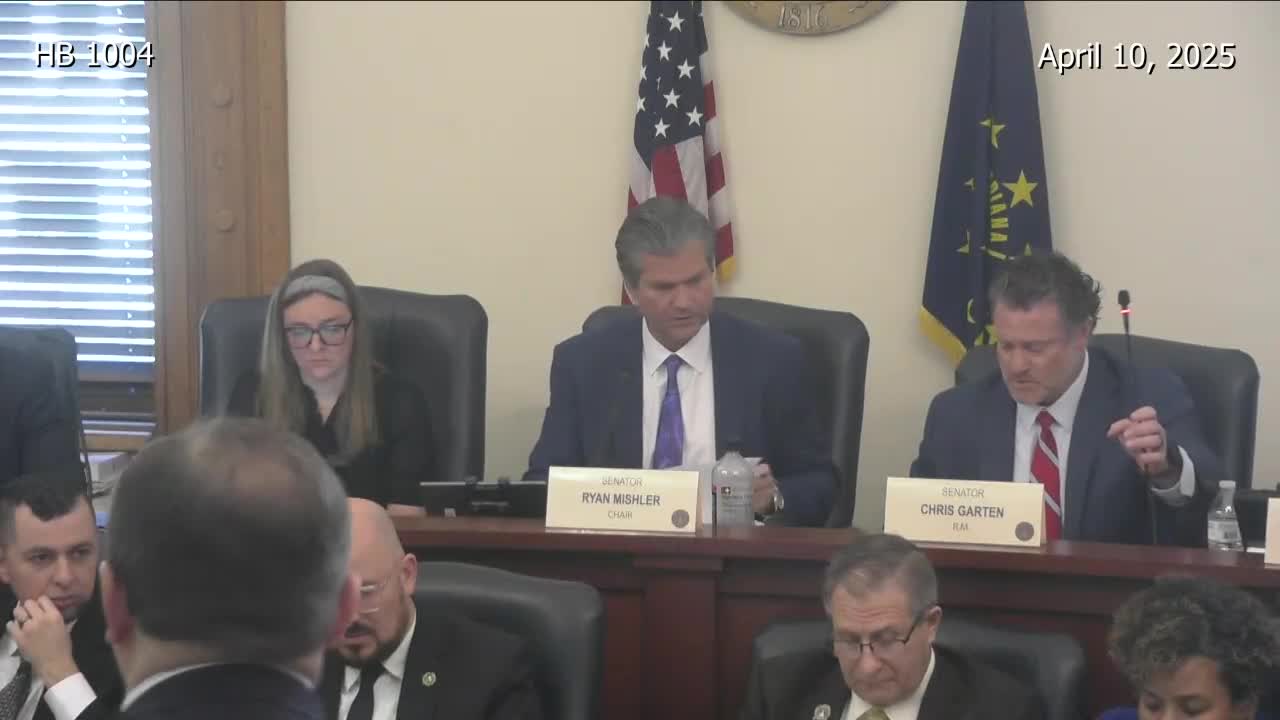
Committee backs hospital pricing package with phased freeze, a pricing study and language to return assessment dollars to hospitals
Summary
The Senate committee advanced an amended bill that freezes hospital prices for two years while the state conducts a pricing study and sets a later benchmark; sponsors said the phased approach balances cost control and protections for rural providers.
(Note: This article covers a lengthy committee discussion of House Bill 1004 and its amendment. Below is an edited, neutral summary of committee testimony, amendments and the committee’s vote.)
The Senate Appropriations Committee considered and advanced an amended House Bill 1004 that packages multiple changes aimed at reducing health‑care costs and redirecting hospital assessment revenues. Sponsors described a phased approach: a temporary price freeze, a state‑commissioned hospital pricing study, and a later reference‑based benchmark (placeholder figure cited in committee) with escalating penalties for repeat exceedances. The committee took amendment 8 by consent and passed the amended bill 9–4.
Why it matters: supporters said the bill offers a coordinated way to lower commercial hospital prices, restore some assessment dollars (the hospital assessment fee, or HAF) to draw down federal matching money, and allow hospitals to negotiate separately for Medicare Advantage. Opponents warned the policy could be destabilizing for hospitals — especially rural providers — if price caps or enforcement mechanics do not account for local cost pressures.
Core elements discussed
Two‑year freeze and pricing study: The amendment institutes a two‑year price freeze for covered hospital systems while the state Office of Management and Budget (OMB) completes a study (due in committee language by mid‑2026) intended to produce a reliable benchmark for pricing. Sponsor testimony emphasized that the early freeze buys time to create data the legislature and stakeholders can trust.
Reference benchmark and penalties: The amended language includes a placeholder reference number (discussed in committee as 270% of Medicare rates in current draft material) as a possible long‑term benchmark; sponsors said that number is provisional and that the properly scoped OMB study would inform the final benchmark. Penalties for exceeding the eventual benchmark would escalate over time (100% of overage then higher percentages for repeat exceedances in later years), with a multi‑year runway before the most severe remedies take effect.
Alternative compliance path: hospitals that reduce aggregate prices by a fixed annual percentage (committee discussion noted 6% as an example) would avoid penalties. Sponsors presented this as a compliance pathway that avoids hard single‑service caps and provides an incremental path to the benchmark.
Return of assessment revenue and distribution mechanics: sponsors proposed returning hospital assessment administrative dollars (cited in committee as approximately $300,000,000 the hospitals receive as part of the hospital assessment mechanism) back into a hospital fund to be used for Medicaid, workforce and rural health investments — contingent on federal approval of matching arrangements (MCAF modeling was discussed). The amendment included “may” language to provide flexibility in distribution models and included a potential weighted distribution to favor rural hospitals.
Decoupling Medicare Advantage from commercial contracts: the amendment directs contracts to allow separate negotiation of Medicare Advantage rates and commercial rates, a change hospitals requested to reduce cross‑subsidization pressures.
Committee concerns and tradeoffs
Rural hospital risk: Several senators expressed concern that marketwide benchmarks or penalties could unintentionally harm rural hospitals that have smaller volumes, different payer mixes, and higher per‑unit costs. Sponsors responded that weightings, the runway and the compliance path are meant to protect smaller systems and that returning assessment dollars could strengthen rural hospitals’ finances.
Employer direct contracting and narrow networks: amendment language includes provisions encouraging hospitals to offer direct‑to‑employer and narrow network pricing (example ceiling noted in committee language, again as a hospital‑requested approach), but sponsors said technical corrections may be needed to ensure inpatient, outpatient and facility fees are treated consistently.
HOF/MCAF technicalities and federal uncertainty: committee discussion acknowledged that federal approval for some mechanisms (MCAF/HOF changes) is uncertain; several senators requested clearer statutory triggers and contingency language. Sponsors said they built trigger language to guard the state’s structural surplus if federal match levels differ from forecasts.
Action and vote
- Amendment 8 (substantive package described above) was taken by consent; committee subsequently voted to advance the amended bill by a recorded vote of 9–4.
Speakers and quoted material
- Senator Garten (sponsor): explained the phased approach and repeatedly emphasized collaboration with hospitals and stakeholders and that the placeholder benchmark “is strictly a placeholder” that would be refined by a state pricing study. - Senator Brown (critic): warned of implementation risks for ambulatory and outpatient shifts and said the bill, as drafted, could expose hospitals to enforcement or financial risk if the aggregate benchmark and service accounting do not credit site‑neutral or outpatient moves.
Authorities and administrative notes
- OMB (Office of Management and Budget) — directed in amendment language to house the hospital pricing study and compile data to set benchmarks; referenced_by: ["hb1004-hospital-pricing-halting-fees-and-mcaf"] - HAF / hospital assessment fee and MCAF modeling — financing mechanisms discussed as key to returning funds to hospitals and drawing federal match; referenced_by: ["hb1004-hospital-pricing-halting-fees-and-mcaf"]
Actions
- {"kind":"motion","motion":"Adopt amendment 8 (hospital pricing package with freeze, study and distribution mechanics)","mover":"Senator Garten","second":"consent","vote_record":[],"tally":{"yes":(consent),"no":0},"outcome":"approved","notes":"Taken by consent; establishes study and phased compliance approach."}
- {"kind":"other","motion":"Committee passage of amended House Bill 1004","mover":"Chairman Micheler","second":"not specified","vote_record":[],"tally":{"yes":9,"no":4},"outcome":"approved","notes":"Bill advances to Senate floor for further consideration."}
Discussion/decision separation
- Discussion only: numerous technical questions about how to allocate returned assessment dollars, how to treat outpatient/ambulatory site changes in the benchmark, and how to insulate rural hospitals. - Direction: OMB directed (in bill language) to complete a pricing study; sponsors committed to continued stakeholder work to adjust technical language before final action. - Decision: amendment 8 accepted by consent; bill advanced in committee 9–4.
Clarifying details
- Pricing study deadline (as represented in committee): study to be completed by 06/30/2026 (committee language cited). - Placeholder benchmark: 270% of Medicare cited in committee as a placeholder to be revised after the study. - Compliance pathway: hospitals may avoid penalties by reducing aggregate prices on a multiyear schedule (example 6% annual reduction cited in committee discussion).
Searchable tags:["hospital_pricing","pricing_study","HAF","MCAF","medicare_advantage","rural_health"]
Provenance:{"transcript_segments":[{"block_id":"t5833","local_start":0,"local_end":480,"evidence_excerpt":"Sure. Yeah. Mr. Chair, I've got Amendment 8. Would you like to take that first? ... Speak to Amendment 8.","global_start":5833,"global_end":6313,"reason_code":"topicintro"},{"block_id":"t8080","local_start":0,"local_end":160,"evidence_excerpt":"Bill passes 9 to 4.","global_start":8078,"global_end":8238,"reason_code":"topicfinish"}]}
salience:{"overall":0.87,"overall_justification":"Major health sector policy with multi‑year compliance mechanics, potential fiscal effects and rural hospital implications.","impact_scope":"state","impact_scope_justification":"Applies to hospital contracts, insurer payments and Medicaid match mechanisms in the state.","attention_level":"high","attention_level_justification":"Lengthy committee debate and multi‑stakeholder technical issues.","novelty":0.70,"novelty_justification":"New enforcement and distribution mechanics combined with study‑driven benchmark are novel in combination.","timeliness_urgency":0.80,"timeliness_urgency_justification":"Study and phased rules require near‑term agency action and legislative follow‑up."}