Get Full Government Meeting Transcripts, Videos, & Alerts Forever!
Get email alerts on the Veterans Services topic
No spam. Unsubscribe anytime.
House committee approves bill to standardize accreditation and oversight for county veteran service officers
Summary
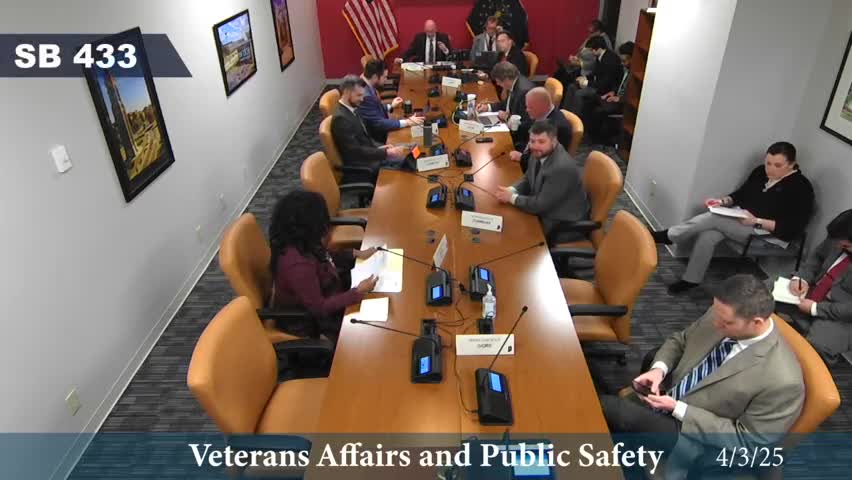
The Indiana House Veterans Affairs Committee voted to pass Senate Bill 433 as amended, a measure that would authorize the director of the Indiana Department of Veterans Affairs to create and oversee a certification and accreditation program for county veteran service officers and require biannual public progress meetings, committee members and witnesses said.
The Indiana House Veterans Affairs Committee voted to pass Senate Bill 433 as amended, a measure that would authorize the director of the Indiana Department of Veterans Affairs to create and oversee a certification and accreditation program for county veteran service officers and require biannual public progress meetings, committee members and witnesses said.
Supporters said the bill aims to raise and standardize training for county veteran service officers so veterans across Indiana receive consistent, accredited assistance with federal benefits claims. Senator Scott Baldwin, the bill—s sponsor, told the committee the measure "is aimed at providing support for veterans by making sure that we have a qualified cadre of veteran service officers." Baldwin also described the bill as a vehicle for the department director to "oversee the training and accreditation of service officers."
Why it matters: County veteran service officers (VSOs) help veterans with benefits and related services. Witnesses and the bill—s sponsor said standardizing accreditation and public reporting could reduce predatory practices and increase the quality of representation, especially in counties with fewer resources.
The amended bill directs the IDVA director to establish a certification/accreditation program for county VSOs and expands the department's authority to supervise administrative and technical functions tied to that program. Amendment No. 4, which the committee adopted by consent, requires biannual public meetings so county officials and the public can review progress; Amendment No. 6 applied technical corrections submitted by the department.
Testimony and concerns: Jim Byerly, representing the Military Veterans Coalition of Indiana, said the organization remained neutral and urged changes to language that he said could be read as returning day-to-day supervision of county employees to the state. Byerly told the panel that the bill—s current supervision language "is a very dramatic change to the current law" and warned it could re-create legal exposure for the state by inviting disputes with counties over supervisory authority. He also noted a conflict between language in SB 433 and a separate measure, House Bill 1235, over eligibility tied to military separation codes.
Byerly and other witnesses pointed to several specific concerns and ambiguities captured in the bill text: an apparent conflict between a 30-day accreditation requirement and another clause that allows a year to obtain accreditation; unclear enforcement mechanisms for noncompliance; and department approval requirements when counties seek to share VSOs across jurisdictions. Byerly also raised workforce and funding concerns, citing a persistent turnover problem among county VSOs: "we lose about 9 to 10 county veteran service officers every year," he said, and noted a 2017 summer study recommending about 5,000 veterans per VSO as a target caseload.
Other testimony: Judy King, representing the Veterans of Foreign Wars Department of Indiana, testified in full support and described federal accreditation rules (cited in testimony as "38 chapter 59") as a key protection for veterans. King said the VFW can provide cross-accreditation and that some counties can complete VFW accreditation in as little as a week. Alex Dobson, president of the Indiana Veterans Service Officers Association and Steuben County VSO, said he moved his group—s position from neutral to support and urged raising standards statewide. Chris Glumski, vice president of the IVSOA, described cross-accreditation practices and characterized the bill as an opportunity for consistency, collaboration and accountability.
Jake Adams, director of the Indiana Department of Veterans Affairs, backed the bill as a "launching pad to reform how we deliver services to veterans in the community," saying in his first weeks on the job he found the system needed change. "If they're not connected to benefits and health care, they're at a higher risk for suicide," Adams said, arguing the bill would give the department latitude to improve outreach and eligibility assistance.
Vote and next steps: The committee passed Senate Bill 433 as amended; the committee clerk recorded the result as "Bill passes as amended 12." The committee did not record any no votes in the transcript.
Context and unresolved issues: Several witnesses asked for clearer statutory language on supervision vs. direction, explicit enforcement steps for counties that do not comply, and reconciliation with House Bill 1235 on discharge-code eligibility. Witnesses also urged further study of staffing levels and compensation to reduce turnover. The bill as amended creates a state-level accreditation process but leaves county hiring and compensation authority with local governments.
Looking ahead: The IDVA director and stakeholder groups signaled willingness to work with counties on implementation and training standards. Affected counties, veterans organizations and the department will likely negotiate details as the measure moves through the legislature.