Get Full Government Meeting Transcripts, Videos, & Alerts Forever!
Get email alerts on the Emerald Ash Borer topic
No spam. Unsubscribe anytime.
Minnesota Department of Agriculture: emerald ash borer confirmed in 54 counties; new quarantines and guidance announced
Summary
At an MDA informational webinar, entomologist Jonathan Ostes summarized emerald ash borer biology, confirmed new detections this winter in Aitkin, Pine and Virginia, and described quarantine rules, treatments and reporting channels for residents and municipalities.
Jonathan Ostes of the Minnesota Department of Agriculture told listeners that emerald ash borer (EAB) infestations are now confirmed in 54 Minnesota counties and described new detections this winter in Aitkin County, Pine County and in Virginia, Minnesota.
Ostes said the infestations discovered this winter include trees found near a timber sale in Malmo Township, Aitkin County; two locations east of Willow River in northern Pine County; and eight trees near the eastern entrance to Mesabi Community College in Virginia. He urged landowners and municipal staff to check the MDA status map, which the department updates nightly, and to begin planning for tree management where EAB is nearby.
The nut of Ostes’s message was practical: EAB can be cryptic for years but spreads rapidly once established, and human-assisted movement of infested wood—especially firewood—remains a major pathway for long-distance jumps. “It’s a good idea just to buy firewood where you’re going to burn it,” Ostes said during the webinar.
Why this matters: Minnesota has a large ash resource and high local reliance on ash in urban and forested settings. Ostes said the state has “over a billion” ash trees and that, on average, ash accounts for about one in five trees in many communities; in some places in western and northern Minnesota ash can be one in two or three trees. Once EAB populations explode locally, Ostes said communities often face large-scale tree mortality over a short period and limited capacity to remove hazardous trees.
What MDA described at the webinar
Distribution and recent finds: MDA’s map shows the state’s quarantine boundaries and a “generally infested area” polygon (a buffered area around confirmed trees). Ostes noted that EAB’s natural spread averages about 1–2 miles per year but that human-assisted movement (for example, moving cut firewood) causes long-distance jumps. He described the three detections this winter and said there are likely additional, as-yet-unconfirmed infestations near those discovery sites.
Quarantine rules and regulated material: MDA maintains both intrastate (“internal”) and external quarantines. Regulated articles include any ash material, any EAB life stage found in wood, ash mulch and all hardwood firewood defined as hardwood cut to 4 feet or less (split or not). Key points Ostes emphasized: - Material may not be moved from a quarantine area to a non-quarantine area except under a MDA compliance agreement that specifies treatment or mitigation steps. - Material may transit a quarantine county if origin and destination are non-quarantine, but such loads may not be left overnight while carrying regulated material. - Regulated material can move freely within a contiguous quarantined area and may be brought into a quarantine area from an unquarantined area, but once inside it is regulated.
Compliance and treatment options for regulated wood include chipping or grinding to roughly 1"×1" pieces, complete debarking with removal of half an inch of sapwood, specified composting regimes, heat treatment (MDA cited certified firms that heat wood to 140°F for 60 minutes), kiln drying for some lumber uses, and fumigation. Ostes said about a dozen companies in Minnesota are certified for heat-treatment firewood sales.
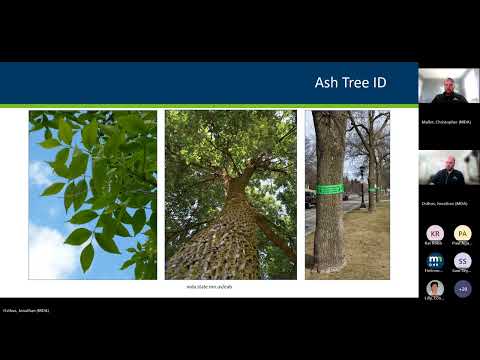
Recognizing EAB and surveillance guidance: Ostes reviewed life cycle, typical signs and symptoms (S-shaped larval galleries under bark, D-shaped adult exit holes, woodpecker blonding and small oval holes, bark splits, canopy thinning and epicormic sprouting). He recommended early-season canopy inspections (binoculars are useful), branch sampling for first-year infestations, and that people report suspected new infestations to MDA via the department’s Report a Pest form, by email or phone, to local city or county foresters, or through EDDMapS.
Management options for trees and communities: Ostes framed management around three broad approaches—pre-emptive removals, targeted removals (trees showing woodpecker damage or poor condition), and insecticide treatments. Key technical details provided: - Treatable insecticides: trunk-injected emamectin benzoate (a restricted-use pesticide applied by licensed applicators; commonly effective for two years and sometimes shows activity into a third year) and systemic products applied as soil drenches (neonicotinoid active ingredients) that typically require annual reapplication. Ostes recommended professional application for large trees; homeowner products may be unsuitable for trees over roughly 12–15 inches trunk diameter. - Cost guidance: MDA reported typical treatment costs roughly $10–$12 per diameter inch (for example, a 15-inch-diameter tree might cost ~$150 per treatment cycle). Treatments must be reapplied on a manufacturer-recommended schedule. - Treatability threshold: Ostes said a commonly used rule of thumb is that trees with up to about 30% canopy decline may still be candidates for treatment; beyond that their ability to move systemic insecticide is likely too limited.
Priorities by stage: In uninfested areas MDA recommended inventorying ash resources and preparing management plans. Where EAB has been found, the department prioritizes treating high‑value trees and sanitation removals (removing known-infested trees and disposing of material safely). When mass mortality occurs, minimizing wood movement out of the area and using safe local disposal or certified processing is the priority.
Reporting and local assistance: Ostes listed reporting avenues (MDA online report, email, phone, EDDMapS, local foresters) and urged detailed photos and precise locations for follow-up. He pointed to additional resources and assistance programs: DNR Forest Stewardship and DNR Community and Urban Forestry (cost-share and grant opportunities), University of Minnesota Extension planting guidance, and local financial assistance programs in some cities and counties for homeowners with low incomes.
Questions from webinar participants included whether treatments can be stopped after local EAB mortality (Ostes said no—treated trees will need continued treatment to remain protected), existing and forthcoming grants for community assistance (Ostes pointed to DNR grant cycles and the Minnesota Shade Tree Advisory Committee newsletter as a funding-information source), and why specific counties were or were not included in the quarantine polygon (boundaries are drawn close to known infestations and change after new confirmed reports).
What the department asked people to do: report suspected infestations with photos and exact location, avoid moving firewood long distances, buy firewood where you’ll burn it, and consult the MDA EAB status map and published resources for details on quarantine boundaries and compliance agreements. Ostes closed by noting the webinar would be posted to MDA’s YouTube channel and encouraging sharing of the recording.
Ending note: The presentation emphasized surveillance, reporting, and adherence to quarantine rules to slow human-assisted spread, and provided concrete treatment and disposal options for landowners and community managers.