Get Full Government Meeting Transcripts, Videos, & Alerts Forever!
Get email alerts on the Rezoning Data Center topic
No spam. Unsubscribe anytime.
Kosciusko APC recommends denying rezoning for proposed 554‑acre data‑center site
Summary
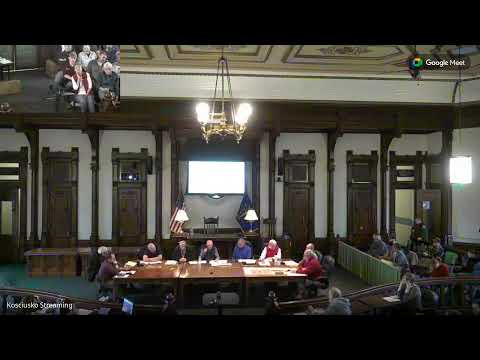
The Kosciusko County Area Plan Commission on April (regular meeting) recommended that County Commissioners deny a petition to rezone about 554 acres along County Road 700 North from agricultural to Industrial‑3 for a proposed hyperscale data center.
The Kosciusko County Area Plan Commission on April (regular meeting) recommended that County Commissioners deny a petition to rezone about 554 acres along County Road 700 North from agricultural to Industrial‑3 for a proposed hyperscale data center.
The recommendation, made during the commission’s April meeting and approved unanimously by members present, follows hours of testimony from the petitioner’s representatives and more than 40 members of the public. The commission’s recommendation is advisory and will be transmitted to the Kosciusko County Commissioners for a final decision at their April 22 meeting at 9:15 a.m. in the same room.
Why it matters: The petitioner sought to change district zoning to I‑3 — the county district that permits large, intensive industrial uses — but offered a voluntary condition limiting development on the site to a “data center” as defined in county ordinance. Supporters said the site is uniquely sited for a data center because three 345 kV transmission lines and a switching station converge there, and they presented projections for tax revenue, jobs and limited ongoing water use. Opponents argued the rezoning would amount to spot zoning that conflicts with the Kosciusko County Comprehensive Plan and would permanently remove productive farmland, harm local water and traffic systems and reduce neighbors’ quality of life.
Petitioner presentation and infrastructure claims: Steve Schneider, attorney for the petitioner, said the developer’s voluntary condition would limit future development to a data center and explained technical features the petitioner says make the site suitable. Schneider presented site plans, a multi‑phase buildout that could include as many as 10 buildings, and an electrical map showing a three‑line transmission convergence on the parcel. He said the developer expects phased construction over many years and proposed that road and utility improvements be made by the developer during construction and restored or improved for county benefit afterward.
JC Webb of Prologis, the proposed developer, described data centers at a high level and said they are “intended to and, desire to be not seen” and aim to minimize interaction with surrounding neighborhoods. Dalton Kaley, director of business development for Kosciusko REMC, told commissioners the utility’s analysis found the project would not force rate increases or cause reliability declines for REMC members: “The addition of this to our community will not cause rate increases. In fact, it'll keep rates where they're at,” Kaley said, adding the site’s transmission convergence was unique and relocation would be costly and time‑consuming.
Schneider provided the commission with the petitioner’s written projections for water use and tax benefit. He said the full 10‑building buildout would consume about 40,000 gallons of water per day (about 15.6 million gallons per year) — mostly evaporative loss from closed‑loop cooling — and that agricultural irrigation on the tract historically used about 47,000,000 gallons per year. He also presented a conservative 20‑year tax‑revenue projection (assuming hypothetical abatements) that estimated first‑year tax revenue after abatement of roughly $2.45 million and cumulative increases in later years.
Public testimony and concerns: Dozens of residents, farmers and local organizations spoke in opposition. Common concerns included spot zoning, loss of prime farmland, long‑term water impacts, noise and lighting, road traffic during construction and operation, and doubts about projected job numbers and tax benefits. Jack Birch, representing multiple farms, warned the commission against creating an “island in the center of something that's completely incompatible,” saying the site sits amid highly productive agricultural land. Several speakers cited the Kosciusko County Comprehensive Plan and county zoning sections (including references to performance standards and light/noise controls) and urged the commission to prioritize farmland preservation.
Supporters included representatives of local economic development and business groups who said diversification, infrastructure investment and new tax base could benefit schools, roads and services. Peggy Friday, CEO of the Kosciusko County Economic Development Corporation, described the proposal as a potential long‑term investment for the county. Local developer Frank Levinson and others also spoke in favor of the project’s economic potential.
Commission discussion and vote: After closing public comment, commissioners discussed legal and planning factors, including consistency with the comprehensive plan and the risk of setting a precedent. One commissioner said the proposal raised concerns about “the camel’s nose under the tent” and the long‑term implications of rezoning prime farmland. A motion to deny the rezoning was made and seconded; commissioners voted to deny the petition by voice vote with no recorded opposing votes. The commission’s recommendation to deny will be forwarded to the County Commissioners for consideration on April 22, 2025.
What’s next: This recommendation is advisory; the County Commissioners will make the final zoning decision. If the commissioners choose differently and approve a rezoning, additional permits and reviews would be required — including any Board of Zoning Appeals reviews of exception uses and any development agreements the county negotiates.
Ending note: The meeting also included dozens of written remonstrances read into the record and sustained public turnout; commissioners said they had reviewed submitted letters prior to voting.