Get Full Government Meeting Transcripts, Videos, & Alerts Forever!
Get email alerts on the Budget topic
No spam. Unsubscribe anytime.
OCII approves $622.2 million budget for 2025–26, prioritizing affordable housing and infrastructure projects
Summary
The Commission on Community Investment and Infrastructure approved a $622.2 million budget for July 1, 2025–June 30, 2026, funding affordable housing, Mission Bay and Transbay infrastructure, and bond issuances; commissioners voted 5–0.
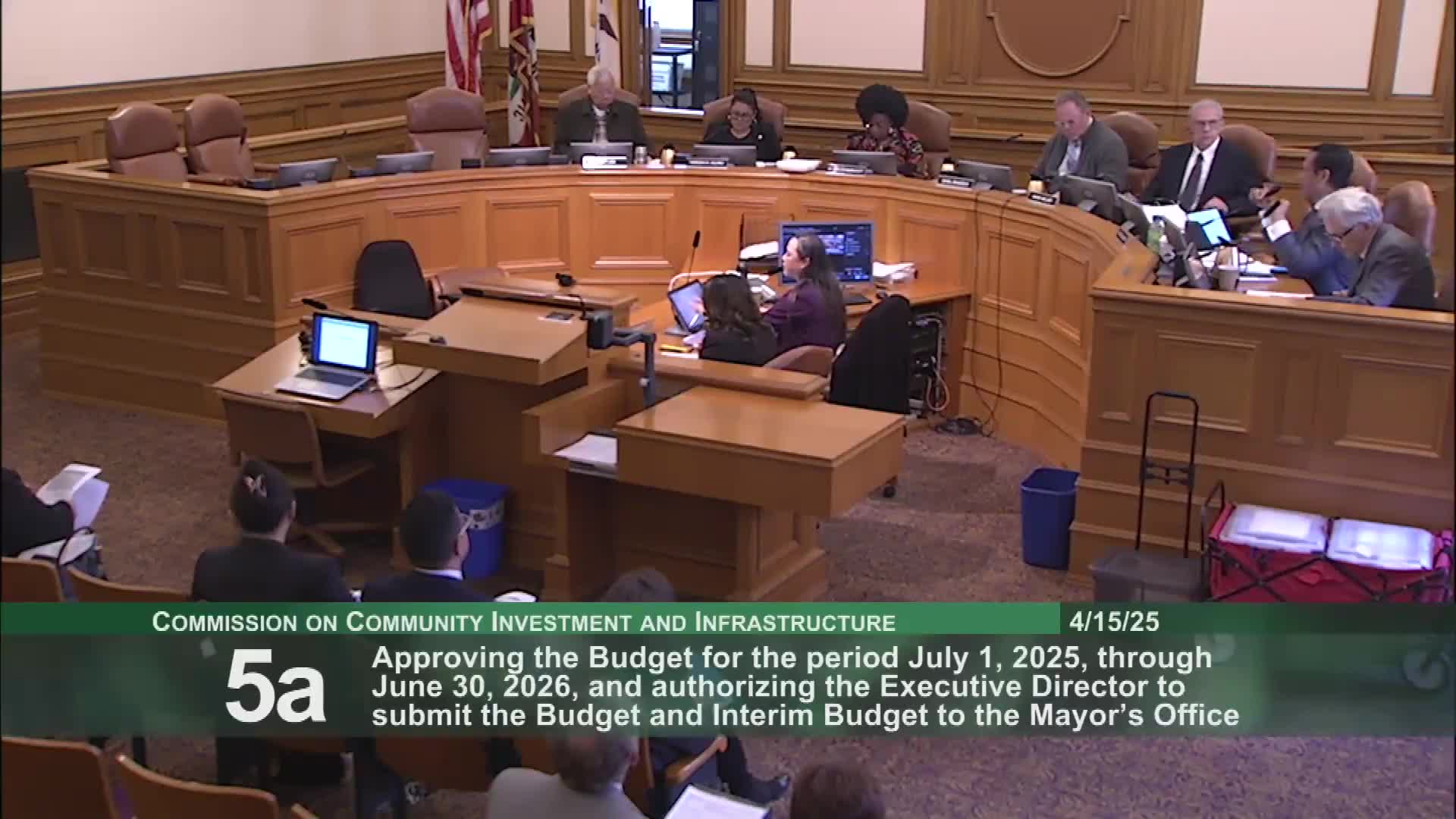
The Commission on Community Investment and Infrastructure on Tuesday approved a $622,200,000 budget for fiscal year 2025–26 and authorized the executive director to submit the budget and interim budget to the mayor's office and the Board of Supervisors.
The action, resolution number 4-2025, passed by a 5–0 vote after a staff presentation that summarized project spending across OCII's three project areas: Mission Bay, Transbay and Hunters Point Shipyard/Candlestick Point. Acting deputy director Mina Yu told commissioners, “So, our budget is $622,200,000,” and described the package as including affordable-housing loans, infrastructure construction and planned bond issuances.
Why it matters: OCII is the successor agency charged with carrying forward redevelopment-era obligations in these project areas. The budget guides bond sales, reimbursements to developers for infrastructure and the agency’s affordable-housing loan pipeline, and therefore shapes what housing and public-space work advances in the coming year.
Key figures and priorities - Total budget: $622,200,000, a year-over-year decrease of about $62,900,000. Staff attributed the decline primarily to changes and timing in the affordable housing project pipeline and ongoing drawdowns of prior-period authority. Mina Yu explained that prior-period authority (PPA) and bond proceeds make up large shares of the funding. - Affordable housing: About half of the budget is dedicated to affordable housing programs and loans; staff listed plans to execute two predevelopment loans, complete construction on Transbay Block 2 East and 2 West, and advance multiple Mission Bay affordable-housing blocks. - Infrastructure and parks: Mission Bay and Transbay infrastructure and park work remain major line items. Mission Bay’s budget (about $70 million for the program) will fund infrastructure such as streets and pump stations and planned new park construction. Transbay’s upcoming year includes an under-ramped park and continued Block 3 infrastructure work. - Bonds and debt: The agency is planning multiple bond issuances for affordable housing, Transbay infrastructure and Mission Bay South. Debt manager Nick Jones presented planned issuances and said property taxes are the principal source used to pay debt service; OCII projects roughly $85.8 million in property-tax-supported debt service in 2025–26. - Operating budget and staffing: OCII’s operating budget is roughly $20 million (about 3.2% of total). Staff costs are approximately $10.2 million, with a total authorized count of 55 full-time equivalents and 17 vacancies. The staff presentation included scheduled cost-of-living adjustments: a 2% increase in July 2025 and 1.5% in January 2026.
Project-area details presented to the commission - Mission Bay: Project manager Gretchen Heckman said the area is approaching completion with remaining open-space parcels and two affordable-housing focus blocks. Mission Bay will spend bond proceeds on infrastructure construction and use developer public-art fees for a new park artwork. - Transbay: Project manager Ben Brandon emphasized the redevelopment plan’s 35% affordability requirement for new housing and described predevelopment funding for Blocks 4 and 12 and a planned under-ramped park. He noted a $32 million property-tax pledge to the Transbay Joint Powers Authority (TJPA) that supports the region’s transit investments. - Hunters Point Shipyard/Candlestick: Senior project manager Lila Hussain described ongoing cleanup and parcel transfers from the Navy, the continued focus on permitting and plan review, and predevelopment work in Candlestick Point and Shipyard Phase 1 and 2.
Public comment and local-hire commitments During public comment, longtime Bayview resident Oscar James urged prioritizing “hyper local black contractors” and that certificate-of-preference holders receive preference on hiring. Chair Dr. Carolyn Ransom Scott responded in the meeting that staff and commissioners were working to ensure San Francisco residents are included in contracting and hiring on OCII projects, and multiple commissioners echoed the importance of neighborhood hiring.
Formal action and vote Vice Chair Vanessa Aquino moved approval of item 5(a) (the FY 2025–26 budget) and Commissioner Mark Miller seconded. The roll call vote was 5 ayes (Commissioners Lim, Miller, Shattuck, Vice Chair Aquino and Chair Scott). The commission’s action transmits the budget to the mayor’s office and the Board of Supervisors for their review.
What happens next OCII staff said bond sales and project-specific financing actions will follow this approval; when construction funding is requested for individual projects the commission will return with specific contract, bid and financing approvals. The budget presentation also noted that some projects’ spending shown in the budget is driven by multi-year bond proceeds and prior-period authority and that not all line-item amounts are expected to be spent in the single fiscal year.
End note The commission’s approval sets the agency’s financial blueprint for the year beginning July 1, 2025. Staff emphasized that the approved ROPS (recognized obligation payment schedule) had previously been reviewed by the oversight board and the State Department of Finance.