Get Full Government Meeting Transcripts, Videos, & Alerts Forever!
Get email alerts on the Public Space Civic Center topic
No spam. Unsubscribe anytime.
Planning Commission endorses Civic Center Public Realm Plan after years of outreach
Summary
The San Francisco Planning Commission unanimously endorsed the Civic Center Public Realm Plan, a framework for long-term improvements to Civic Center Plaza, Fulton Mall and UN Plaza that staff say responds to years of community input and aims to improve safety, activation and maintenance funding strategies.
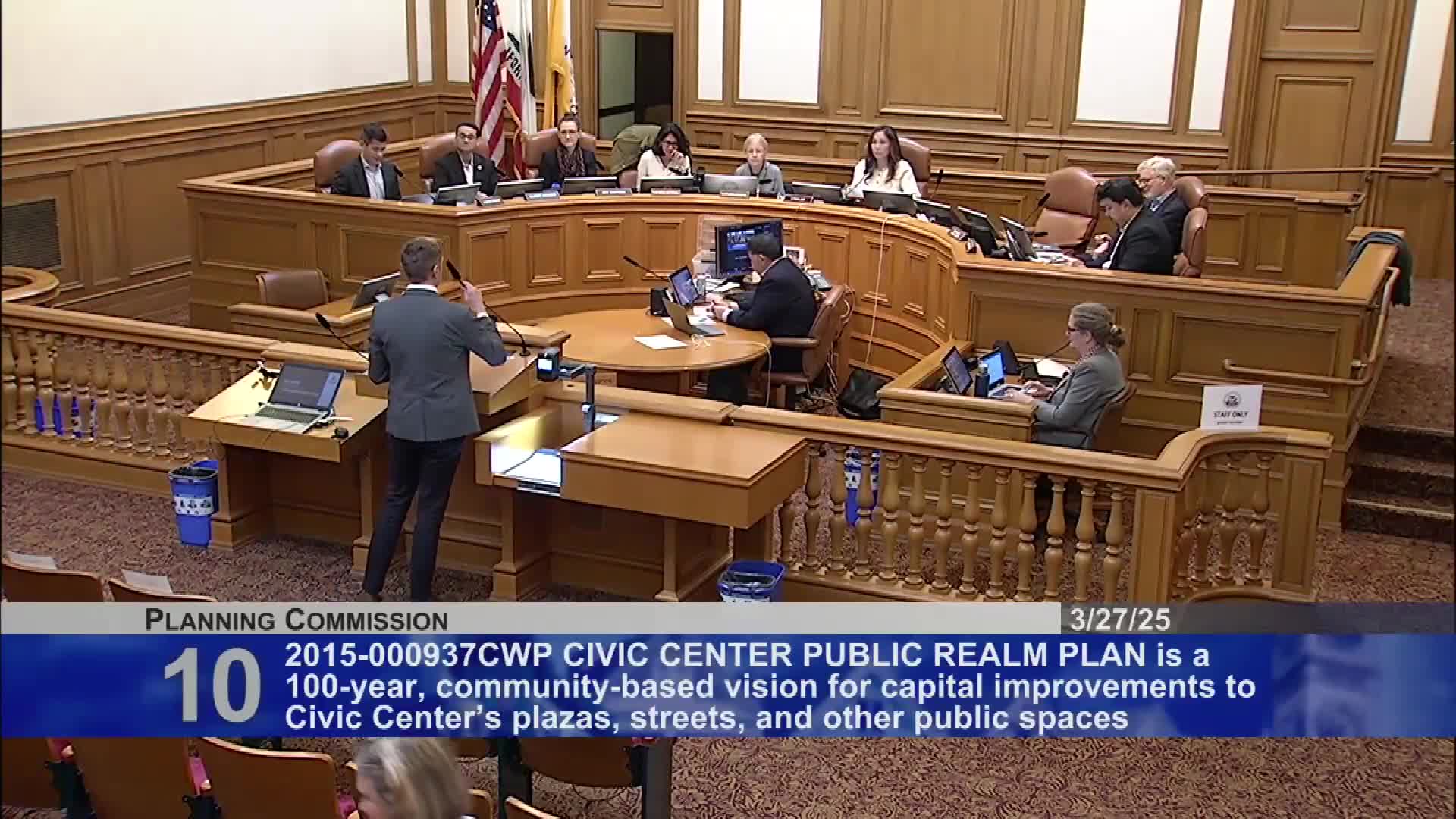
The San Francisco Planning Commission on March 27 endorsed the Civic Center Public Realm Plan, a long-running framework to remake the district around City Hall, UN Plaza and Fulton Mall into more human-scaled, activated public space.
Planning staff presented the plan as a neighborhood-driven framework built on seven public-space principles and more than 3,000 community interactions, including working groups and intercept surveys. “The Civic Center Public Realm Plan is a roadmap for creating a unified and inclusive public space that celebrates our shared history, fosters civic engagement, and enhances quality of life for everyone,” Planning Department staff member Patrick Race told commissioners.
The nut of the plan is threefold: restructure the oversized Civic Center Plaza into a combination of a large central gathering space and four smaller “rooms” for respite; reconfigure Fulton Mall for more flexible programming and improved connections to the Asian Art Museum and Main Library; and retain and adapt UN Plaza’s existing structure while adding more market and seating space and reworking the Halprin Fountain so it is less of a circulation obstacle.
Staff emphasized the plan is a long-range framework rather than a single construction package. The document includes an operations and maintenance strategy and suggests potential funding sources — grants, public–private partnerships and bonds — but does not commit specific dollars. Race said projects could advance as independent utility as funding becomes available, and that further community conversations will be part of implementation.
Public commenters, including longtime Civic Center advocate Jim Hass and representatives of the Civic Center Community Benefit District, endorsed the plan’s direction. Hass said the plan “takes the 1912 John Galen Howard plan for the public areas of Civic Center as a template” and adapts it for contemporary needs. Civic Center CBD and other groups praised recent near-term activations and urged that early, visible pilot projects accompany longer-term capital work.
Commission discussion noted the plan’s depth and outreach. Vice President Moore praised the project as “urban design at its best” and recommended appendix A for commissioners interested in the plan’s public-life analysis. Commissioners asked for a technical edit: staff proposed, and commissioners agreed, to add named references in the draft plan to other initiatives the Civic Center plan is intended to support, including the Tenderloin Community Action Plan, Golden Gate Greenway improvements, Safe Passage, Elm Alley and Dodge Alley improvements.
On a voice roll call, the commission voted to adopt a resolution endorsing the document with the proposed edits. The motion passed unanimously, 6–0.
The endorsement is framed as a milestone: it finalizes the planning document and signals the city’s intent to pursue implementation steps as funding and partnerships are identified. Staff said the plan is in the city’s capital plan and includes a phasing strategy to allow smaller, cost-effective early projects to move forward while larger items await financing or interagency agreements.