Get Full Government Meeting Transcripts, Videos, & Alerts Forever!
Get email alerts on the Special Education topic
No spam. Unsubscribe anytime.
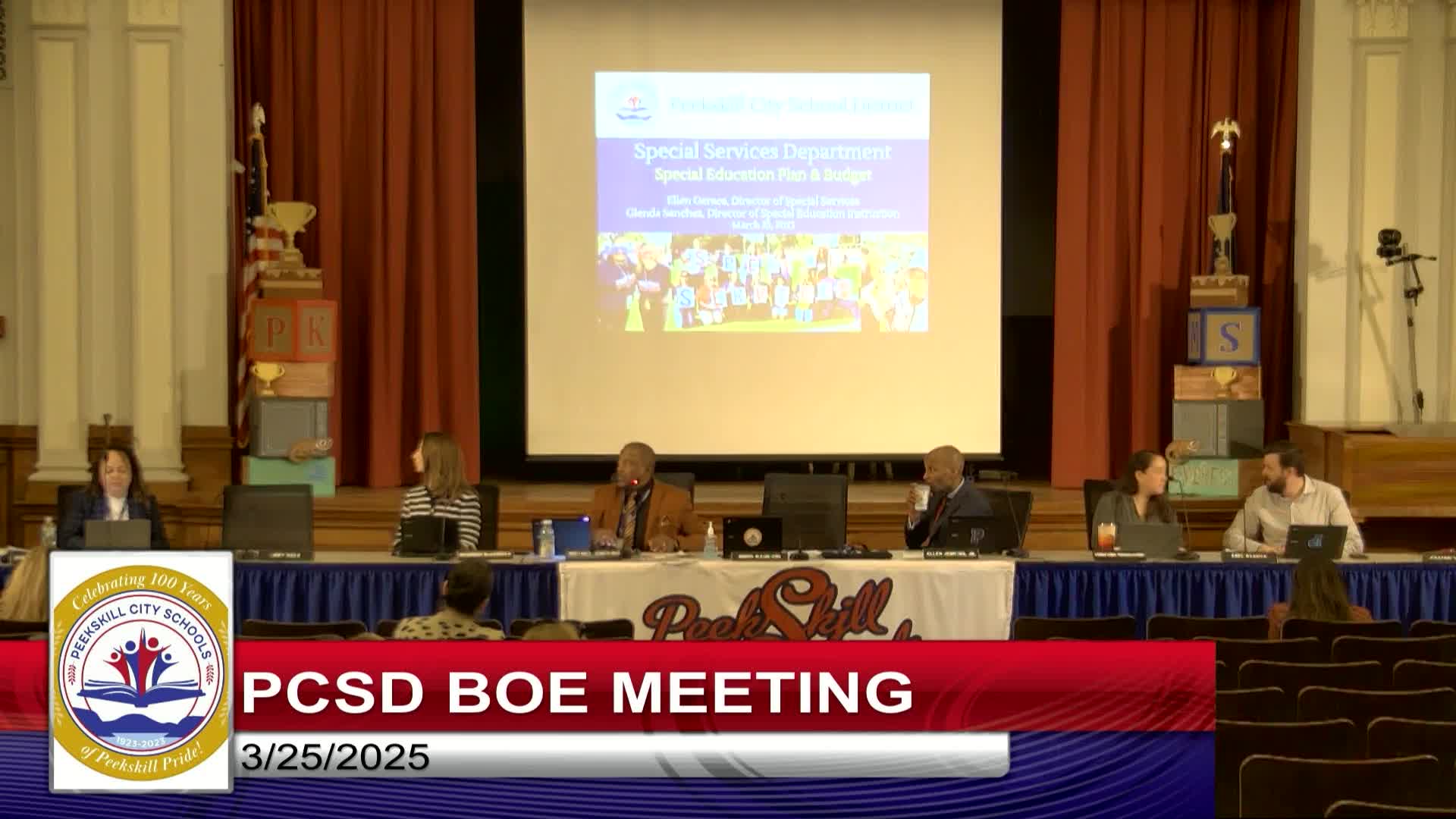
Peekskill Special Services outlines program growth and funding needs as enrollment rises
Summary
The district's Special Services department told the Board of Education it now serves about 634 students with Individualized Education Programs and about 858 students when 504 and preschool services are included, and presented proposed budget changes and new programs funded partly by grants and federal aid.
Ellen Duraiss, director of special services for the Peekskill City School District, told the Board of Education that the district currently serves about 634 students with Individualized Education Programs (IEPs) and roughly 858 students when 504 plans and county-run preschool special education are included.
Duraiss said the department is proposing budget adjustments for the 2025-26 school year to maintain expanding services, including moving two school social worker positions from federal American Rescue Plan (ARP) grants into the general fund and shifting some salary lines that were previously grant-funded. "So currently here are the numbers that of students that we currently serve. So as you can see, we have approximately 634 students district wide, kindergarten through twelfth grade, with individual education plans currently," Duraiss said.
The change responds to what Special Services described as steady enrollment growth and a modest rise in classification rates. Duraiss and Glenda Sanchez, who presented program-level details, said the department is seeing a larger share of students requiring therapeutic and medically intensive placements, driving increases in tuition and contracted-service lines. Duraiss said high-cost tuition and BOCES tuition are expected to rise roughly 6% to 8% depending on placements.
Why it matters: Special education services make up a substantial portion of district programming and budget. District leaders told the board that continued federal and state support plus internal budget shifts are needed to sustain recently added classrooms and clinical staff.
Key details
- Scope: Duraiss said the district has about 3,800 total students; IEP students are about 16% of enrollment. In addition to IEP students, the department serves roughly 104 students under Section 504 plans and about 120 preschool special education students served through the Westchester County Department of Health.
- Budget impact: The Special Services presentation identified two primary cost drivers for 2025-26: classified salaries (some positions previously paid with ARP funds) and increased contracted services to cover students placed outside the district. The department described a proposed increase of about 8% overall for its next-year spending to support programming.
- Funding sources: Duraiss said the district receives roughly $1 million annually from the federal Individuals with Disabilities Education Act (IDEA). The department also reported awarding a $2,200,000 two-year grant from the New York State Office of Mental Health to expand social-emotional learning (SEL) and mental health access.
- Staff and programming: Presenters noted about 150 special-education staff districtwide, including teachers, aides, related service providers and nurses. New and expanded programs highlighted in the presentation include: - RISE (Reaching Independence Through Skills in Education), a high-school program for ages 17-21 focused on employment readiness and independent living skills; the program operates a school coffee stand and community service activities. - A workforce-development partnership with Westchester Community College creating cohorts for RISE students, with the goal of certificates that support employment. - A pilot adaptive swim class (April 23'June 11) for neurodivergent students, limited to small cohorts and supported by trained volunteers and swim coaches. - New classroom models including a 12:1:2 transitional class at Woodside Elementary and therapeutic-support classes at Oakside; expanded co-teaching and ICT offerings K'12.
- Reported student outcomes: Presenters singled out a 15:1 class where four students posted improved New York State English Language Arts results (two scored Level 3; two scored Level 2). The district said external partners, including BOCES, have requested to film and share some classroom practice as a model.
- Family and community work: The department described SEPTO (Special Education Parent Teacher Organization) activities, Saturday Academy, transition workshops and a Family Resource Center that supports parents in transition planning.
Discussion and next steps
Board members asked clarifying questions about federal IDEA reimbursement and state aid for out-of-district placements; Duraiss and staff said high-cost aid typically reimburses a percentage of prior-year costs. The presentation was given as part of the district's budget series; district staff said specific staffing and spending changes will be folded into the board's overall 2025-26 budget proposal, to be presented for adoption in April.
Ending: The Special Services presentation concluded with board members and staff recognizing teachers and specialists; presenters asked the public to consider program outcomes and upcoming parent workshops and student events.