Get Full Government Meeting Transcripts, Videos, & Alerts Forever!
Get email alerts on the Transportation topic
No spam. Unsubscribe anytime.
Lancaster County council debates scaled transportation sales-tax proposal, timeline and priorities
Summary
Lancaster County Council heard a lengthy presentation and discussion April 8 on a proposed voter referendum for a transportation sales tax. Staff and the County Transportation Committee outlined two funding packages and differed on which major road projects to prioritize; councilmembers raised concerns about timing, project phasing and delivery.
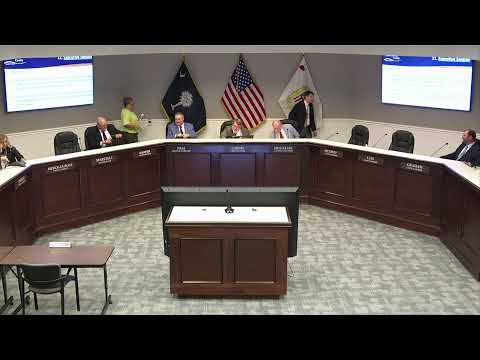
Lancaster County Council discussed a proposed transportation sales-tax referendum during its April 8 meeting, hearing a presentation from members of the County Transportation Committee and county staff about two recommended project packages and a possible timeline for placing the measure before voters.
The proposal under consideration would generate roughly $200 million–$250 million over a multi‑year collection period for county and municipal roadway projects, with large buckets proposed for improvements to the Highway 521 corridor, municipal and county road projects, and smaller allocations for roundabout/intersection work, greenways and sidewalks. The county’s transportation presenters — identified in the meeting as Mr. Kato and Mr. Marsden — said the committees had scaled an earlier $405 million plan down after council direction given at a February retreat.
The council discussion focused on three core concerns: whether to prioritize a large commitment to widening or improving Highway 521; how to phase projects so voters see measurable work early; and whether to pair a sales-tax question with a bonding component that would allow construction to begin before all revenue is collected.
"If we commit large sums to 521 and the work is years out, voters may feel they did not get timely results," said Councilman Graham during the discussion. Several council members urged more attention to relief projects off 521 — such as Henry Harris Road or Barbourville Road — that could provide shorter-term congestion relief while longer designs and state coordination for 521 proceed.
County staff explained the difference between the two proposals on the table. The County Transportation Committee’s recommendation included approximately $70 million aimed at Highway 521, $85 million for municipalities and county roads, and a total program near $216 million; staff’s version shifted some of that allocation to a larger miscellaneous/contingency line and added $2 million for greenways and sidewalks, while substituting Henry Harris Road for Barbourville in the priority list. Staff also noted that previous state and local funding streams (including Capital Sales Tax 3 and an earlier proviso) provide some dollars already programmed for road work. "The transportation sales tax is structured differently from a capital projects sales tax," staff said; it can be used to advance multiple projects in tandem rather than strictly in revenue order.
Multiple council members said they were reluctant to place a proposal on the November 2025 ballot because voters rejected a similar package in 2024 and because the county has limited staff time before the summer budget season. "The voters told us no last year and I don't know if I can support 12 months later," said Councilman Harper. Several members urged more public outreach and more refined project phasing before deciding the ballot timing, with at least one councilmember favoring a 2026 ballot to allow additional planning and public education.
Presenters and council members discussed using a bond component to accelerate work on priority projects (especially Highway 521) and the practical need to coordinate with the South Carolina Department of Transportation and the State Infrastructure Bank if the county expects the state to provide matching or leveraging funds. Staff and committee members also emphasized the need for a program manager or transportation planner to oversee prioritization, escalation risks, and design sequencing if the county approves a large program.
The meeting did not produce a final vote on whether to put the question on the 2025 ballot. Council requested further analysis and additional information; staff said they would return with more details. Several council members asked staff to continue stakeholder outreach and to prepare ordinance language and timelines that would allow council to act in May or June if it chooses to proceed.
Council concluded the discussion by directing staff to continue refinement and outreach; no binding action to place the measure on the ballot was taken during the April 8 meeting.