Get Full Government Meeting Transcripts, Videos, & Alerts Forever!
Get email alerts on the Pace Financing topic
No spam. Unsubscribe anytime.
Presentation urges Washtenaw County to renew commercial PACE participation to finance building upgrades
Summary
Andy Levin of Lean and Green Michigan described how Commercial Property Assessed Clean Energy (C-PACE) financing has funded energy, resiliency and hazard remediation projects across Michigan and asked Washtenaw County to reauthorize updated program language to reflect recent state statutory changes.
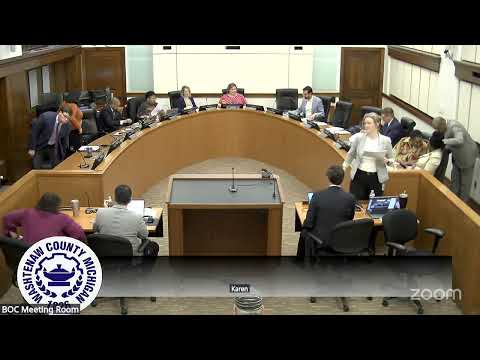
Andy Levin, founder and chief strategist of Lean and Green Michigan, briefed the Washtenaw County Board of Commissioners and the county’s environmental council on the state’s Commercial Property Assessed Clean Energy (C-PACE) program and urged the county to update its program documents to reflect statutory changes made at the state level.
Levin said C-PACE provides private capital to finance energy and resiliency upgrades for qualifying non‑residential properties and nonprofit buildings. He described the mechanism as a county-authorized tax assessment secured by private lenders: lenders can offer long-term, fixed-rate financing because the municipal assessment provides a senior, tax‑enforcement backed security if a property owner defaults.
Why it matters: Levin and supporters said updated PACE language would allow property owners to finance a wider range of projects — from energy efficiency and solar to lead-paint abatement, PFAS remediation and flood‑resilience measures — without using county general‑fund dollars. Proponents said PACE is market-driven, can support local jobs and works alongside other incentives and programs.
Program details and local context
Levin said Lean and Green Michigan administers a statewide program that currently covers dozens of municipalities and counties; he said it has supported projects ranging from hotels and repurposed warehouses to nonprofits and low-density storage facilities. Levin provided summary metrics for projects statewide and said the program has enabled hundreds of millions in private investment.
Commissioner and public discussion
Former commissioner Michelle Dietrich — introduced in the meeting as chair of the county environmental council — told the board the council voted to recommend that commissioners adopt amendments to the county’s PACE program to align with state law. Dietrich said the expanded scope, including environmental hazard work such as lead paint remediation, would “make our children healthier.” She called PACE “a win, win, win” for property owners, communities and climate goals.
Commissioners asked practical questions about how the program works for different property types. Commissioner Somerville asked how PACE could apply to large multi‑unit apartments and receiverships. Levin said Lean and Green Michigan has experience with “old hotels, apartment buildings, buildings that haven't been used for many years” and with new construction, and he encouraged early engagement between property owners, lenders and the program administrator.
Commissioner Ravi, who described having sponsored related legislation while in the legislature, asked how non‑energy projects such as lead abatement and stormwater resiliency are handled. Levin replied that the recent state changes permit projects that do not have to be cash‑flow positive (for example, hazard remediation) and that property owners may waive energy‑savings guarantees in some cases; lenders and credit providers still shape the capital stack for each transaction.
No formal board action was taken during the working session. Levin asked commissioners to consider a county resolution to reauthorize and align the county’s PACE program documents with recent state statutory changes; Levin said the administrator and the county’s economic development and resilience staff can partner to identify candidate county sites and projects.
Ending
Commissioners and staff expressed interest in exploring more PACE projects locally and in reaching out to regional economic developers and lenders. Levin offered his contact information and said Lean and Green Michigan will help local governments run the program if the county decides to adopt updated program documents. The board did not vote on a resolution in the session; Levin and environmental council members signaled they will follow up with staff for next steps.