
State budget gap forces delays, puts home visiting expansions and rate increases at risk
Get AI-powered insights, summaries, and transcripts
Subscribe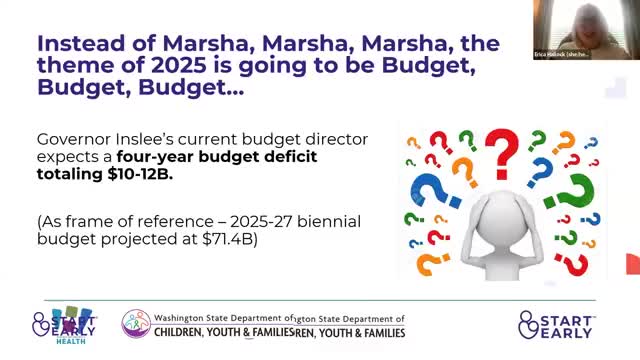
Summary
State and advocacy representatives told the Home Visiting Advisory Committee that Washington's projected multi‑year budget shortfall and the governor's proposed budget leave several home‑visiting items unfunded or delayed, including continued funding for 61‑09 slots and planned rate increases.
State and advocacy representatives said Washington’s deepening budget gap will affect home‑visiting programs and early learning expansions, after Governor‑elect Ferguson’s proposed budget aimed to close a multiyear shortfall with a mix of cuts and new revenue.
Mary Scruti Garland, senior policy adviser, Department of Children, Youth, and Families (DCYF), and Erica Hallock, director of policy at Start Early Washington, briefed the Home Visiting Advisory Committee (HVAC) on the fiscal outlook. “The theme of 2025 is going to certainly be the budget,” Hallock said. “It is projected over the 4 year to be anywhere from 10 to 12, and now we're even hearing up to $14,000,000,000.”
The budget pressure matters to home visiting because the governor’s proposal delays or reduces several statutory and programmatic expansions previously scheduled to begin in the next biennium, and does not continue one‑time funding streams the department used for expansion. Mary Scruti Garland said the governor’s proposal included both reductions and new revenue ideas, notably a proposed wealth tax, and that DCYF had not placed home visiting on its internal cut list: “Nothing in home visiting was included as in our potential cut list.”
Key details DCYF and advocates gave the committee: - Statewide gap: presenters described a projected multiyear gap of roughly $10–$14 billion against a projected 2025–27 biennial budget of about $71.5 billion. Hallock said collective bargaining costs negotiated this year add about nearly $3 billion to four‑year obligations. - Program delays and reductions: the governor’s proposal delays parts of the Fair Start for Kids implementation (including ECAP entitlement and steps in Working Connections child care eligibility and reimbursement) into later biennia (DCYF and advocates cited delays pushing some changes into the 2030–31 timeframe). - One‑time and opioid settlement funds: the governor’s draft drew down some home‑visiting underspend (about $400,000 in FY25) and did not continue funding for 61‑09 slots that had been supported with opioid settlement dollars; DCYF staff said the 61‑09 allocation had initially been one year of funding. - Administrative constraints: the governor issued a hiring, travel and contracts freeze for state agencies; DCYF said an exceptions process exists for essential work.
Advocates said the lack of funding for planned rate increases would undercut efforts to correct long‑standing payment inequities across implementing agencies. Hallock said advocates will continue to press the case for rate increases in the legislature even though the governor did not include them in his proposal.
How decisions will be made: the governor’s budget is an opening proposal; the Legislature will revise it. DCYF staff said they would evaluate the administration’s and Legislature’s proposals and continue to brief HVAC as the session proceeds. Representative appointments to cabinet posts were also noted: DCYF staff said Representative Tana Sen (as named in the briefing) will be appointed to lead the agency in mid‑January and that her prior roles in early learning and appropriations could shape legislative discussions.
Lawmakers begin the 2025 session with competing priorities across behavioral health, education, Medicaid, transportation and early learning; DCYF and advocates urged committee members to track proposals and expect further updates as revenue, cuts and agency lists evolve.
Ending: HVAC members were asked to remain engaged during the legislative session and to expect regular updates from DCYF and advocacy partners on how the budget process affects funding for expansion, rates and one‑time initiatives.