Get Full Government Meeting Transcripts, Videos, & Alerts Forever!
Get email alerts on the County Budget topic
No spam. Unsubscribe anytime.
Dorchester County councilors back framework for FY2026 budget, endorse tax and fee changes to cover $3.8M shortfall
Summary
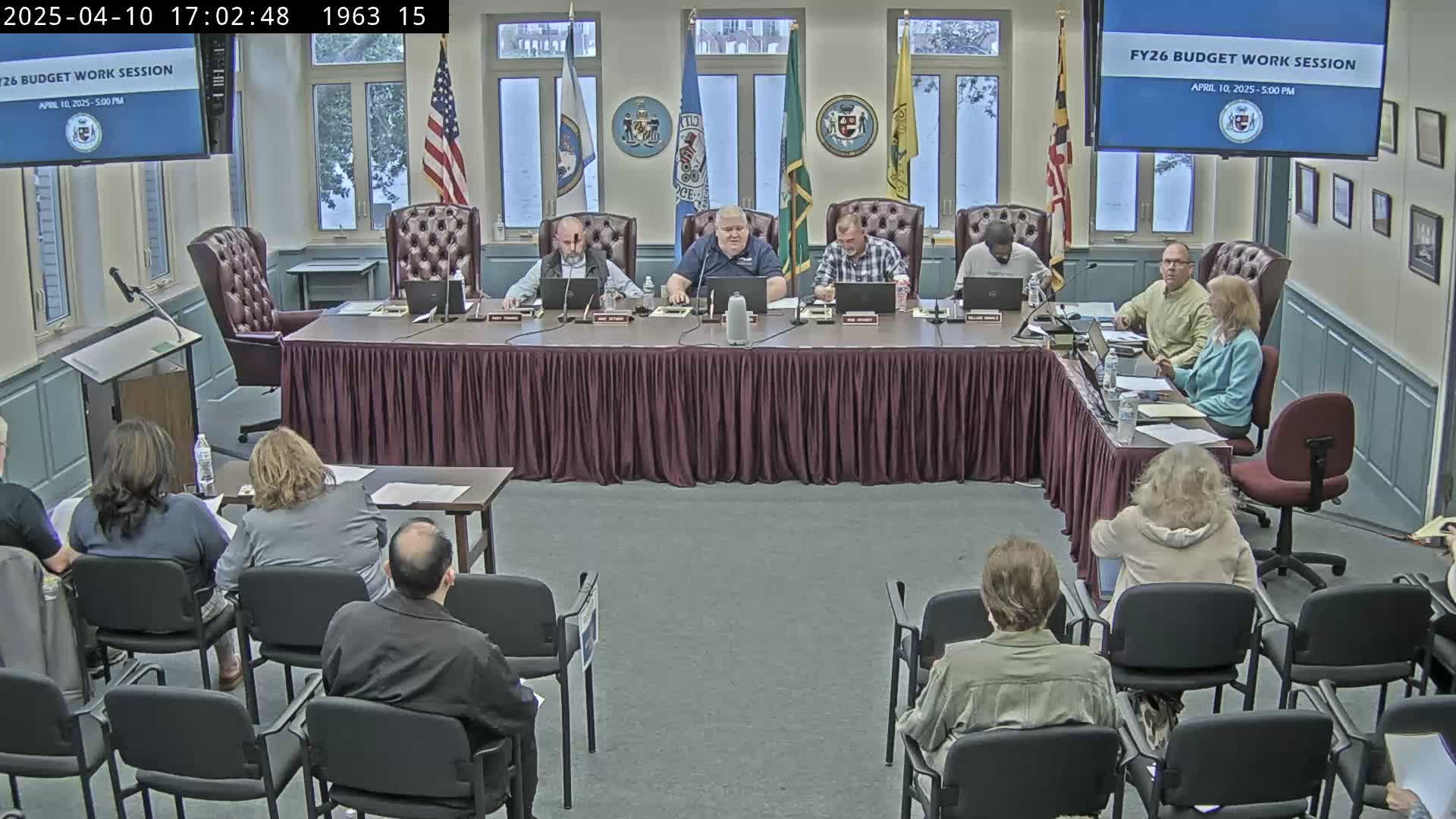
Dorchester County staff presented a proposed FY2026 budget framework in a council work session that relies on a mix of a local income tax increase, a proposed 9-1-1 fee hike, elimination of municipal tax differentials and a modest property tax increase to close an estimated $3.776 million deficit.
Dorchester County, Md. — County staff presented a proposed FY2026 budget framework at a council work session that combines a set of revenue increases and spending shifts intended to close an estimated $3,776,000 shortfall and keep the county on a balanced budget path.
"The goal here is to get to a balanced budget," said Mister Jones, a county staff presenter, describing the need to monitor state and federal developments that affect local revenues. Staff estimates that a one-cent change in the property tax rate produces about $340,000 in revenue; without other offsets the shortfall would have required roughly a 12-cent increase in the property tax rate.
Councilors and staff outlined a package of deficit-reduction measures that together reduce the county's required property tax increase to roughly 3 cents (from the baseline 12 cents): raising the county's local income tax rate from 3.2% to 3.3% (estimated $600,000 revenue), proposing an increase to the 9-1-1 fee from $2.00 to $4.25 (estimated roughly $1,000,000 additional revenue), eliminating municipal tax differentials (estimated $1,140,000), and keeping $137,000 in recommended nonprofit funding requests under review. Taken together, staff said, these items would produce the revenue mix that supports a 3% overall property-tax impact in the proposed budget (a county rate moving from $1.00 to $1.03 per $100 of assessed value as presented to the council).
The proposal includes these notable details and clarifications provided in the work session:
- Deficit and tax math: Staff calculated a $3,776,000 deficit. At the stated assumption ($340,000 per one-cent property tax change), closing the gap without other revenue would have required a 12-cent increase; combined measures reduce that to about 3 cents. Using a median home value of $300,000, staff said each cent equals about $30 per year for that median house; a 3-cent change would be about $90 annually on that example home.
- Local income tax and disparity grant risk: Staff said raising the local income tax rate to 3.3% is intended both to offset a state-level income tax revenue reduction and to preserve the county's eligibility for the state's disparity grant. Staff estimated the 0.1-point income tax increase would yield roughly $600,000 for the county, and warned that failing to remain at the maximum locally allowed rate could reduce the disparity grant by "hundreds of thousands of dollars" (staff said the county's current disparity grant is about $4.1 million).
- 9-1-1 fee: Staff proposed increasing the 9-1-1 fee from $2.00 to $4.25. The county estimated the increase would generate roughly $1,000,000. Council members emphasized that funds raised by the fee are earmarked for public safety/9-1-1 infrastructure and personnel, not the general fund.
- Municipal differentials and nonprofit requests: Eliminating municipal tax differentials was presented as a revenue source that would yield about $1,134,000. Staff also presented six community partner funding requests totaling approximately $137,000; councilors left those line items in the proposed budget but signaled they would be examined again during public hearings.
- Capital and roads: The capital request was pared back from earlier drafts. Staff reported recommended capital spending of about $1.68 million (having removed several large items including a previously discussed $40 million public-safety building) and proposed shifting remaining capital savings toward road repairs. Staff estimated roughly $2.5 million would cover about 9 miles of asphalt overlay plus 35 miles of tar-and-chip work in prioritized locations; a quoted estimate for repaving 3.4 miles (Indian Town) was $465,000. Staff reported roughly 67 miles of roads in poor condition under current assessment.
- Causeway and federal funding: Staff said the county had been pursuing federal technical assistance under a program that was canceled by the federal government; FEMA had toured local sites, including the causeway, in January. Councilors noted ongoing discussions with the U.S. Army Corps of Engineers to assess the causeway and bridge before major capital decisions are made.
- Fleet and public-safety equipment: Council discussed leasing versus capital purchase for sheriff's vehicles and other county fleet assets. Staff said two ambulances already budgeted are expected in August and September and a third unit budgeted in the capital plan is on a manufacturer's delivery schedule about three years out. Council also agreed to include a proposed 3% cost-of-living increase for county employees (staff noted the state is offering roughly the same increase) and to propose a $2,500 per fire company supplement for the county's 14 volunteer departments (about $35,000 total).
What council did and next steps
The council did not adopt a final budget at the session; the meeting was a work session to provide staff direction. Councilors gave staff general concurrence to move the draft budget package forward for formal introduction and public hearings in May, to pursue an extension of the state's waiver/submission window for certain education-funding calculations, and to revisit community partner requests during public hearings. Several council members said they wanted the municipal differential elimination included in the introduced budget; others noted the effect on municipal residents and encouraged outreach to affected municipalities ahead of hearings.
Staff and council repeatedly stressed that many elements depend on final state and federal actions. Mister Jones urged quarterly monitoring of the budget once adopted, saying staff expects ongoing uncertainty from recent legislation and possible special sessions at the state level.
Public comment at the end of the session included local residents urging scrutiny of the state Blueprint implementation and urging continued public engagement during the upcoming budget hearings.
The council scheduled formal introduction and public hearings for the proposed FY2026 budget; staff said they will return with any updated revenue estimates and a final introduced bill for subsequent council action.