Get Full Government Meeting Transcripts, Videos, & Alerts Forever!
Get email alerts on the Veteran Services Assessment topic
No spam. Unsubscribe anytime.
SMU team to map Dallas veteran needs; city-contracted assessment launches May 10 forum
Summary
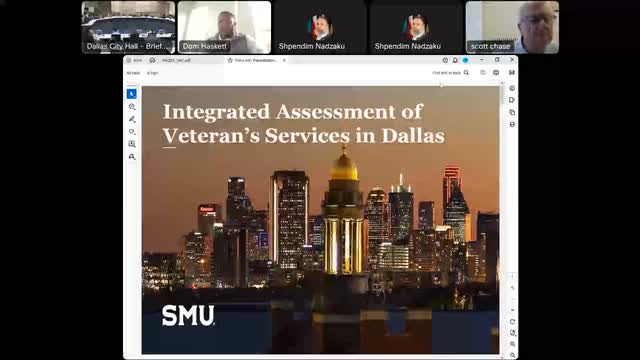
A Southern Methodist University research team told the commission it has a city contract to assess veteran services in Dallas using a three-part approach — a one-day Veterans Innovation and Insight Forum on May 10, survey analysis and geospatial mapping — and will deliver monthly updates and a report with recommendations within roughly 12 months.
A team from Southern Methodist University, working under a contract with the City of Dallas, outlined a data-driven assessment of veteran services in Dallas and said it will launch a one-day Veterans Innovation and Insight Forum on May 10 to collect first-hand perspectives from veterans and service providers.
Moni McGee, associate professor of statistics and data science at SMU and principal investigator for the project, told the commission, "we have an official contract with the city of Dallas to perform the services that we're talking about today." The SMU team described a three-pronged approach that combines the forum, analysis of existing survey data and a geospatial mobility and services map intended to show where veterans live, how often services are offered and how accessible they are.
The project team said the forum will gather qualitative input from veterans and stakeholders through hands-on exercises and facilitated table discussions; SMU plans to invite roughly 80 to 100 participants and run the event as a full-day session. Jessie Zarizaga, associate professor in civil and environmental engineering, said the geospatial component will "make it visible and spatial in a way that can be assessed" and overlay veteran population data with transit routes and service locations.
Why it matters: Commission members said they expect the study to fill long-standing information gaps about service access and logistics and to provide material they can use with the city and other partners. Commissioner Scott Chase praised the timeline, saying he was impressed that the team aims for "actionable recommendations within 12 months." Commissioners also emphasized that the commission has no budget or statutory authority and sees the assessment as a tool for informing council and city departments.
Project scope and methods: SMU described three workstreams: (1) the Veterans Innovation and Insight Forum to capture veterans' lived experience and attitudes using exercises and physical artifacts; (2) a veteran-support-service impact analysis using public surveys such as the American Community Survey and possibly Bureau of Labor Statistics data; and (3) a veteran location and mobility project using GIS to layer service locations, transit (including DART rail/stations) and veteran household concentrations. Student team member Dylan Harvey said he will help implement an "innovative mapping system" to quantify qualitative findings.
Timing and deliverables: The team said the forum is scheduled for Saturday, May 10 (a full-day event, roughly 9 a.m. to 5 p.m.), with the geospatial and survey work proceeding over the summer. SMU committed to monthly written updates to the commission, including budgetary expenditures, and to produce a final report and recommendations after the data collection and analysis period. The team said some products may require additional time for data cleaning and validation.
Participation and design concerns: Commissioners asked whether veterans would feel inhibited discussing needs in mixed tables with service providers. The SMU team said they expect a strong veteran presence at the forum and that facilitators will manage table composition and encourage honest feedback; Jessie Zarizaga and the team noted heterogenous groups can surface perspectives veterans might not otherwise hear. The team asked commissioners to help with invite lists and to share public materials, meeting minutes and planning documents that would help build historical context.
Data sources and sharing: SMU said it will combine qualitative artifacts gathered at the forum with public survey data and city data where available, and that it will make GIS outputs available for the city's GIS staff to build on. The team said it will draw on instruments already used at the national level for veteran assessments where appropriate and will adapt them for local context.
No formal policy decisions were taken on the study during the presentation. Commissioners indicated they will continue the conversation under agenda items and provide SMU with contact lists and commission records the team requested.
Next steps: SMU will begin sending invitations and collect recommended participants from commissioners; the forum is scheduled for May 10. The commission plans to consider a separate resolution regarding death-notification procedures for veterans later under new business.