Get Full Government Meeting Transcripts, Videos, & Alerts Forever!
Get email alerts on the Utilities Sewer Service topic
No spam. Unsubscribe anytime.
Senate panel approves bill to require study before municipalities cut sewer service outside city limits
Summary
Senator Taylor, sponsor of Senate Bill 11-38, told the Senate Finance, Ways and Means Committee on April 9 that the bill would prevent municipalities that have operated sewage systems outside their corporate limits for more than 25 years from stopping service unless a study demonstrates the utility lacks capacity, and would allow landowners with preexisting gravity sewer lines on their property to request connection.
Senator Taylor, sponsor of Senate Bill 11-38, told the Senate Finance, Ways and Means Committee on April 9 that the bill would prevent municipalities that have operated sewage systems outside their corporate limits for more than 25 years from stopping service unless a study demonstrates the utility lacks capacity, and would allow landowners with preexisting gravity sewer lines on their property to request connection.
The measure matters to residents served by municipal sewer systems beyond city boundaries, committee members said, because it addresses disputes over connection denials and clarifies who may tap lines already located on private property.
Taylor, speaking to the committee, said the bill “does 2 things.” It bars discontinuation of service to existing customers outside corporate limits for systems operated more than 25 years unless a capacity study shows the utility cannot serve them, and it requires utilities to permit connections when a gravity sewer line already exists on a landowner’s property and there is sufficient capacity. “That's what this bill does,” Taylor said (s=176.00–214.42).
Several senators asked detailed questions about scope and mechanics. Senator Lamour asked whether the bill speaks to expansion; Taylor said it does not — it applies only to customers already connected outside corporate limits and does not require municipalities to expand sewer service (s=259.42–271.53). Senator Hensley sought clarification about the provision letting landowners with an existing gravity sewer line “tap” into service; the sponsor explained such a line could have been installed for prior development and that, in some places, utilities have declined to permit taps even where the line is on private property (s=343.77–377.37).
Committee members pressed on operational details. The sponsor and other senators said tap fees would be borne by the applicant, as is typical when a new connection is made, and that ownership of the sewer line and resulting tap would remain with the utility once installed. “The sewer line as it's installed ... becomes the property of the utility,” Taylor said when asked about ownership (s=804.83–849.60). The bill, the sponsor said, does not affect utility rights of way (s=850.64–868.13).
Committee members also discussed how capacity should be determined. One senator suggested that the Tennessee Department of Environment and Conservation (TDEC) would be better placed to assess municipal sewer capacity than the entity named in an earlier draft; Taylor said the current amendment removed that named agency and requires a study, which the landowner would present to the Tennessee Board of Utility Regulation for a determination (s=636.86–712.44; 692.43–709.74).
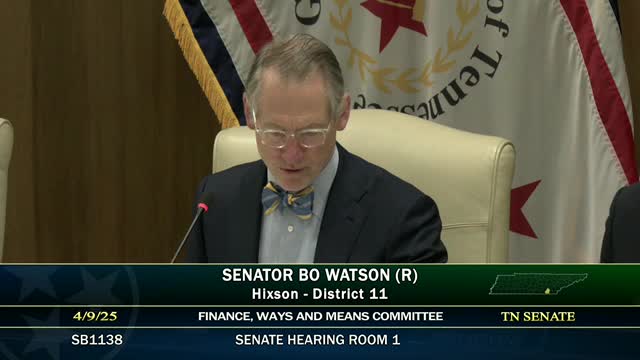
The committee adopted the finance amendment to SB 11-38 and, after debate, recommended the bill for passage to the committee on the calendar. The Chair announced the result as 9 ayes, 2 noes (s=880.28–907.00).
Questions remained in the record about operational impacts: whether required taps could create backups, how utilities would assess and document capacity, and how costs and permitting responsibilities would be allocated. Committee members noted the bill’s narrow scope — it applies where a sewer line already exists on the landowner’s property and only when the utility has sufficient capacity.
Looking ahead, the committee recorded SB 11-38 as recommended for passage to the calendar; the transcript does not record subsequent actions beyond committee recommendation.
Ending: The committee’s action sends the amended bill forward; further detail on implementation — including what studies will be required and which agency will make capacity determinations — will be determined in subsequent steps of the legislative process.