Get Full Government Meeting Transcripts, Videos, & Alerts Forever!
Get email alerts on the Bail Bonds Regulation topic
No spam. Unsubscribe anytime.
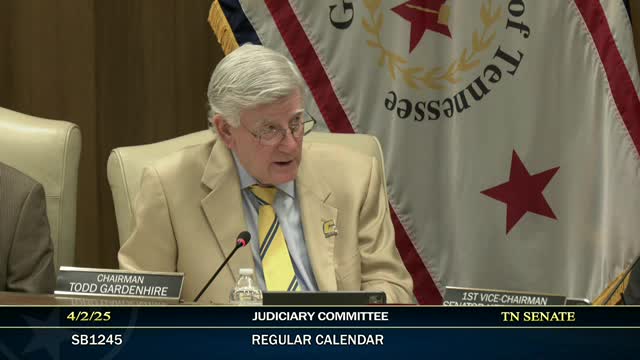
Judiciary Committee Approves State Board to License Bondsmen after Contested Hearing; Judges’ Authority and Constitutional Questions Raised
Summary
The Tennessee Senate Judiciary Committee advanced Senate Bill 12-45 to further committees after a contentious hearing on a proposal to create a state board to license and discipline professional bondsmen.
The Tennessee Senate Judiciary Committee voted to advance Senate Bill 12-45, which would create a state Board of Professional Bondsmen to license and discipline bail agents, after an extended and often contentious hearing that drew sheriffs, bondsmen and prosecutors to the committee table.
As amended, SB 12-45 moves much of the regulatory authority over professional bondsmen from individual courts to a state-level board, while preserving an explicit, limited role for judges to restrict bondsmen from operating in a given courtroom. The committee added Committee Amendment 49-08 and a second amendment (67-86) to the bill before advancing the measure; the chair announced the bill would go to the finance committee after a recorded vote of nine ayes at the earlier amendment stage and, later in the day, SB 12-45 as amended went to finance with nine ayes. A separate vote on a later configuration recorded nine ayes; subsequently when the main bill was reported out it was recorded as going to finance.
Sponsor Senator Hale told the panel the bill seeks to standardize oversight across Tennessee, citing widely varying local practices that create confusion for consumers and courts. Supporters who testified included Sheriff Joe Guy of McMinn County and Ken Holmes of Tennessee Bonding Company. Sheriff Guy said local law enforcement and victims have reported abuses by some bonding agents and urged a single body to investigate complaints more quickly than disparate local responses. "There are a lot of different practices, and we would like to see some standardization," Sheriff Guy said, recounting local investigations into allegations that agents pocketed extra fees and, in a separate matter, held a person at a bonding office until more money was paid.
Ken Holmes, testifying for bonding professionals, said a centralized board would provide consistent rules statewide and permit information-sharing about disciplinary actions. "If the system... isn't working, why would we want to keep it the same?" Holmes asked, citing other states that rely on boards to regulate bondsmen.
Opponents and some committee members voiced concern about diminishing judicial control and the practical effects of statewide licensing. Joel Mosley, general counsel for a bondsmen association, urged caution, saying the court-by-court system provides flexibility that serves judges and rural jurisdictions. Several members, including Senator Roberts, raised a constitutional question under Article II, Section 17 (the single-subject rule for bills) after an amendment sought to enhance penalties for assaults on first responders; Roberts asked the sponsor to request an expedited Attorney General review if the amendment remained in the bill. The sponsor agreed to seek AG guidance and indicated he would consider alternative vehicles if required.
Committee debate also explored whether the courts retain authority to bar licensed bondsmen from operating in a courtroom; sponsors emphasized that judges would continue to be able to deny, suspend or revoke a bondsman's privilege to operate in that judge's court if the judge found the conduct detrimental to a client or disruptive to court proceedings. Prosecutors, represented by Stephen Crump, executive director of the Tennessee District Attorneys General Conference, said the bill provides useful information sharing and would not curtail judges' essential authority.
After extended questioning and public testimony, the committee recorded the bill for further action. The hearing was notable for the number of witnesses and for the range of proposed fixes discussed—some witnesses also pressed for a statutory cap on fees and other consumer protections that were not part of SB 12-45.
The committee recorded votes and recorded that the bill will move to the finance committee for further consideration.