Get Full Government Meeting Transcripts, Videos, & Alerts Forever!
Get email alerts on the Deepfakes topic
No spam. Unsubscribe anytime.
Senate Judiciary Panel Sends Bill Criminalizing Nonconsensual "Deepfakes" to Calendar after Meteorologist’s Testimony
Summary
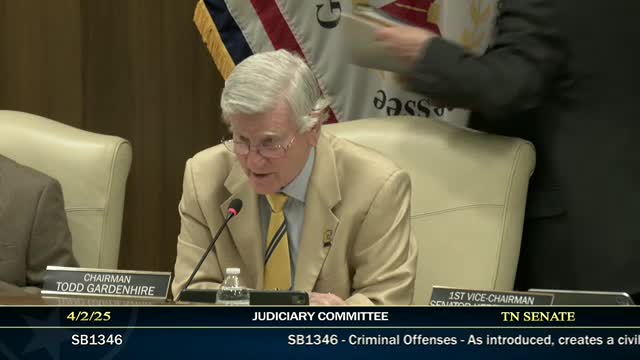
The Tennessee Senate Judiciary Committee on Monday advanced Senate Bill 13-46, which would create civil and criminal remedies for nonconsensual intimate deepfakes, after testimony from a local meteorologist who said AI-generated impostor accounts used her likeness to try to extort followers.
The Tennessee Senate Judiciary Committee advanced legislation aimed at penalizing nonconsensual sexually explicit or intimate deepfakes after a Sumner County meteorologist described repeated impersonations of her online.
Senate Bill 13-46, sponsored on the floor by Senator Cynthia Yarborough, would add a civil cause of action and a criminal offense for the creation or distribution of intimate digital depictions made without consent. The committee adopted Amendment 5,183 and voted to send the bill to the Senate calendar; the chair recorded eight ayes and no nays.
The committee heard testimony from Bree Smith, who identified herself as a meteorologist and Sumner County resident. Smith told the committee she found dozens, possibly hundreds, of fake social media accounts using her name, face and voice to humiliate her and to trick her followers into sending money. "These accounts used fake pictures of my face on someone else's body and videos that used my face and my name and my voice degrading images was devastating," Smith said. She said the impersonators had direct-messaged followers and tried to move people into private chat apps such as Telegram, where they solicited money or personal information.
Smith described the personal toll of the impersonations, telling the panel the campaign left her ``humiliated'' and depressed and left her unsure how to stop the accounts as platforms demanded evidence and IDs. She also cited a cross-border case in Kentucky, telling the committee that a 16-year-old victim had taken his life after a similar extortion threat; she used that case to underscore the harm she and others face when images are weaponized.
Senator Yarborough told the committee the bill is intended to "ensure that the state of Tennessee continues to keep up with what we all know is a rapidly developing and changing technology in artificial intelligence" and to provide both civil and criminal remedies where none are clearly available now. In describing Amendment 5,183, Yarborough said the measure defines relevant terms, creates a civil veil (private right of action) for victims of nonconsensual deepfakes and establishes a criminal offense for intimate digital depictions.
Committee members asked how investigations and prosecutions would proceed and whether law enforcement resources would be deployed before the conduct is a criminal offense. Yarborough and sponsors said the criminalization is intended to enable investigators and prosecutors to pursue bad actors and to give victims a legal path to stop impersonation and extortion. Senator White and others questioned platform responses; Smith said a representative from Meta once advised her to capture page IDs and URLs for enforcement.
After questions, the chair moved the bill; the motion carried 8-0. The committee record shows the vote included senators recorded as voting aye: Harshbarger, Kyle, Lamar, Roberts, Rose, Stevens, Taylor and White. The bill will proceed to the Senate calendar.