Get Full Government Meeting Transcripts, Videos, & Alerts Forever!
Get email alerts on the Civil Rights Speech topic
No spam. Unsubscribe anytime.
House panel advances bill barring coerced use of names or pronouns; teacher testifies against measure
Summary
The House Finance, Ways and Means Subcommittee voted to send House Bill 12-70 to full finance after testimony and debate. Sponsors said the bill protects state employees and students from being forced to use language that conflicts with their beliefs; opponents warned it could spur federal litigation and harm trans students.
The House Finance, Ways and Means Subcommittee advanced House Bill 12-70 on a 10-0 vote after roughly an hour of testimony and member questions.
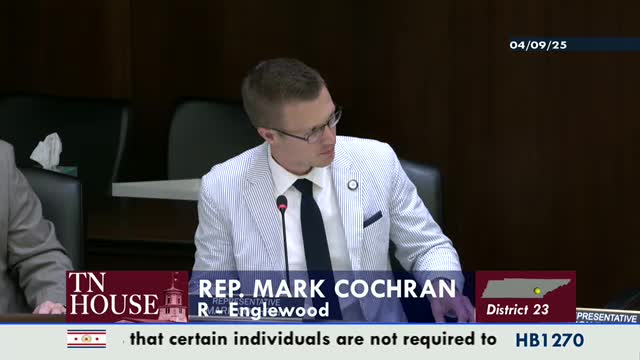
House Bill 12-70, described by sponsor Leader Curtis Cochran as legislation to prevent coercion in “being compelled to speak in a certain way,” would bar state actors and employees from requiring another person to use a specific name or pronoun if doing so conflicts with that person’s sincerely held beliefs or conscience. Leader Cochran said the measure “simply says you cannot be coerced to do that” and framed it as protection for employees with religious or moral objections.
Opponents and a teacher who testified warned of consequences for students and school systems. Damien Alexander Buglio, a classroom teacher who testified in opposition, told the committee he had shared his own experiences about transitioning while teaching and described disciplinary risk and litigation exposures if staff are encouraged to ignore students’ names or pronouns. “I shared heartbreaking data and other statistics surrounding the negative impact of having anti‑trans policies in school,” Buglio said during his three minutes of testimony. He argued that encouraging staff to ignore names and pronouns invites “expensive litigation dealing with free speech, Title IX and Title VII,” and noted the U.S. Supreme Court decision in Bostock v. Clayton County when describing federal protections for LGBTQ people.
Sponsor Cochran said the bill does not require anyone to change private practice and that federal case law includes decisions protecting individuals from being compelled to use particular speech. Committee discussion included questions about frequency of incidents and the bill’s impact in classrooms; Buglio said he had experienced “a handful of times” being misnamed and described one incident where a parent interrupted a virtual class to curse at him after he asked to be called “Teacher Buglio.” He said students who feel unseen lose focus and that “feeling like they belong opens up doors to learning.”
After discussion, the subcommittee opened the roll call and the clerk reported 10 ayes, 0 nos. The chair announced House Bill 12-70 will move to full finance.
The measure will now be available for additional fiscal and policy review in full finance. The subcommittee record shows debate and public testimony focused on classroom effects, litigation risk, and protections for employees who say speech would violate their beliefs.